
An open box ice maker can be a good deal, but the discount alone does not determine whether it is worth buying. Check the unit’s condition, included accessories, return eligibility and warranty coverage before comparing prices. A larger discount may not be worthwhile if the machine cannot be returned or has visible damage. If the seller cannot confirm the unit’s condition or return terms, buying new may be the safer choice.
This guide is about the buying decision for an open box ice maker, including countertop ice maker and portable ice maker units sold as open box. It is not a repair guide. If you already bought one and it fails to make ice, that is a separate troubleshooting topic and is not covered here.
Note on model differences: Ice maker designs, included parts and cleaning instructions vary by model and brand. Confirm the packing list and the owner’s manual for the specific unit before you buy or clean it.
When an Open-Box Ice Maker Is Worth Buying
An open box ice maker is worth considering when all of the following are true:
- You can inspect the unit before paying, or the seller offers a return window you can live with.
- The unit is complete, or the missing parts are cheap and easy to replace.
- The housing, water reservoir and drain plug show no cracks or leak traces.
- The seller confirms the return terms and any remaining warranty in writing.
- After adding missing parts, cleaning and any known repair, the real cost is still clearly below the new price.
If any of these cannot be confirmed, the risk rises and the case for buying new gets stronger.
How Much Should You Save on an Open-Box Ice Maker?
There is no verified universal discount threshold. This guide uses around 30 percent off the new price as an example scenario, not a standard. The right number depends on the unit’s condition, the parts included, the return window and the warranty.
The practical method is to calculate the real cost:
Open box real cost = purchase price + necessary parts + necessary repairs + other actual costs.
Then compare that figure with the new price and the coverage each option includes. Treat the time you spend cleaning and setting up as a secondary factor in the decision, not as a cost line.
A Worked Example
- New countertop ice maker: 100, complete, standard return window and warranty.
- Open box price: 65 (35 percent off).
- Missing ice basket: 20 to replace.
- Cleaning supplies: 5.
- No known repair needed.
- Open box real cost: 65 + 20 + 5 = 90.
At 90 against a new price of 100 with weaker coverage, the saving is small and the return and warranty terms decide the case. If the same unit were 50 instead of 65, the real cost would be 75, and the open box unit would be the clearer choice.
This is how to judge whether a discount is enough: subtract parts, cleaning and known repairs from the saving first. If what remains is small and the coverage is weaker, buy new.
Do not assume an open box unit has no warranty; confirm the terms for that specific unit on the product page, with the seller, or from the warranty card in the box.
Open-Box Ice Maker Inspection Checklist
Inspect the unit in person if possible. If you are buying online, ask the seller for photos and a written condition statement, and confirm the return window before paying.
Signs worth checking, which are clues rather than proof: water residue in the reservoir, scratches around the ice basket area, and a cord that has clearly been uncoiled and recoiled. A cord that was simply unwrapped for inspection is not the same thing, so weigh each clue with the rest of the inspection.
Check the Housing, Water Reservoir and Drain Plug
Look for cracks, deformation or leak traces on the housing and around the reservoir. Check that the drain plug is present and seats properly. A cracked reservoir is a serious fault; a light scratch is cosmetic.
Confirm All Included Parts Are Present
Compare what is in the box with the packing list for that model. Typical items include the ice basket, ice scoop, drain plug and manual. A missing manual is minor because it is often available from the manufacturer; a missing basket or drain plug affects whether the unit works at all.
Check the Power Cord and Plug
Look for cuts, damage, deformation or other obvious damage to the cord and plug. A damaged cord is a reason to walk away, not a reason to negotiate.
Inspect the Water Reservoir for Residue or Odors
Look for visible dirt, residue or odor in the water area. A practical test for light scale: if it wipes off with a soft cloth, it is likely cleanable; if it does not, treat it as heavy residue. Heavy residue, a musty smell, or residue that does not come off after following the manual is a reason to return the unit or walk away, not a reason to make ice for drinking.
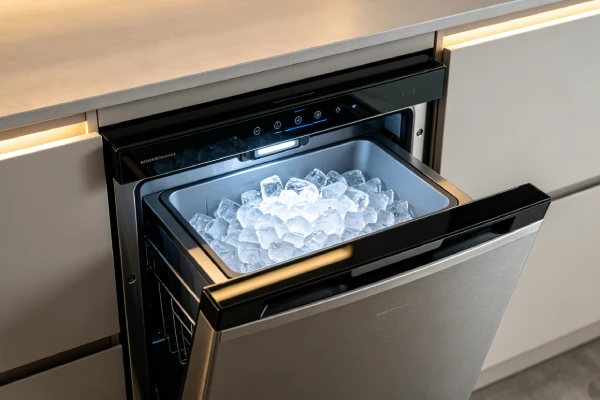
Test the Unit if the Seller Allows It
If the seller permits it, follow the manufacturer’s instructions to test the unit: confirm it powers on, takes in water, starts an ice cycle and drains. A unit that powers on is not proof that every function works. If a full cycle is not possible, at minimum confirm it powers on, takes in water and starts a cycle, and note what you could not test.
If the seller does not allow testing, treat the return window as your only protection and confirm it in writing before paying. This matters most for online purchases, where you cannot inspect the unit before it ships.
A note on packaging: damaged packaging, water stains or multiple layers of tape are reasons to inspect more carefully. They are not proof that the unit was returned repeatedly or that it is internally damaged.
Check the Return Policy and Warranty Before Buying
This is the part that most affects whether an open box ice maker is worth it. Confirm in writing:
- Whether the open box item can be returned, and when the return window starts.
- What the seller does if parts are missing, the unit is damaged, or it fails to make ice.
- Whether you need to keep the original packaging, accessories and receipt. Many returns are refused without the original packaging, so confirm this before you throw the box away.
- Whether the manufacturer’s ice maker warranty applies to this unit, this sales channel and you as the current buyer.
- Whether the item is marked final sale or non-returnable, and whether you accept that risk.
How to verify these terms: check the product page for the open box listing, read the seller’s written return policy, and ask the seller to confirm the warranty status in writing before paying. A seller who will not confirm the terms in writing is itself a reason to walk away. Do not assume every open box unit is final sale, and do not assume most units have no manufacturer warranty. These terms vary by retailer, unit condition and sales channel.
If the item is final sale and the discount is not large enough to cover the risk of a total loss, skip it. The discount has to justify the possibility that you cannot return the unit at all.
Open-Box vs. New Ice Maker: Compare the Total Cost
Use this table to compare the two options side by side.
| Cost item | New unit | Open box unit |
|---|---|---|
| Purchase price | New unit price | Open box price |
| Missing parts | Usually none, confirm | Add the actual replacement cost |
| Cleaning supplies | As needed | As needed |
| Known repairs | As quoted | As quoted |
| Return and warranty coverage | Confirm terms | Confirm terms |
Open box real cost = purchase price + necessary parts + necessary repairs + other actual costs.
Compare that total with the new price and the coverage each option includes. If the open box real cost is clearly lower and the return window and warranty are acceptable, the open box unit can be the better buy. If the two are close and the coverage is weaker, buy new.
When You Should Skip an Open-Box Ice Maker
Skip the open box unit if:
- The seller will not let you inspect it and offers no return window.
- The reservoir or housing is cracked, or there are leak traces.
- Multiple functional parts are missing and replacements are expensive or unavailable.
- The unit shows heavy residue or odor that does not come off after following the manual.
- The seller cannot confirm the warranty status in writing.
- The item is final sale and the discount does not cover the risk of a total loss.
- After adding parts, cleaning and known repairs, the real cost is close to the new price and the coverage is weaker.
What to Do After Buying an Open-Box Ice Maker
- Test it as soon as possible, within the return window.
- Take photos of the unit and packaging before cleaning, in case you need to return it.
- Clean and descale it according to the manufacturer’s instructions for that model before making ice for drinking.
- Run a full cycle and check for leaks around the reservoir and drain plug.
- Keep the receipt, the original packaging and any accessories until the return window closes, and note the deadline. Losing the packaging can cause a return to be refused.
Do not use a generic vinegar or citric acid routine unless the manual for your model allows it; cleaning instructions differ between countertop and portable units.
Frequently Asked Questions
Are open-box ice makers used?
Not always. Some are returned unopened, some are lightly used, and some were returned because of a fault. Check for water residue, scratches around the basket area and a clearly recoiled cord, and weigh those clues with the return terms.
Do open-box ice makers come with a warranty?
It depends on the retailer, the unit and the sales channel. Some carry the remaining manufacturer warranty, some carry a retailer warranty, and some are sold as-is. Check the product page, ask the seller in writing, and look for the warranty card in the box.
Can you return an open-box ice maker?
Some sellers allow returns within a window; others mark open box items as final sale. Check the written policy before paying, confirm what happens if parts are missing or the unit fails to make ice, and keep the original packaging because a return can be refused without it.
Is an open-box ice maker better than a refurbished one?
They are different categories. A refurbished unit may have been checked and repaired by the manufacturer or a refurbisher, or it may only have been cleaned and resold, and it may carry a defined warranty. An open box unit is simply a returned item, and its condition is whatever the seller states. Confirm the condition statement, the return terms and the warranty for each specific listing before comparing.
How much should I save to make an open-box ice maker worth it?
There is no verified universal number. This guide uses around 30 percent off as an example scenario. Subtract parts, cleaning and known repairs from the saving first; if what remains is small and the coverage is weaker, buy new.