
Search Intent Opening
If your robot vacuum keeps getting stuck under furniture, wedges itself against chair legs, tangles in cords, or detects a drop-off only after 25% of the unit has passed the edge, you are dealing with mechanical entrapment, clearance limitations, or sensor response delays. Owners searching for “robot vacuum wheel stuck,” “robot vacuum gets stuck under couch,” or “robot vacuum tangled in cords” are facing failures that combine physical design constraints, navigation logic, and debris interference.
Search Query Coverage Block
Users commonly describe this as:
- robot vacuum wheel stuck
- robot vacuum gets stuck under couch
- robot vacuum tangled in cords
- robot vacuum stuck on rug edge
- robot vacuum keeps getting stuck under furniture
- robot vacuum won’t go under bed
- robot vacuum stuck on chair legs
- robot vacuum caught in curtains
- robot vacuum jammed with debris
- robot vacuum cliff detection delayed
- robot vacuum stuck on threshold
- robot vacuum trapped under low clearance
- robot vacuum wheel not turning
- robot vacuum stuck in same spot
- robot vacuum needs rescue every run
Observed Failure Patterns
Pattern 1: Cord Tangling — Wheels or Brush Entrapped
- Robot runs over charging cables, shoelaces, or curtain hems. Wheels lose traction or brush locks.
- Occurs during normal cleaning, especially in cluttered areas.
- Usually indicates physical obstruction, not motor failure. Debris wraps around axle or brush end.
- Does NOT indicate wheel motor burnout (unless repeated strain occurs).
Pattern 2: Under-Furniture Wedging — Low Clearance
- Robot drives under couch, bed frame, or low table. Lidar tower or top housing contacts underside, lifting wheels off floor. Unit stops with “wheel stuck” error.
- Occurs when furniture clearance is less than robot height (typically <3.5 inches for non-Lidar models, <4 inches for Lidar models).
- Usually indicates profile height mismatch with furniture. Robot physically cannot fit.
- Does NOT indicate navigation failure (robot attempted to clean accessible area).
Pattern 3: Chair Leg Entrapment — Circling Failure
- Robot approaches chair legs, bumps, but fails to navigate around. May bounce off and leave area uncleaned, or wedge between legs.
- Occurs with four-legged chairs, table bases, or complex leg arrangements.
- Usually indicates navigation logic limitation, not wheel motor failure. Robot lacks 360-degree circling behavior.
- Does NOT indicate hardware defect.
Pattern 4: Rug Edge Climbing — Wedged or High-Centered
- Robot transitions from hard floor to rug. Edge of rug lifts, catches under wheels, or high-centers robot.
- Occurs on rugs with thick edges, tassels, or unsecured corners.
- Usually indicates rug design issue, not robot fault. Robot cannot climb vertical edge >0.5 inches.
- Does NOT indicate wheel motor failure.
Pattern 5: Mechanical Debris Jam — Roller or Wheel Blockage
- Small object (cat toy, sock, cable) sucked into roller or wrapped around wheel axle. Motor strain detected, unit stops.
- Occurs when debris enters brush housing or wheel well.
- Usually indicates physical obstruction. Motor strain detection is safety feature, not failure.
- Does NOT indicate motor burnout unless ignored.
Pattern 6: Cliff Detection Delay — Overhang Risk
- Robot approaches stairs. Sensors trigger only after 25% of unit has passed edge, causing nervous watching.
- Occurs at speed on dark carpets or glossy floors where sensor reflection is delayed.
- Usually indicates sensor sensitivity or surface reflection issue. Does NOT indicate imminent fall if sensors eventually trigger.
- Does NOT indicate complete sensor failure (unit would fall if sensors dead).
Most Common Root Causes (Ranked by Field Frequency)
1. Physical Entanglement (Cords, Tassels, Curtains) — 35%
- Why it happens: Wheels and brush axles have gaps where string-like debris wraps. Rotating components pull material tighter until jammed.
- Triggers: Cords left on floor, loose curtains, shoelaces, rug tassels.
- Confirms: Visible debris wrapped around wheel axle or brush ends. Unit stops with jam error.
- Disproves: If no visible debris but wheel won’t turn, motor or gearbox failure suspected.
2. Low Clearance Furniture — 25%
- Why it happens: Robot height (including Lidar) exceeds clearance under furniture. Robot drives in, top contacts, wheels lift.
- Triggers: Sofas with <4 inches clearance, bed frames, low entertainment centers.
- Confirms: Robot stuck with top pressed against furniture underside. Wheels spinning without traction.
- Disproves: If robot clears underside but gets stuck on legs, clearance is not the issue.
3. Rug Edges and Thresholds — 15%
- Why it happens: Thick rug edges act as ramps or barriers. Wheels lose traction climbing, or robot high-centers.
- Triggers: Unsecured rugs, thick pile, tassels.
- Confirms: Robot stopped with front or center on rug edge, wheels spinning.
- Disproves: If robot navigates rug edge successfully but gets stuck elsewhere, rug not the issue.
4. Navigation Logic (Chair Legs, Complex Furniture) — 15%
- Why it happens: Robot lacks advanced circling behavior; bounces off legs without cleaning around them, or wedges between legs.
- Triggers: Four-legged chairs, dining tables, office chair bases.
- Confirms: Robot bumps chair leg, backs up, and does not return to clean area around it. May wedge between legs.
- Disproves: If robot navigates legs successfully but fails on other obstacles, navigation logic is not the primary issue.
5. Debris in Wheel Gearbox — 5%
- Why it happens: Fine dust or hair works past wheel seals into gearbox, increasing friction.
- Triggers: Long hair, pet fur, dusty environments.
- Confirms: Wheel turns slowly or with grinding sound. No visible external debris.
- Disproves: If wheel spins freely when lifted, gearbox likely clear.
6. Cliff Sensor Contamination or Delay — 5%
- Why it happens: Dust on sensors reduces reflectivity, causing delayed detection. Dark carpets absorb IR signal, also delaying trigger.
- Triggers: Dusty sensors, dark carpets, glossy floors.
- Confirms: Unit approaches stairs, pauses, then reverses after slight overhang. No complete fall.
- Disproves: If unit falls off edge, sensors have failed completely.
Rapid Triage Checklist (2-Minute Tests)
1. Wheel Spin Test
- Lift robot. Manually spin each wheel. Listen for grinding, feel for resistance.
- Result: Wheels spin freely, smooth → OK. Grinding, sticking, or uneven → debris or gearbox issue.
2. Furniture Clearance Test
- Measure clearance under problem furniture. Compare to robot height (spec sheet).
- Result: Clearance > robot height + 0.5 inches → should fit. Clearance < robot height → robot will get stuck.
3. Rug Edge Test
- Place robot on rug, facing edge. Drive toward hard floor.
- Result: Transitions smoothly → OK. Wheels spin, high-centers, or stuck → rug edge too steep.
4. Visual Debris Inspection
- Flip robot over. Inspect wheel axles, brush ends, and caster wheel.
- Result: Clear → proceed. Hair or string wrapped → remove, test again.
5. Cliff Sensor Test
- Place robot on table near edge. Slowly push forward. Observe when it stops.
- Result: Stops before wheels clear edge → OK. Stops after overhang → sensor delay.
Step-by-Step Diagnostic Procedure
Step 1: Visual Debris Removal
- Action: Flip robot. Remove main brush and end caps. Clear hair from brush ends. Inspect wheel axles for wrapped string. Use tweezers to remove debris.
- Expected: Wheels spin freely after cleaning.
- Failure: Debris removed but wheel still stiff.
- Decision: If wheel still stiff, go to Step 2. If wheels free, test navigation.
Step 2: Wheel Motor Test
- Action: Using app or manual control, command robot to drive forward. Observe wheel movement. Lift robot, listen for grinding.
- Expected: Both wheels turn at same speed, no noise.
- Failure: One wheel slower, grinding, or not turning.
- Decision: If one wheel dead, motor or gearbox failure. Go to Step 3.
Step 3: Gearbox Inspection (If Accessible)
- Action: Remove wheel assembly (varies by model). Inspect gearbox for hair intrusion. Clean with compressed air.
- Expected: Gears move freely, no debris.
- Failure: Hair packed in gears, cracked gear teeth.
- Decision: If gearbox damaged, replace wheel module. If clean but stiff, motor failure.
Step 4: Furniture Clearance Mapping
- Action: Identify all stuck locations. Measure clearance under each.
- Expected: All furniture has clearance > robot height + 0.5 inches.
- Failure: Multiple locations with insufficient clearance.
- Decision: If clearance insufficient, use magnetic strips or virtual walls to block problem areas.
Step 5: Rug Edge Evaluation
- Action: Check rug edges for curling, thickness, or tassels.
- Expected: Rug edge flat, <0.5 inches thick.
- Failure: Rug edge >0.5 inches, curled, or tasseled.
- Decision: If rug edge problematic, secure rug with double-sided tape or remove tassels.
Step 6: Navigation Observation
- Action: Run robot in room with chair legs. Observe behavior around legs.
- Expected: Robot circles legs or navigates around without wedging.
- Failure: Bounces off and leaves area uncleaned, or wedges between legs.
- Decision: If navigation logic fails, may require software update or model limitation.
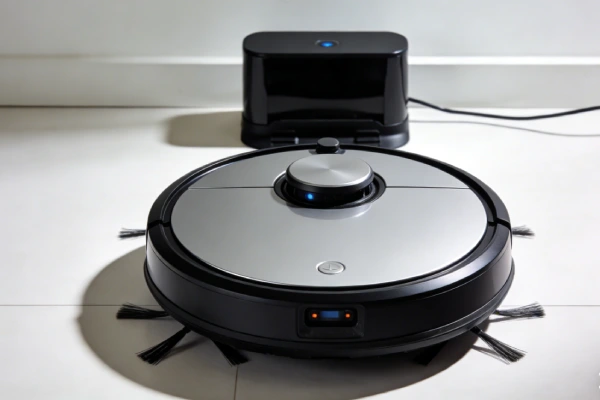
Physical Layer Inspection
- Wheel Axles: Look for hair tightly wrapped around axle base. Use tweezers or knife to cut and remove.
- Brush Ends: Remove brush end caps. Hair accumulates here, causing brush drag and wheel strain.
- Caster Wheel: Front caster often accumulates hair that locks wheel, causing drag.
- Lidar Tower: Check for scratches or cracks. Impact damage can misalign sensors.
- Cliff Sensors: Locate IR sensors (small windows underneath). Clean with microfiber cloth. Look for dust buildup, scratches.
- Rug Edges: Inspect for curling, fraying, tassels. These are mechanical traps.
Reset and Recovery Behavior Mapping
- Normal Reset: After clearing debris, robot resumes cleaning or returns to dock.
- Wheel Stuck Reset: App notification cleared after obstacle removed. Robot restarts from dock or last position.
- Failed Reset (Debris Remains): Wheel still stiff after cleaning. Indicates internal gearbox debris.
- Failed Reset (Navigation Loop): Robot returns to same stuck spot repeatedly. Indicates mapping or obstacle avoidance logic failure.
False Fixes That Do Not Work
- “Let it figure it out”: If robot is physically wedged, it will not free itself. Manual rescue required.
- “Raise furniture with blocks”: Temporary, but robot may still attempt to go under and get stuck if clearance remains marginal.
- “Ignore rug edge”: Robot will repeatedly get stuck on same rug edge. Secure rug or block area.
- “Replace wheels without inspecting gearbox”: Hair in gearbox will destroy new wheel module.
Confirmed Fix Scenarios
Scenario A:
- Symptom: Wheel stuck error, visible hair wrapped around axle.
- Confirmed Cause: Hair entanglement.
- Fix: Remove hair with tweezers, clean brush ends.
- Verification: Wheels spin freely; robot completes cleaning without error.
Scenario B:
- Symptom: Robot wedged under couch repeatedly.
- Confirmed Cause: Low clearance (couch height 3.5 inches, robot height 3.8 inches).
- Fix: Create no-go zone in app or use magnetic boundary tape.
- Verification: Robot avoids couch area; no further entrapment.
Scenario C:
- Symptom: Robot stuck on rug edge, wheels spinning.
- Confirmed Cause: Thick rug edge with curling.
- Fix: Secure rug edge with double-sided carpet tape.
- Verification: Robot transitions from rug to hard floor smoothly.
Scenario D:
- Symptom: Robot wedged between chair legs, fails to navigate.
- Confirmed Cause: Navigation logic limitation (no 360-degree circling).
- Fix: No hardware fix. Use virtual wall or move chairs during cleaning.
- Verification: Robot avoids problem area or user moves chairs before run.
Scenario E:
- Symptom: Wheel stiff after cleaning, no visible debris.
- Confirmed Cause: Hair packed into gearbox.
- Fix: Disassemble wheel module, clean gears with compressed air.
- Verification: Wheel spins freely; no grinding noise.
Scenario F:
- Symptom: Robot pauses near stairs after slight overhang.
- Confirmed Cause: Cliff sensor delay due to dark carpet.
- Fix: Clean sensors. If persists, limit is design characteristic.
- Verification: Robot stops before wheels clear edge; no fall.
Post-Fix Verification Checklist
- Wheel Spin Test: Both wheels spin freely, no grinding.
- Furniture Clearance: Robot navigates under all furniture without stopping.
- Rug Transition: Robot crosses from hard floor to rug and back without stalling.
- Chair Leg Navigation: Robot cleans around chair legs without wedging or leaving gaps.
- Cliff Sensor Check: On test edge, robot stops before wheels clear.
- Debris Resistance: Robot runs full cycle without manual rescue.
Why Is My Robot Vacuum Wheel Getting Stuck on Cords?
Cause: Cords or shoelaces get tangled around the wheel or brush axle.
Fix: Clear debris from the brush and wheel axle to ensure smooth movement.
What Causes My Robot Vacuum to Get Stuck Under the Couch?
Cause: Low clearance between furniture and the vacuum.
Fix: Measure the clearance under your furniture. If it’s less than 3.5 inches, consider using virtual boundaries.
How Do I Stop My Robot Vacuum from Getting Stuck on Rug Edges?
Cause: Rug edges are too high for the robot to transition smoothly.
Fix: Secure rug edges with double-sided tape or remove the tassels.
How to Fix Robot Vacuum Tangled in Cords
- Power off robot. Flip over.
- Locate cord wrapped around wheel axle or brush.
- Use tweezers or small scissors to cut and remove.
- Spin wheel manually to ensure no remaining debris.
- Reassemble and test.
How to Fix Robot Vacuum Wheel Stuck Under Couch
- Measure couch clearance. If less than robot height, robot cannot fit.
- Use no-go zones in app to block couch area.
- Alternatively, raise furniture with furniture risers (permanent fix).
- If clearance adequate, check for debris on wheels that reduces traction.
How to Fix Robot Vacuum Stuck on Rug Edge
- Inspect rug edge for curling or tassels.
- Apply double-sided carpet tape to secure edge flat.
- If tassels cause entanglement, tuck them under rug or trim.
- Test transition from rug to hard floor.
Escalation Threshold
Wheel Module Replacement Required When:
- Wheel motor does not turn after cleaning debris and inspecting gearbox.
- Grinding noise persists after cleaning.
- Wheel axle visibly bent or damaged.
Navigation Logic Escalation When:
- Robot repeatedly gets stuck on same furniture despite clearance being adequate.
- Software updates available but do not resolve behavior.
- Model limitation confirmed by manufacturer (no fix).
Factory Repair Required When:
- Multiple wheel modules fail repeatedly.
- Main board damage causing erratic movement.
- Lidar or sensor array damaged, causing repeated collisions.
Have you experienced this issue with your robot vacuum? Let us know in the comments below!
If you need further assistance, feel free to ask your question here!