
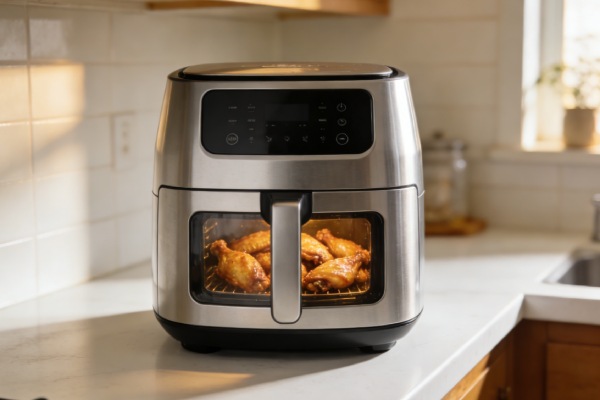
This guide is based on field failure data: appliance teardowns, repair logs, and documented safety incidents. We ignore marketing claims about “healthy cooking” or “crispy results.” Instead, we judge an air fryer by what fails catastrophically first—emitting toxic fumes, catching fire, or suffering sudden electrical death. The goal is to equip you with the engineering and safety logic to reject designs that prioritize form and features over fundamental thermal stability and material safety.
Most Common Buyer Mistakes
Mistake 1: Choosing Based on Advertised Capacity Instead of Functional Airflow
Buyers compare “5 qt vs 6 qt” but never consider the shape of the basket or the path of the convection airflow. A tall, narrow basket with a stacked accessory racks airflow, while a wide, shallow one promotes it. The failure outcome is Failure Mode 8 (Inconsistent Cooking) and Failure Mode 14 (Accessory-Induced Overheating). Poor airflow causes hot spots that burn food and can lead to grease ignition and Failure Mode 5 (Excessive Smoke & Fire Risk).
Mistake 2: Prioritizing “Advanced” Digital Controls Over Simple Thermal Management
Buyers are drawn to touchscreens, companion apps, and numerous pre-sets, assuming more technology equals better performance. These complex control boards are the single most expensive and common point of failure. The failure outcome is Failure Mode 3 (Internal Electrical Failure / Sudden Death). A $150 air fryer with a $90 non-serviceable control board is a disposable appliance.
Mistake 3: Ignoring the Physical Composition of the Heating Element and Fan
Buyers check for a non-stick basket but don’t ask about the heater’s construction or the fan’s bearing type. A low-cost, exposed coiled-wire heating element can sag over time, contacting the fan or dripping molten metal. A fan with a sleeve bearing (instead of a ball bearing) will seize. The failure outcome is Failure Mode 4 (Fan Failure) and Failure Mode 2 (Fire Hazard).
Mistake 4: Assuming “Premium Price” Equals “Premium Safety”
Buyers pay more for a brand name, assuming it buys better safety engineering. However, many premium brands use the same third-party OEM designs as budget models, with identical internal components. The failure outcome is the same catastrophic Failure Mode 1 (Severe Chemical Odor) and Mode 2 (Fire Hazard), just in a more expensive package.
Marketing Claims That Mislead Buyers
- “Healthier Fried Food”: A nutritional claim, not an engineering one. It distracts from the fact that many units require significant oil to function properly (Failure Mode 9) and that overheating can create harmful compounds in food.
- “Rapid Air Technology”: A trademarked term for convection cooking. It has no standardized meaning for airflow volume (CFM) or heat distribution uniformity, which are the actual determinants of performance.
- “Dishwasher Safe Basket”: Focuses on cleanability but distracts from the Failure Mode 6 (Non-Stick Coating Degradation). Aggressive dishwasher detergents and heat accelerate coating failure, creating ingestion hazards.
- “Smart Cooking with Sensors”: Implies precise thermal control. In reality, most “doneness” sensors are simple timers or crude temperature probes that cannot account for food density or starting temperature, leading to Failure Mode 8.
Specs That Matter vs. Specs That Don’t
Specs That Matter (And Are Almost Never Published):
- Heating Element Type and Watt Density: A sheathed, metal-encased heating element is safer and more durable than an exposed, coiled-wire element. Watt density (watts per square inch of element) indicates how hot the element runs; a lower density is gentler and less likely to burn food or off-gas.
- Fan Airflow (CFM – Cubic Feet per Minute): The volume of air the fan moves. Higher CFM with a properly designed shroud means better cooking and less risk of hot spots. Unpublished because it’s often very low.
- Thermal Fuse/Cutoff Temperature and Location: The unit should have a primary thermal cutoff on the heating element and a secondary one in the electronics compartment. The activation temperature should be listed (e.g., 150°C/302°F). Its absence is a major red flag.
- Basket Coating Certification: Look for explicit reference to a PFOA- and PFOS-free non-stick coating that is certified to a food-safe standard (e.g., FDA CFR 21, EU 10/2011). “Non-stick” alone is meaningless.
Specs That Don’t (The Inflated Distractions):
- Number of Presets: More presets means more complex, failure-prone software on the control board.
- “XXL” or “Family Size”: Marketing terms for capacity. The usable capacity is determined by airflow, not basket volume.
- Digital vs. Analog Dial: An interface preference. A robust mechanical dial can be more reliable than a digital touchpad.
- Exterior Finish Colors: Purely cosmetic.
Build Quality Signals
- Weight and Stability: Pick up the unit. A heavier base indicates a more substantial motor, a metal inner housing, or better counterweight to prevent Failure Mode 10 (Mechanical Instability). It should not slide when you tug the basket handle.
- Ventilation Exhaust Placement and Guard: Hot air exhaust should be directed upwards or backwards, not sideways towards cabinets or curtains. The exhaust grill should have a fine mesh to prevent foreign object entry. A side exhaust is a design flaw that contributes to Failure Mode 2 & 5.
- Basket Handle Mechanism: The handle should engage and disengage with a solid, positive click. A wobbly or vague mechanism will fail, dropping hot food. The basket should also physically interrupt the circuit (Failure Mode 12) when removed, causing the heater and fan to pause.
- Inner Housing Material: The cavity surrounding the basket should be metal (stainless or aluminized steel), not plastic. Plastic can off-gas (Failure Mode 1) and deform under repeated high heat.
Reliability Indicators
- Separate, Serviceable Heating Element and Fan Assembly: These are wear items. They should be mounted on a removable plate inside the top housing, connected with standard spade connectors, not soldered wires.
- Mechanical Timer and Thermostat: A simple dial timer and a bimetallic thermostat are virtually indestructible compared to a digital control board. They offer fewer failure points.
- Physical “Pause” Button Linked to Basket Removal: The most important safety feature. Removing the basket should trigger an immediate, mechanical pause via a switch, not a software command.
- Minimal Seams in the Cooking Cavity: The interior should be a smooth, single piece of metal or have welded seams. Overlapping or riveted seams trap grease, creating a fire risk and making cleaning impossible.
Hidden Ownership Costs
- Consumables: Replacement baskets ($30-$50), accessory racks ($15-$25), and drip pans. Non-stick coatings are consumable by design.
- Maintenance: Degreasing the interior cavity and fan assembly is critical for fire prevention. Many designs make this extremely difficult.
- Replacement Part Availability: Control boards and proprietary heating element/fan combos are rarely sold, making repair economically irrational.
- Energy Inefficiency: A unit with poor insulation and a weak fan must run the heater longer and hotter to cook, using more electricity and increasing wear.
- Downtime & Inconvenience: A failed air fryer during meal prep forces alternative cooking. The replacement cycle for a failed unit under warranty can take weeks.
When Cheaper Is Actually Worse
In air fryers, low cost is achieved through dangerous and failure-prone compromises:
- Exposed Coiled-Wire Heating Element: Prone to sagging, grease drips, and rapid oxidation, leading to element failure and fire.
- Plastic Inner Cavity/Liner: Will warp and emit toxic fumes (Failure Mode 1) under repeated high heat.
- Sleeve-Bearing Fan: Will seize within 6-12 months of regular use from grease infiltration, causing Failure Mode 4 and overheating.
- Lack of a Safety Thermal Cutoff: Or a single, poorly placed fuse. Allows runaway overheating.
- Thin-Gauge Outer Housing: Provides poor insulation, making the exterior dangerously hot to touch.
When Premium Is Justified
A higher price is only justified if it buys tangible engineering that prevents the critical failure modes:
- All-Metal, Seamless Inner Cooking Cavity: Eliminates plastic fumes and grease traps.
- Sheathed, Inaccessible Heating Element: Prevents grease ignition and is more durable.
- Ball-Bearing or Brushless DC Motor for the Fan: For long life and consistent airflow.
- Multiple, Correctly Placed Thermal Fuses: With accessible, user-replaceable parts.
- A Robust, Mechanical Basket-Pause Safety Interlock: Not a software feature.
If the premium price only buys a digital display, more presets, or a “sleek” design, it is not justified.
Pre-Purchase Inspection Checklist
In-Store / Physical Inspection:
- Inspect the inner cavity. Shine a light inside. Is it all metal? Are there visible seams, rivets, or plastic liners? Any plastic is an immediate reject.
- Test the basket removal safety. With the unit unplugged, insert and remove the basket. Look for a physical micro-switch or lever that the basket depresses. If you can’t see or feel a physical switch, it likely relies on software, which can fail.
- Check the exhaust vent. Is it on the top/back? Does it have a fine mesh guard? A side vent or an unprotected vent is a poor design.
- Feel the weight. Compare two models of similar capacity. The substantially heavier one is likely better built.
- Examine the heating element (if visible). Through the exhaust or fan opening, look for a sheathed metal tube, not glowing red coils.
Online Research (Before Buying):
- Search for “[Model Number] fire” or “[Model Number] smoke”. This is your primary safety due diligence.
- Search for “[Model Number] burning smell”. Read the experiences. Persistent odor issues indicate material failures.
- Search for “[Model Number] fan not working”. This is a very common mechanical failure.
- Find the official parts website. Search for the model. Do they sell the heating element assembly and fan motor separately? If not, it’s not designed for repair.
- Look for teardown videos on YouTube. See what’s actually inside. Look for plastic liners, coil heaters, and the control board construction.
Buyer Safety Summary
Most air fryers fail not because of cooking performance, but due to unsafe materials, poor airflow, and inadequate thermal protection. Buyers who focus on capacity, presets, or brand names often overlook critical safety engineering that determines whether an air fryer operates safely or becomes a fire and fume hazard.
Decision Framework
- Classify Your Usage: Are you a light user (1-2 times per week for fries), a regular user (daily vegetable/ protein cooking), or a heavy user (multiple batches, meal prep)? For anything beyond light use, all-metal construction and a ball-bearing fan are non-negotiable.
- Apply Elimination-First Logic:
- Eliminate any air fryer with a plastic interior lining or plastic-coated interior walls.
- Eliminate any air fryer that does not have a physical, mechanical safety switch to pause operation when the basket is removed.
- Eliminate any air fryer where the heating element and fan are not sold as separate, replaceable parts by the manufacturer.
- Eliminate any unit where your search reveals multiple, credible reports of fire, smoke, or severe chemical smells.
- Reinforce Long-Term Value: A $60 air fryer that catches fire or dies in 8 months is infinitely more expensive than a $200 model that safely lasts 5+ years and allows for a $40 fan replacement in year 3.
- Final Protective Buying Rule:
Only consider an air fryer with a fully metal, seamless interior cooking cavity, a physical safety interlock that pauses operation upon basket removal, and for which the manufacturer sells the heating element and convection fan as separate replacement parts. If you cannot verify all three conditions before purchase, you are assuming an unacceptable safety risk and buying a disposable appliance with a high probability of premature failure or hazard. Your safety and the integrity of your home are not worth gambling on hidden plastic or software-controlled safety features.