
This guide is not about refrigerating drinks. It is about avoiding a leaking, noisy, broken appliance in 18 months. It is based on documented failure patterns from real-world use: compressor noise that drives you out of the room, float switches that flood your floor, and internal materials that taint your water. We evaluate a beverage center not by its can capacity, but by its ability to dispense clean, cold water silently and reliably for years without becoming a maintenance nightmare.This guide focuses on beverage fridges that include an integrated water dispensing system, which introduces unique failure risks beyond basic cooling.
Most Common Buyer Mistakes
- Prioritizing Tap Count Over the Pump & Float System: Choosing a unit with hot, cold, and room temp taps without investigating the single-point-of-failure mechanism that controls water flow (usually a cheap plastic float switch). Failure Outcome: A stuck float leads to either no water or constant flooding, as this $2 component fails under normal mineral deposits or ice formation.
- Ignoring Noise Specifications for Shared Spaces: Buying a unit for an office, bedroom, or open-plan living area without verifying its noise profile under load. Failure Outcome: A loud compressor and rattling internal panels create a constant, disruptive hum that forces you to unplug it, rendering it useless.
- Assuming “Stainless Steel” Means Quality Internals: Being swayed by an exterior stainless facade while ignoring the internal tank and insulation materials. Failure Outcome: A plastic reservoir that cracks, brittle Styrofoam insulation that degrades, and a persistent plastic/chemical taste in your water from low-grade materials in the fluid path.
- Not Planning for the Inevitable Leak: Treating it as a sealed appliance like a traditional fridge. Failure Outcome: Being unprepared when the float valve, reservoir seam, or connection line eventually leaks, causing water damage to flooring or cabinetry because you had no leak detector or tray in place.
- Overlooking the Serviceability of the Cooling System: Assuming the entire unit is disposable. Failure Outcome: A failed thermoelectric cooling module or compressor seals the unit’s fate. If these core components aren’t user-replaceable or serviceable by a technician, a single failure turns the appliance into scrap metal.
Marketing Claims That Mislead Buyers
- “Quiet Operation”: A meaningless claim without a decibel (dBA) rating at a specified distance. True quiet operation requires a compressor with sound-damping mounts, a balanced fan, and a cabinet designed to not act as a resonance chamber—features absent in cost-cut designs.
- “Energy Efficient”: Can be achieved by using a weak compressor that runs constantly to maintain temperature. True efficiency is a balance of low power draw and effective insulation so the compressor cycles off. Check the EnergyGuide label for yearly kWh and compare.
- “Triple Temperature” or “Multi-Temperature Taps”: Often, the “room temperature” tap is just the cold line before it passes through the cooler, or a simple mixing valve. It’s not a third, independently regulated system. This spec distracts from the quality of the single cooling system.
- “Hygienic” or “Clean-Taste” Design: Vague language that hides the critical question: What materials are in the water path (tank, tubing, valves)? Are they FDA-compliant food-grade plastics or stainless steel, or are they cheap, taste-leaching polymers?
Specs That Matter vs. Specs That Don’t
| Specs That Matter (Investigate First) | Specs That Don’t (Distract Later) |
|---|---|
| Cooling System Type & Serviceability: Compressor-based is superior for reliability and cooling power. Is the cooling module user-replaceable or behind a service panel? | Number of Taps / Faucets: More than two (Hot, Cold) is usually a gimmick. Adds complexity without real function. |
| Noise Level (dBA): Must be published. For an office, aim for <40 dBA. Over 45 dBA will be intrusive in a quiet room. | Exterior Finish (Stainless vs. Black): Cosmetic. A stainless skin doesn’t improve internal mechanics. |
| Water Reservoir Material: Must be food-grade, BPA-free plastic (e.g., Tritan) or stainless steel. Avoid generic “plastic.” | Digital Temperature Display: Prone to moisture failure and adds little value. You need cold and hot, not a precise 37°F readout. |
| Dispensing Mechanism: Prefer a simple, positive-action mechanical lever directly connected to the valve. Avoid overly complex electronic buttons or touch sensors. | “Can Capacity”: A fictional marketing number. Judge interior space with your own containers. |
| Annual Energy Consumption (kWh): Find this on the yellow EnergyGuide label. Lets you calculate true operating cost. | LED Lighting: Adds internal heat and is another component to fail. |
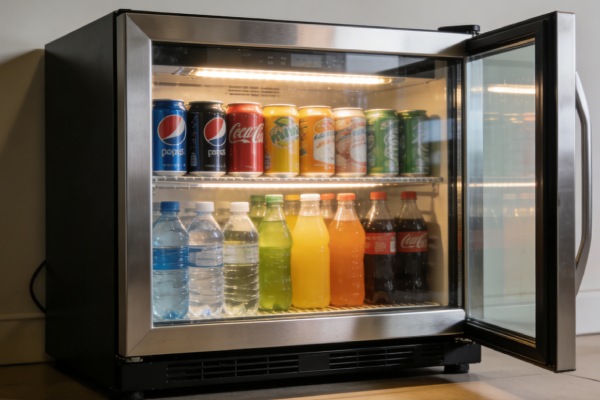
The Biggest Red Flag: Sealed, Opaque Construction. If you cannot find information on how to access the pump, float, or cooling module for cleaning or replacement, the unit is designed to be thrown away at the first malfunction.
Most long-term beverage fridge failures trace back to sealed designs that prevent basic maintenance.
Build Quality Signals
- Weight and Heft: A heavier unit typically has more metal in the structure, better insulation, and a more substantial compressor. Lift it. Lightweight = thin walls and poor noise dampening.
- Door Seal and Closure: The door should close with a solid thunk, held by a strong magnet. A weak seal lets cold air escape, forcing the compressor to run constantly.
- Internal Tank Inspection: If visible, the water tank should look like a single, robust molding without visible seams or thin, flexible spots. Brittle, cracked tanks are a common failure.
- Dispensing Lever Feel: Operate the lever. It should have a smooth, positive action with a clear end point. Mushy or sticky levers indicate poor internal linkage that will fail.
Reliability Indicators
- Simplicity in the Water Path: The fewer valves, sensors, and pumps between the reservoir and the tap, the better. Each junction is a potential leak and failure point.
- Accessible and Cleanable Components: A unit with a removable reservoir, cleanable sediment filter, and accessible float valve area is designed for longevity. A sealed unit is designed for obsolescence.
- Over-spec’d Cooling: A compressor rated for a much larger space (in BTU/hr) will cycle less frequently in a small beverage fridge, reducing wear, noise, and temperature fluctuation.
- Mechanical Thermostat: A simple dial thermostat is more reliable and less prone to moisture damage than a digital control board, which is a common point of failure.
Hidden Ownership Costs
- Filters and Additives: If the unit has a water filter (for taste/odor), factor in the annual replacement cost. Some also require sanitizing tablets for the hot tank.
- Energy Inefficiency: A poorly insulated unit with a weak compressor that runs constantly can double or triple the energy cost projected on its EnergyGuide label.
- Water Damage: The cost of repairing flooring or drywall from an undetected leak, or the cost of a water alarm and drip tray you’ll need to buy separately.
- Forced Early Replacement: The ultimate cost when a non-serviceable pump or cooling module fails just after the warranty expires, requiring a full repurchase.
When Cheaper Is Actually Worse
In beverage centers, low price is a direct purchase of noise, leaks, and early death:
- The Float Switch: The cheapest possible water control mechanism, prone to sticking from minerals or ice.
- Thin, Resonant Cabinet Walls: Amplifies compressor and pump noise into a loud hum or rattle.
- Brittle Internal Plumbing: Plastic fittings and tubing that become brittle with temperature cycles and crack.
- Undersized or Low-Quality Compressor: Runs hot and loud, fails within 2-3 years.
You are not saving $150; you are buying a subscription to frustration and a future flood.
When Premium Is Justified
A higher price is only justified if it buys silence, serviceability, and material quality:
- A Redesigned Water Management System: A peristaltic pump or solenoid valve system that replaces the failure-prone plastic float switch.
- Advanced Sound Damping: Insulated compressor compartment, anti-vibration mounts, and a cabinet designed to not resonate.
- Serviceable Cooling Module: A thermoelectric or compressor module that can be unplugged and replaced by the user in 10 minutes.
- Stainless Steel or High-Grade Plastic Fluid Path: Ensures no taste contamination and resistance to cracking.
Premium is NOT justified for: smartphone apps, colored lighting, excessive digital displays, or designer branding on a unit that still uses a cheap float switch and a sealed compressor.
Pre-Purchase Inspection Checklist
In-Store / Physical (If Possible):
- Listen to it run. If plugged in, is the compressor hum noticeable from 6 feet away? Is there a rattle?
- Operate the dispensing lever. Does it feel solid or flimsy?
- Examine the water tank (if accessible). Does it feel robust or cheap and thin?
- Check the door seal. Is it a full magnetic gasket?
Online Research (Mandatory):
- Search for “[Model Name] leak” and “[Model Name] loud”. Read the 1- and 2-star reviews focusing on issues after 6+ months.
- Find the owner’s manual PDF. Look for the “Cleaning & Maintenance” section. Does it show how to access and clean the float area and reservoir?
- Look for the EnergyGuide label in the product images. Note the estimated yearly operating cost.
- Search for “[Model Name] water taste”. Are there reports of plastic or chemical flavor?
Decision Framework
- Classify Your Priority: Is it reliable, quiet operation in a living space or basic cooling in a garage/workshop? For the former, noise and leak prevention are paramount.
- Apply Elimination Logic:
- Eliminate any model with multiple reports of leaking or a stuck float switch.
- Eliminate any model that does not publish a noise level (dBA) for a living space.
- Eliminate any model where the internal water tank is not removable or visibly flimsy.
- Eliminate any model that is completely sealed with no user-serviceable parts described.
- Make the Protective Choice: The best beverage fridge for you is the simplest, quietest, and most serviceable model you can find. It is the one designed with a serviceable pump, a robust water path, and proper sound insulation. Its job is to be an unnoticed utility. Any design that uses a failure-prone float switch in a sealed cabinet is a leaking time bomb, not an appliance. Choose the one you can fix, not the one you’ll be forced to replace.