
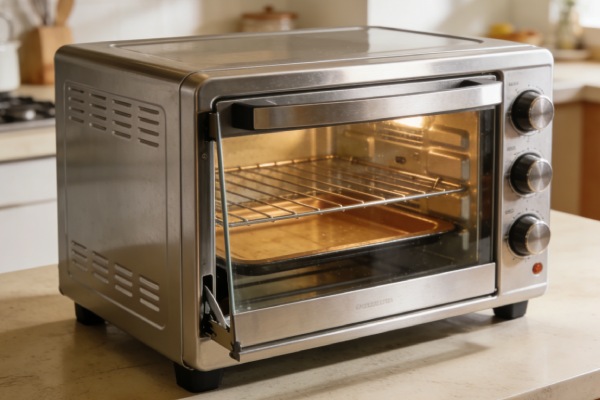
This guide is based on field failure data: appliance teardowns, repair logs of melted wiring, and documented thermal runaway events. We ignore marketing claims about “versatility” or “restaurant-quality.” Instead, we judge a countertop oven by what fails catastrophically first—uncommanded heating, electrical fires, and internal rust. The goal is to provide the engineering and safety logic you need to reject complex, multi-function appliances that bundle multiple failure modes into a single, non-serviceable chassis.
Buyer Protection Summary
Most countertop ovens fail not because of cooking performance, but due to predictable thermal, electrical, and material design compromises. This buyer protection guide focuses on failure modes that create real safety risks—uncommanded heating, wiring degradation, rust, and fire—so buyers can eliminate unsafe, non-serviceable designs before purchase.
Most Common Buyer Mistakes
Mistake 1: Prioritizing Feature Count Over Thermal System Integrity
Buyers are drawn to units that list 10+ functions (air fry, rotisserie, dehydrate, pizza, toast) but never investigate if these modes share a single, undersized heating element and fan. This strains the thermal system. The failure outcome is Failure Mode 8 (Premature Heating Element Failure) and Failure Mode 9 (Power Degradation). The fan and heater, designed for intermittent use, are run continuously at high output, leading to burnout.
Mistake 2: Believing Advertised Max Temperature Equals Usable Performance
A spec sheet listing “500°F” is meaningless if that temperature is only accessible through one or two locked presets, not manual control. Buyers assume they can set any temperature up to the max. The failure outcome is Failure Mode 1 (Inflated Temperature Claims). This restriction reveals the unit’s thermal and control system cannot stably manage high heat across all modes, limiting its real utility for searing or baking.
Mistake 3: Ignoring the Physical Clearance and Stability of Accessories
Buyers see a rotisserie spit included and assume it will work. They fail to measure the actual horizontal and vertical clearance between the spit, heating elements, and door. They also don’t test rack stability. The failure outcome is Failure Mode 2 (Rotisserie Design Failure) and Failure Mode 11 (Poor Rack Retention). The spit jams or drops food, and racks tip, creating a burn hazard and food safety issue (Failure Mode 3).
Mistake 4: Assuming a “Premium” Brand Avoids Fundamental Material Flaws
Paying more for a recognized brand in this category often buys better marketing, not better metallurgy or insulation. High-end brands frequently use the same thinly plated steel for interiors as budget models. The failure outcome is Failure Mode 7 (Rust Formation), identical to that of a cheap unit, just in a more expensive package.
Marketing Claims That Mislead Buyers
- “True Convection”: Often just means a fan is present. It does not specify if the heating element encircles the fan (true convection) or if it’s just a bake element with a fan behind it (forced air). True convection requires a third, dedicated heating element.
- “Cooks 30% Faster”: A comparative claim with no baseline. It distracts from the actual wattage and airflow (CFM), which determine cooking speed. Faster cooking with poor insulation leads to Failure Mode 6 (Overheating).
- “Easy-Clean Interior”: Usually refers to a non-stick coating on thin metal. This coating degrades under high heat and scratches easily, eventually revealing bare metal that rusts. It distracts from the lack of durable, thick enamel coating.
- “Professional Performance”: An emotional claim with no engineering definition. Professional appliances have over-spec’d components, serviceable parts, and calibrated thermostats—traits almost entirely absent in countertop combos.
Specs That Matter vs. Specs That Don’t
Specs That Matter (And Are Almost Never Published):
- Heating Element Watt Density and Configuration: Total wattage (e.g., 1800W) is less important than how it’s distributed. Are there separate, dedicated elements for bake, broil, and convection? A single element doing all jobs will fail. Watt density (watts per inch) should be low for even heating.
- Interior Cavity Material and Thickness: Should be explicitly stated as porcelain-enamel coated steel of a specific gauge (e.g., 18-gauge). “Stainless” or “non-stick” without detail is a red flag for rust.
- Fan Motor Type and Bearing: Is it a brushless DC motor with ball bearings or a cheap AC shaded-pole motor with sleeve bearings? The latter will become loud and fail (Failure Mode 10).
- Thermal Cutoff Fuse Rating and Location: There should be multiple fuses: one on the heating element assembly and one on the main control board. Their trip temperatures (e.g., 150°C, 90°C) should be documented. Their absence suggests poor thermal protection.
Specs That Don’t (The Inflated Distractions):
- Number of Presets: More presets mean more complex, failure-prone software on the control board.
- “Digital Precision”: A touchscreen is less reliable and more vulnerable to heat/steam than a mechanical dial and button interface.
- Included Accessory Count: A rotisserie spit or pizza stone is useless if the oven can’t properly accommodate it or heat it effectively.
- Exterior Dimensions: Doesn’t translate to usable interior volume, which is often compromised by thick insulation (good) or large motor housings (bad).
Build Quality Signals
- Door Seal and Hinge: Open and close the door(s) repeatedly. It should seal tightly and evenly with a silicone gasket, not a thin felt strip. The hinge should be solid metal with a dampened close, not a spring that causes a loud slam (Failure Mode 14).
- Weight and Insulation: A heavier unit almost always indicates better insulation (less exterior heat, more efficient cooking) and a more substantial metal chassis. Lightweight units get dangerously hot on the outside.
- Interior Inspection for Seams and Corners: Look inside. The corners should be smoothly rounded, not sharp, folded metal. Seams should be welded and coated, not riveted or overlapped—these trap grease and will rust.
- Power Cord Length and Gauge: The cord should be at least 3 feet long and thick (16-gauge or lower). A short, thin cord (Failure Mode 15) indicates cost-cutting and creates a hazardous setup.
Reliability Indicators
- Independent Heating Elements: Separate, identifiable bake (bottom) and broil (top) elements that can be replaced individually. A single “dual” element is a compromise.
- Mechanical Thermostat and Timer: A simple, bimetallic thermostat and mechanical timer knob are more reliable and repairable than a fully digital control board, which is the source of Failure Mode 4 (Spontaneous Heating).
- User-Accessible, Cleanable Fan Assembly: The convection fan should be behind a removable cover for de-greasing. A sealed fan will cake with grease and fail.
- Positive Rack Stop Design: Racks should have clear, robust notches or guides that prevent accidental tipping or sliding when fully extended.
Hidden Ownership Costs
- Consumables: Replacement drip trays, air fryer baskets, and non-stick racks that wear out. Proprietary accessories are often overpriced.
- Maintenance: Intensive de-greasing of the fan and cavity to prevent smoke and fire. Complex interiors make this difficult.
- Replacement Part Availability: Control boards, display panels, and specialized heating elements are rarely sold, or cost 50%+ of a new unit.
- Energy Inefficiency: Poor insulation means longer pre-heat times and more heat lost to the kitchen, increasing electricity use.
- Downtime & Inconvenience: A failed oven disrupts meal planning. The repair process for these units is often “replace,” leaving you without an appliance for weeks.
When Cheaper Is Actually Worse
In countertop ovens, low cost is achieved through dangerous and failure-prone compromises:
- Thin, Uncoated or Poorly Plated Steel Interiors: Guarantees Failure Mode 7 (Rust) within months.
- Single, Exposed Heating Element Doing Multiple Jobs: Overworks the element, leading to burnout (Failure Mode 8).
- Inadequate Wiring and Insulation: Uses wire with low-temperature insulation too close to heat sources, causing Failure Mode 5 (Melting Wiring).
- No Thermal Fuse or a Single, Poorly Placed Fuse: Allows runaway heating, leading to Failure Mode 6 (Fire & Smoke).
- Sleeve-Bearing Fan Motor: Will seize from grease and heat (Failure Mode 10).
When Premium Is Justified
A higher price is only justified if it buys tangible engineering that prevents the critical failure modes:
- Porcelain-Enamel Coated, Thick-Gauge Steel Interior: Eliminates rust and is durable.
- Separate, Replaceable Bake and Broil Elements: Allows for repair and even heating.
- Brushless DC Fan Motor with Ball Bearings: For quiet, long-lasting convection.
- Multiple, Accessible Thermal Fuses: On the element and the control board.
- A Simple, Hybrid (Dial + Button) Control Interface: Reduces the risk of digital board failure.
If the premium price only buys a touchscreen, more presets, or included but flawed accessories (like a useless rotisserie), it is not justified.
Pre-Purchase Inspection Checklist
In-Store / Physical Inspection:
- Test the rack stability. Fully extend every included rack. Apply slight downward pressure on the front edge. It should not tip or dislodge.
- Inspect the interior coating. Scratch it gently with a fingernail in an inconspicuous spot. A good enamel coating will not scratch easily. Look for any thin spots or exposed metal.
- Check the door seal. Close the door on a piece of paper. You should feel even resistance pulling it out from various points around the door. A poor seal wastes heat and causes uneven cooking.
- Examine the heating elements. Can you see distinct top and bottom elements? Are they tightly wound and securely anchored, or loose and sagging?
- Measure the power cord. It should be at least 3 feet long. Anything shorter is a deliberate limitation.
Online Research (Before Buying):
- Search for “[Model Number] fire” or “[Model Number] smoking”. This is your primary safety filter.
- Search for “[Model Number] rust”. This is the most common material failure.
- Search for “[Model Number] control board” or “[Model Number] error code”. Digital failures are endemic.
- Find the official parts website. Search for the model. Do they sell the heating elements, fan motor, and control board separately? If not, it’s a sealed unit.
- Look for long-term (1+ year) user reviews. Ignore unboxing and “first impressions.” Look for comments on performance degradation and failures.
Decision Framework
- Classify Your Need: Do you need a basic toaster oven replacement (Simple), a better oven for roasting/baking (Intermediate), or are you trying to replace multiple appliances (Complex)? For Complex needs, these combo units are a high-risk choice. You are better off with two separate, purpose-built appliances.
- Apply Elimination-First Logic:
- Eliminate any unit where you find multiple reports of electrical burning smells, melting, or uncommanded heating.
- Eliminate any unit with a thin, non-enamel interior that feels like painted tin.
- Eliminate any unit where the control system forces you into presets instead of offering full manual temperature/time control (Failure Mode 12).
- Eliminate any brand that does not sell heating elements and fan assemblies as separate parts.
- Reinforce Long-Term Value: A $150 combo oven that rusts and fails in 18 months costs $100 per year and risks a fire. A $300 simple convection oven with an enamel interior that lasts 10 years costs $30 per year and cooks reliably.
- Final Protective Buying Rule:
Only consider a countertop oven with a thick, porcelain-enamel coated interior, physically separate and replaceable heating elements, and a control system that allows full manual operation without restrictive presets. If you are considering a multi-function ‘combo’ unit, it must pass this test and you must verify that its specialty functions (like rotisserie) have sufficient real clearance and power to work as advertised. Most units fail this, making them expensive, unreliable hazards. Complexity is the enemy of reliability in small appliances. Choose simplicity and repairability over a long list of broken promises.