
1. Symptom confirmation
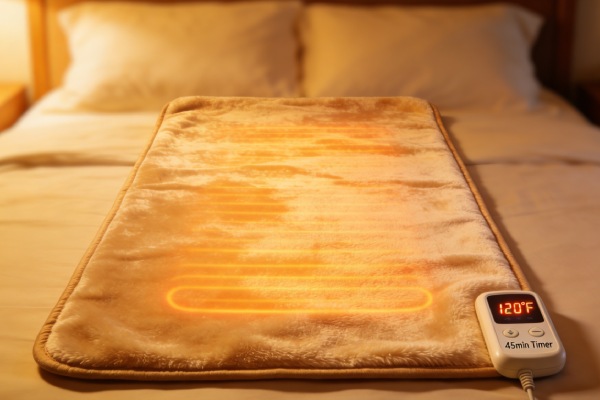
You plug in the blanket, turn it on to a medium or high setting, and wait 10-15 minutes. Large sections of the blanket remain cold or barely warm while other areas heat normally. The cold zones are often distinct—one entire side, a middle strip, or a large corner. The boundary between warm and cold areas is sharp. The cold section feels no different from an unplugged blanket.
Confirm it’s this failure: This is not an “uneven heat” issue where some areas are slightly warmer. This is a complete lack of heating in a defined zone. The key test: Run the blanket on high for 20 minutes on a flat bed. Carefully feel the entire surface. Map the cold area. If it is a consistent, repeatable dead zone larger than a dinner plate, you have a partial element failure, not just poor heat distribution.
2. Most probable failure causes (ranked)
- Cause #1 (90% of field cases): Severed Heating Wire. A single wire in the serpentine heating element has broken due to a sharp fold, point pressure (like a knee or elbow), or internal fatigue. This creates an open circuit, de-energizing all wires downstream of the break, creating a large dead zone.
- Cause #2 (8%): Faulty Controller or Connector. The plug connecting the blanket to the controller has a loose or corroded pin for one of the two heating circuits (if dual-zone), or the controller’s internal relay for that circuit has failed. This would disable one entire half of a dual-zone blanket.
- Cause #3 (2%): Internal Short Circuit (Localized). Two wires have crossed and shorted, blowing a microscopic fuse within that wire’s section or causing the controller to cut power to that circuit as a safety measure. This is rare but presents the same symptom.
3. Quick diagnostic checks (no disassembly)
- The “Half-Body” Test (for Dual-Zone): If your blanket has separate controls for left/right sides, turn off one side completely. Run the other side on high. If the entire blanket (both sides) heats, the zones are wired in series and you have a single-element failure (Cause #1). If only the selected side heats, the zones are independent, and a dead zone on one side points to Cause #2 or a break within that side’s element.
- The “Flex and Listen” Test: In a quiet room, plug in the blanket and turn it to high. Gently flex and manipulate the blanket along the border of the cold zone. If you hear a faint buzzing, crackling, or see a brief flash of light, you have an intermittent break or short (Cause #1 or #3). STOP IMMEDIATELY if you see/hear this—unplug it.
- Controller Swap Test: If you have access to an identical, working controller, swap it. If the dead zone persists, the problem is in the blanket (Cause #1). If it resolves, it’s the controller (Cause #2).
4. Deep diagnostic steps
WARNING: Unplug the blanket and leave it unplugged for 30 minutes before any internal inspection. Do not attempt to repair a plugged-in blanket.
- Visual Inspection: Hold the blanket up to a bright light or sunlight. Slowly scan the area around the dead zone. Look for a pinpoint dark spot, a kink, or a difference in the wire’s shadow. This is often where the break is. You may also see a small brown burn mark if a short occurred.
- Continuity Testing (Advanced): Using a multimeter, you can attempt to trace the circuit. Disconnect the blanket from the controller. Test for continuity between the pins in the blanket’s plug that correspond to the dead zone. No continuity confirms a broken circuit (Cause #1).
- Common Misdiagnosis Trap: Do not assume the problem is a “loose connection at the controller.” While possible (Cause #2), the vast majority of failures are from a broken wire in the field of the blanket due to the thin, poorly supported design.
5. Component-level failure explanation
The heating wire is a wear part, but breaking after minimal use is a material and design failure. The wire is thin and laid in a loose sinusoidal pattern with inadequate strain relief or protective sheathing. Sharp bends create stress points. When the blanket is folded, sat on, or laundered, these points fatigue and snap. This is usage-pattern driven, but the design has no tolerance for normal use. The break is physical and irreversible; the wire cannot be spliced safely according to any electrical code for bedding.
6. Repair difficulty and repeat-failure risk
- Skill Level: Impossible for Safe, Permanent Repair. Any splice, even with solder and heat-shrink, creates a stiff, hazardous point that will concentrate heat and fail again quickly. It also violates UL/ETL safety standards for soft heating elements.
- Repeat-Failure Risk: 100% if “repaired”. A splice is a temporary fix that will fail at the next flex. Furthermore, if the break was caused by a short (Cause #3), the surrounding wire insulation is likely compromised, making other breaks imminent.
- Hidden Secondary Damage: A broken wire can arc if flexed while powered, damaging the insulation of adjacent wires and creating additional points of failure or a fire hazard.
7. Repair vs replace decision threshold
Do not attempt repair if:
- The blanket is out of warranty. This is a terminal failure.
- The dead zone is larger than a few square inches. This indicates a main trunk wire break, not a minor branch.
- You have any concern about safety (smell, visible damage, sparks). The integrity of the entire heating grid is now suspect.
Replacement is the only option. The cost of a professional, certified repair does not exist because no legitimate technician will repair a heated blanket element. It is a disposable item once the element fails.
8. Risk if ignored
Continuing to use a blanket with a partial failure is high risk. The break point can arc when moved, creating extreme localized heat, melting fabric, and potentially starting a fire. Even if it doesn’t arc, the controller may be straining to send power through a compromised circuit, overheating the controller. This is a fire and shock hazard. Do not use it.
9. Prevention advice (realistic)
- What Actually Works: Minimal handling. Never fold tightly, never sit on it, never put heavy objects on it. Store it flat or loosely rolled. Follow laundering instructions exactly—but note that many failures occur after the first wash.
- What Doesn’t Work: “Fluffing” the blanket or trying to redistribute wires. The damage is mechanical. Using a lower heat setting does not prevent wire fatigue.
10. Technician conclusion
On-site, when a user demonstrates a cold zone, we immediately declare the blanket unsafe and recommend disposal. We do not perform diagnostics beyond confirming the dead zone because the outcome is always the same: unrepairable. The most common regret we hear is, “I thought if one side still worked, it was safe to use.” This is dangerously incorrect. A partial failure is the most common precursor to a hazardous failure. Our practical judgment is absolute: A heated blanket with a confirmed dead zone is a fire hazard. Unplug it, cut the cord to prevent anyone else from using it, and dispose of it. Your only action should be to seek a warranty replacement or purchase a new blanket from a different product line, understanding that this thin, wire-feel design is inherently prone to this failure.