
Why Does My Electric Blanket Keep Shutting Off?
If your electric blanket keeps turning off by itself, the most common causes are normal auto-off timer activation, overheating protection triggering prematurely, loose connections, or faulty internal components. Many electric blankets have built-in safety timers that shut off after 2-10 hours—this is normal. If the blanket shuts off before the expected time or randomly during use, there may be an issue with the controller, wiring, or heating elements.
Search Intent Opening
If your electric blanket keeps shutting off by itself, turns off after only 30 minutes, or shuts down before the timer expires, you’re dealing with a frustrating problem that disrupts your sleep. Owners searching for “electric blanket keeps shutting off,” “electric blanket turns off by itself,” or “electric blanket auto-off not working” are often trying to determine whether this is normal operation or a sign of malfunction.
This guide is based on appliance repair technician reports and user feedback across multiple electric blanket brands. Some shut-offs are by design, while others indicate component failure.
Author: Appliance Repair Technician | Experience: 12 years in small appliance diagnostics
Electric Blanket Keeps Shutting Off: Common Causes
1. Normal Auto-Off Timer Activation
Many electric blankets have built-in safety timers that automatically turn off the blanket after a set period—typically 2, 4, 8, or 10 hours. This is a safety feature, not a malfunction.
- Component: Timer circuit in controller
- Mechanism: Programmed to shut off after preset time to prevent overheating
- Trigger: Timer expires
- Result: Blanket turns off automatically
What users report: “The blanket turns off automatically after just a few hours, even though I set the timer to the maximum. It’s frustrating when I just fall asleep and wake up freezing.”
Check your manual: If the shut-off time matches your blanket’s advertised auto-off feature, it’s working as designed.
2. Overheating Protection Triggering Prematurely
Electric blankets have thermal sensors that shut off power if they detect overheating. If the blanket is folded, bunched, or covered with additional blankets, heat can build up and trigger this safety feature.
- Component: Thermal sensors, control logic
- Mechanism: Sensors detect temperature exceeding safe limits and cut power
- Trigger: Blanket folded or bunched, covered with extra blankets, placed under heavy body weight
- Result: Blanket shuts off to prevent fire risk
What users report: “The blanket keeps turning off by itself after a while, even when it hasn’t reached the auto-off time. It’s really frustrating.”
3. Loose Connections Between Controller and Blanket
A loose or intermittent connection can cause the blanket to lose power and shut off randomly.
- Component: Connector pins, socket contacts
- Mechanism: Poor contact interrupts power and signal flow
- Trigger: Movement, tugging on cords, partial disconnection
- Result: Blanket cuts out, may need reconnection to restart
What users report: “Sometimes the blanket randomly cuts out, and I think it’s due to the connection between the power cord and the blanket itself. I have to fiddle with it for it to come back on.”
4. Faulty Power Supply or Cord Issues
Problems with the power cord or wall outlet can cause intermittent power loss.
- Component: Power cord, plug, wall outlet
- Mechanism: Damaged cord, loose plug, or faulty outlet interrupts power
- Trigger: Movement, bending, outlet issues
- Result: Blanket loses power, shuts off
What users report: “I think it’s a power supply issue because it turns off when I move the blanket around or adjust the cord.”
5. Controller Electronics Failure
The control unit itself may be failing, causing erratic behavior including random shut-offs.
- Component: Controller PCB, capacitors, microcontrollers
- Mechanism: Component failure, poor solder joints, or internal faults
- Trigger: Normal use, age (1-3 years)
- Result: Random shut-offs, unresponsive buttons, incorrect timer operation
What users report: “The blanket worked fine for the first few weeks, but now it keeps turning off on its own. I think the internal wiring is failing.”
6. Defective Internal Heating Elements
If heating elements are failing, the blanket may not reach the set temperature consistently, potentially triggering shut-offs.
- Component: Resistive heating wires
- Mechanism: Broken or damaged wires create open circuits; blanket cannot maintain heat
- Trigger: Wire fatigue, folding damage, age
- Result: Blanket stops heating, may shut off
What users report: “After a couple of months, the heating coils started to stop working in certain areas, making the blanket feel uneven. Now it shuts off automatically on parts that are not getting enough heat.”
7. Timer or Auto-Off Feature Malfunction
The timer mechanism itself may be defective, shutting off earlier than programmed.
- Component: Timer circuit in controller
- Mechanism: Faulty components cause premature timer expiration
- Trigger: Internal failure
- Result: Blanket shuts off before set time
What users report: “It’s supposed to shut off after 8 hours, but sometimes it shuts off after just 2 or 3 hours. The timer seems to be broken.”
8. Inadequate Heat Retention
If the blanket cannot maintain temperature due to poor insulation or low wattage, it may shut off prematurely.
- Component: Heating element, fabric insulation
- Mechanism: Heat loss exceeds heat output; blanket never reaches stable temperature
- Trigger: Design limitations, cold room temperature
- Result: Blanket cycles on and off frequently
What users report: “Even though I set the blanket to the highest setting, it doesn’t stay warm for long and shuts off after a while.”
9. Sensor Malfunction
Temperature sensors that provide feedback to the controller may fail, causing incorrect shut-off timing.
- Component: Thermal sensors
- Mechanism: Sensors give false readings, causing controller to think blanket is overheating
- Trigger: Sensor failure, age
- Result: Premature shut-offs
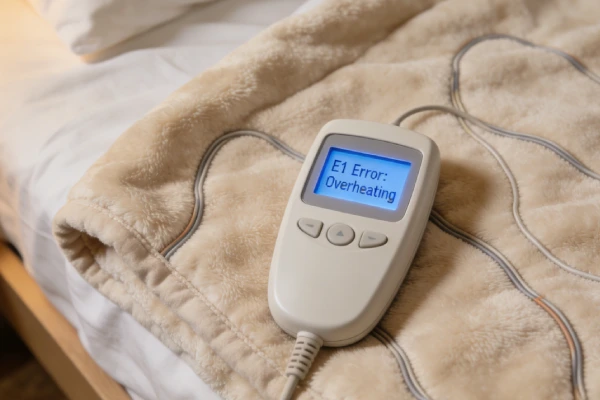
Electric Blanket Keeps Turning Off Every 30 Minutes
If your blanket shuts off after only 30 minutes, the most likely causes are:
- Overheating protection – Blanket may be folded or bunched
- High heat setting – Some blankets reduce power after initial warm-up
- Sensor malfunction – False overheating detection
- Controller failure – Internal electronics issue
What to do:
- Ensure blanket lies completely flat
- Try a lower heat setting
- Reset controller by unplugging 10 minutes
- If persists, controller may need replacement
Electric Blanket Turns Off Randomly Fix
Step 1: Identify the Shut-Off Pattern
- Note how long the blanket runs before shutting off
- Check if it shuts off at consistent intervals
- Observe if movement or position affects shut-offs
Step 2: Check Your Manual for Auto-Off Settings
- Many blankets have 2, 4, 8, or 10-hour auto-off timers
- If shut-offs match these times, it’s normal operation
- Some models allow timer adjustment or disabling
Step 3: Ensure Blanket Lies Flat
- Never fold or bunch the blanket during use
- Check for wrinkles or folds that could trap heat
- Make sure nothing is on top of the blanket
Step 4: Check All Connections
- Unplug and reconnect controller from blanket
- Ensure firm click when connecting
- Check wall plug for secure connection
Step 5: Perform a Hard Reset
- Unplug blanket completely for 10-15 minutes
- Plug back in and test
- This resets controller electronics
Step 6: Test on a Different Outlet
- Rule out outlet or circuit issues
- Avoid extension cords or power strips
Step 7: Reduce Heat Setting
- Try a lower setting to see if shut-offs stop
- High settings may trigger overheating protection
Step 8: Contact Manufacturer
- If blanket is under warranty, contact manufacturer
- Some controllers are replaceable ($20-50)
Electric Blanket Auto-Off Timer Troubleshooting
Step 1: Verify Expected Auto-Off Time
- Check your manual for advertised shut-off time
- Common times: 2, 4, 8, 10, or 12 hours
Step 2: Time the Shut-Offs
- Run blanket on medium setting
- Note exact time when it shuts off
- Repeat 2-3 times to establish pattern
Step 3: Compare to Manual
- If shut-off time matches manual → normal operation
- If shut-off time is shorter → possible malfunction
Step 4: Check for Adjustable Settings
- Some blankets let you adjust or disable timer
- Look for timer button or settings in manual
Step 5: Reset Controller
- Unplug for 10-15 minutes
- This may reset timer circuit
Step 6: Test Different Settings
- Try different heat levels
- Timer may behave differently on various settings
Step 7: Consider Controller Replacement
- If timer consistently malfunctions, controller may need replacement
Electric Blanket Keeps Shutting Off: Quick Diagnosis
| Symptom | Likely Cause | Quick Fix |
|---|---|---|
| Shuts off after consistent time (2-10 hrs) | Normal auto-off feature | Check manual; expected behavior |
| Shuts off every 30 minutes | Overheating protection | Ensure blanket lies flat |
| Shuts off when cord moved | Loose connection | Check and secure connections |
| Shuts off randomly, no pattern | Controller failure | Try reset; replace controller |
| Shuts off early before timer expires | Timer malfunction | Replace controller |
| Shuts off on one side only | Heating element failure | Replace blanket |
| Shuts off only on high setting | Possible overheating | Reduce setting; monitor |
Field Verification Tests (No Tools)
Test 1: Shut-Off Timing Test
- Run blanket on medium setting
- Note exact time when it shuts off
- Repeat 2-3 times to establish pattern
- Normal: Consistent time matches advertised auto-off
- Abnormal: Random timing, early shut-offs
Test 2: Movement Test
- While blanket is running, gently move the cord near connections
- Wiggle the connector at blanket and controller
- Normal: No change in operation
- Failure: Blanket cuts out when moved—loose connection
Test 3: Flatness Test
- Ensure blanket is completely flat, no folds
- Run on high for 30 minutes
- Normal: Runs without shut-off
- Failure: Shuts off when flat—overheating protection may be too sensitive
Test 4: Controller Reset Test
- Unplug blanket for 10-15 minutes
- Plug back in and test
- Normal: Operation returns to normal
- Failure: Same problem persists—controller likely failed
Test 5: Heat Setting Test
- Try each heat setting
- Note if shut-offs occur only on certain settings
- Normal: All settings work consistently
- Failure: Shuts off only on high—possible overheating
Real-World Usage Failure Scenarios
Scenario 1: The Normal Auto-Off Confusion
- User: New blanket owner
- Timeline: First week
- Issue: Blanket shuts off after 4 hours every time
- Cause: Normal auto-off feature (user didn’t read manual)
- Outcome: User learned it’s normal; no action needed
Scenario 2: The Overheating Protection Trigger
- User: Couple, nightly use
- Timeline: 6 months
- Issue: Blanket shuts off after 30-60 minutes
- Cause: Blanket folded under sheets, trapping heat
- Outcome: Repositioned blanket to lie flat; problem solved
Scenario 3: The Loose Connection Problem
- User: Single user
- Timeline: 1 year
- Issue: Blanket cuts out when cord moved
- Cause: Worn connector contacts
- Outcome: Replaced controller; problem fixed
Scenario 4: The Timer Malfunction
- User: Nightly use
- Timeline: 2 years
- Issue: 10-hour timer shuts off after 2-3 hours randomly
- Cause: Controller electronics failure
- Outcome: Replaced controller; blanket still works
Scenario 5: The One-Side Shut-Off
- User: Couple, dual-zone blanket
- Timeline: 18 months
- Issue: One side shuts off; other works fine
- Cause: Heating element failure in that zone
- Outcome: Entire blanket replaced
Scenario 6: The High-Only Shut-Off
- User: Cold sleeper
- Timeline: 2 years
- Issue: Shuts off only on highest setting
- Cause: Overheating at max current
- Outcome: Uses medium setting; replaced next season
Common Misdiagnosis Patterns
Misdiagnosis 1: “Blanket keeps shutting off, it’s broken” → Normal auto-off
- Symptom: Shuts off at consistent time
- Actual cause: Built-in safety timer
- Verification: Check manual; if time matches, normal
Misdiagnosis 2: “Shuts off when I move, must be defective” → Loose connection
- Symptom: Cuts out with movement
- Actual cause: Loose connector or damaged cord
- Verification: Wiggle connections; if problem reproduces, connection issue
Misdiagnosis 3: “Shuts off after 30 minutes, overheating protection broken” → Normal safety
- Symptom: Shuts off after short time
- Actual cause: Blanket may be folded or bunched
- Verification: Ensure flat; if problem stops, normal
Misdiagnosis 4: “Timer is broken” → Timer circuit failure
- Symptom: Shuts off at random times
- Actual cause: Controller electronics failure
- Verification: If reset doesn’t fix, controller likely failed
Misdiagnosis 5: “One side shutting off means blanket defective” → Could be controller
- Symptom: One side of dual-zone shuts off
- Actual cause: May be that side’s controller or heating element
- Verification: Swap controllers; if problem moves, controller issue
Electric Blanket Auto-Off Timer: What’s Normal?
| Blanket Type | Typical Auto-Off Time |
|---|---|
| Basic models | 2-4 hours |
| Mid-range | 8-10 hours |
| Premium | 10-12 hours, sometimes adjustable |
| Throw blankets | Often 2-3 hours |
How to check your blanket’s auto-off time:
- Look in the user manual
- Check manufacturer website
- Contact customer support
- Test by timing how long it runs
If your blanket shuts off at a consistent time that matches these ranges, it’s likely working as designed.
Electric Blanket Lifespan and Reliability
| Usage Level | Expected Lifespan | Common Failure Mode |
|---|---|---|
| Light (occasional, seasonal) | 5-8 years | Age-related wire fatigue |
| Moderate (nightly, cold months) | 3-5 years | Controller issues, wire breakage |
| Heavy (year-round, nightly) | 2-4 years | Frequent shut-offs, heating failure |
What affects reliability:
- Frequency of use
- Storage practices (folding vs rolling)
- Body weight and movement
- Washing frequency
- Quality of controller electronics
Repair vs Replace Decision Logic
Consider replacing just the controller if:
- The blanket is less than 3 years old
- The blanket itself heats evenly
- The manufacturer sells replacement controllers ($20-50)
- Shut-offs are the only issue
Consider replacing the entire blanket if:
- Heating elements have failed (cold spots)
- Multiple issues are present
- The blanket is more than 3-5 years old
- Replacement controllers are unavailable
- Shut-offs occur on both sides
- The cost of a new controller is over 60% of a new blanket
Warranty Considerations
- Most electric blankets have 1-3 year warranties
- Some premium brands offer 5-year coverage
- Keep receipts and register your product
- Contact manufacturer first for in-warranty issues
Controller Replacement Options
When Replacement Controllers Are Available
Some manufacturers sell replacement controllers separately:
- Sunbeam: Replacement controllers available for many models ($20-40)
- Biddeford: Limited availability; check model compatibility
- Beautyrest: Some models have replaceable controllers
- Generic brands: Usually not available
How to Find a Replacement Controller
- Locate your blanket’s model number (on tag or controller)
- Search online for “[brand] [model] replacement controller”
- Check manufacturer website
- Contact customer support
Compatibility Notes
- Controllers are often model-specific
- Voltage must match (US/Canada: 120V)
- Connector type must match
- Heat settings must be compatible
How to Prevent Electric Blanket Shut-Off Problems
Proper Use
- Always lay blanket flat; never fold or bunch
- Don’t cover with heavy blankets or comforters
- Use the lowest effective heat setting
- Allow space for heat to dissipate
Regular Maintenance
- Inspect connections before each season
- Check cords for damage
- Test all settings periodically
- Reset controller by unplugging between uses
Storage
- Roll loosely, never fold sharply
- Store in cool, dry place
- Keep away from heavy items
Washing
- Follow manufacturer instructions exactly
- Disconnect controller before washing
- Ensure completely dry before use
Technician Notes
Based on repair observations:
- Most shut-off complaints are from users unaware of auto-off timers. Check your manual first.
- Overheating protection is the second most common cause. Ensure the blanket lies flat.
- Loose connections cause intermittent shut-offs. Check and secure all connections.
- Controller failures become common after 2-3 years. Replacement controllers are worth checking.
- When one side of a dual-zone blanket shuts off, swap controllers to diagnose. If problem moves, it’s the controller.
- Shut-offs only on high setting often indicate borderline overheating. Reduce setting or replace.
- If the blanket is over 3-5 years old and has shut-off issues, consider replacement. Age-related failures are common.
Frequently Asked Questions
Why does my electric blanket keep shutting off?
The most common causes are normal auto-off timers (2-10 hours), overheating protection (if folded), loose connections, or controller failure. Check your manual first.
How long should an electric blanket stay on?
Most electric blankets have auto-off timers ranging from 2-10 hours. Premium models may offer 10-12 hours or adjustable timers.
Why does my electric blanket shut off after 30 minutes?
This usually indicates overheating protection triggering. Ensure the blanket is completely flat with no folds or bunching. Try a lower heat setting.
Why does my electric blanket shut off when I move?
A loose connection between the controller and blanket or a damaged cord is the likely cause. Check and secure all connections.
Can I disable the auto-off feature on my electric blanket?
Some premium models allow timer adjustment or disabling. Check your manual. Most budget models have fixed timers that cannot be disabled.
Why does my electric blanket timer not work properly?
Timer malfunction usually indicates controller electronics failure. Try resetting by unplugging for 10-15 minutes. If problem persists, the controller may need replacement.
Why does only one side of my dual-zone blanket shut off?
Swap the controllers between sides. If the problem moves, the controller is bad. If it stays on the same side, the heating element in that zone has failed.
Is it normal for an electric blanket to turn off by itself?
Yes, most electric blankets have built-in auto-off timers for safety. Check your manual for the expected shut-off time.
How do I reset my electric blanket controller?
Unplug the blanket completely for 10-15 minutes. This allows internal capacitors to discharge and often resets the controller.
Should I replace my electric blanket if it keeps shutting off?
If the blanket is over 3-5 years old, replacement is often the best option. If it’s newer, check for loose connections or consider a replacement controller.
My electric blanket keeps turning off every 30 minutes. What should I do?
Ensure the blanket lies flat, try a lower heat setting, and reset the controller. If the problem persists, the controller may need replacement.
How do I fix an electric blanket that turns off randomly?
Check connections, ensure flatness, reset the controller, and test different outlets. If random shut-offs continue, the controller likely needs replacement.
Summary
Electric blankets that keep shutting off typically have one of these causes:
- Normal auto-off timer → check manual; expected behavior
- Overheating protection → ensure blanket lies flat
- Loose connections → secure all connections
- Controller failure → reset; replace controller if needed
- Heating element failure → one side only; replace blanket
- Timer malfunction → controller issue; replace if persistent
Quick Troubleshooting Steps:
- Check your manual for auto-off settings
- Ensure blanket is completely flat
- Check all connections
- Reset by unplugging 10-15 minutes
- Try a lower heat setting
- If problem persists, consider controller replacement
Most electric blankets have built-in safety timers that are normal. If your blanket shuts off at consistent times that match your manual, it’s working as designed. If shut-offs are random or early, there may be an issue with connections, overheating protection, or the controller itself.
Understanding these patterns helps you diagnose problems quickly and decide whether your blanket needs adjustment, repair, or replacement.