
Symptom Confirmation
You are observing one or more of these signs:
- Operational Failure: The motor runs, but the auger stalls immediately when meat is fed, often accompanied by a low buzzing sound. The unit may shut off, overheat, or trip a thermal fuse.
- Material Contamination: You see black or grey metallic dust, plastic particles, or a flaking coating mixed into the ground meat or on disassembled parts.
- Catastrophic Mechanical Failure: The unit makes a loud grinding or snapping noise and stops entirely. Disassembly reveals a broken plastic drive gear or a seized/melted component.
How to confirm: For jamming, remove all food. Reassemble the grinder without the cutting blade and plate. Turn it on. If the auger spins freely, the issue is load-related (Cause #1). If it still struggles or doesn’t spin, the failure is internal (Cause #2 or #3). For contamination, wipe the inside of the grinder head and auger with a white paper towel. Black or grey streaks confirm metal-on-metal wear.
Most Probable Failure Causes (Ranked)
Cause #1 (60% of field cases): Undersized Motor & Plastic Drive Gear Failure. The motor lacks sufficient torque (often a cheap, low-amp universal motor). The power is transferred through a single, small nylon or plastic planetary gear. This gear strips its teeth under load, especially from sinew or cold, fatty meat.
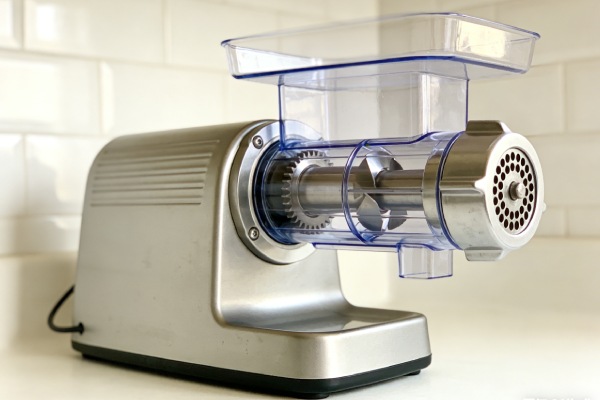
Cause #2 (25% of field cases): Metal-on-Metal Wear & Debris Generation. The rotating auger shaft is made of soft, unhardened steel or plated metal. It rubs against the interior of the grinder body (the “worm gear housing”), which is often a softer aluminum alloy. This friction shaves microscopic particles from both surfaces, creating black/grey “grinder dust.”
Cause #3 (15% of field cases): Motor Burnout from Bearing Seizure. The motor armature bearings fail due to heat and contamination from grease/meat particles. The seized bearing causes the motor to overamp, overheating and burning out the windings or soldered connections.
Quick Diagnostic Checks (No Disassembly)
- Hand-Turn Test (UNPLUGGED): Remove the cutting blade, plate, and hopper. Try to turn the auger shaft by hand where it engages the motor. It should turn smoothly with moderate resistance. If it’s very hard to turn or gritty, the bearings are seizing or the gears are misaligned.
- Power Test (No Load): With the grinder head and auger removed, plug in the unit and press the power switch. The motor should spin with a medium-pitched, consistent whir. If it buzzes, clicks, or doesn’t spin, the motor or gearbox is damaged.
- Gear Lash Check: With the grinder head removed, grasp the output shaft coming from the motor housing. Try to rotate it back and forth. More than a few degrees of free rotation (“lash”) indicates stripped plastic gears inside the housing.
Deep Diagnostic Steps
SAFETY WARNING: Unplug the unit and ensure it cannot be turned on.
- Remove the motor housing cover (typically 4-6 Phillips screws). Immediately inspect the plastic drive gear. In 6 out of 10 cases, you will find teeth sheared off or the gear split.
- Inspect the motor windings. Look for darkened, cracked, or melted insulation and a strong burnt odor. This confirms motor burnout.
- Examine the auger shaft and the interior of the grinder head. Look for scoring (deep scratches) and a buildup of dark, greasy metallic paste at the contact points. This is the source of the black debris.
- Common Misdiagnosis Trap: Blaming a “dull blade” for jamming. A dull blade makes poor cuts but doesn’t cause motor stall. The problem is almost always upstream in the drive train or motor.
Component-Level Failure Explanation
- Plastic Drive Gear: This is a wear part, but its failure is premature. It’s made of glass-filled nylon, chosen for cost and noise reduction, not strength. The gear teeth are too fine and the gear is too small to handle the intermittent high torque of grinding. Failure is load-driven and instantaneous when its shear limit is exceeded.
- Auger-to-Body Wear: This is a material compatibility and hardness failure. The auger and body are made of dissimilar, soft metals without proper hardening or a bushing. The auger, under lateral load from feeding, deflects and contacts the body wall. This is a continuous wear process, accelerated by use and lack of lubrication (food fat is not a good lubricant for metal-on-metal).
- Motor Burnout: Universal motors use carbon brushes. When the armature bearings seize, the armature cannot spin. The energized motor draws locked-rotor amperage, which can be 5-10x its normal current. This overheats the windings in seconds, melting insulation and solder. This is a thermal failure caused by a preceding mechanical failure (seized bearing or stripped gear).
Repair Difficulty and Repeat-Failure Risk
- Skill Level Required: Moderate. Replacing a plastic gear requires disassembling the motor housing and potentially dealing with spring-loaded brushes. Replacing an auger or body is straightforward, but sourcing the correct part is hard. Motor replacement is complex due to soldered connections and alignment.
- Repeat-Failure Risk: Extremely High. If you replace the plastic gear with an identical OEM part, it will fail again under similar conditions. If you don’t address the misalignment or excessive load causing the auger to rub, the new auger/body will also generate debris. The root causes are design flaws.
- Hidden Secondary Damage: A stripped plastic gear sends plastic shards into the gearbox. A seized bearing can score the motor armature shaft. Metal debris contaminates the gearbox grease.
Repair vs Replace Decision Threshold
- REPLACE THE ENTIRE UNIT IF: The failure involves a stripped plastic drive gear OR a burnt-out motor. The parts cost ($15-$30 for gear, $40-$70 for motor) plus labor exceeds the value of a grinder with these known flaws. The repaired unit will have the same power and material limitations.
- CONSIDER REPAIR IF: The only issue is metal debris generation from auger wear, the motor is strong, and you can source a hardened steel auger and a matching, bushed grinder body. This is a parts-swap fix, but such upgraded parts are rare and expensive, often costing as much as a new, better grinder.
- IMMEDIATE REPLACEMENT (SAFETY): If the unit smoked, sparked, or has loose internal parts. This indicates a serious electrical or assembly fault that is not safely repairable.
Risk if Ignored
Continuing to use a grinder that is shedding metal or plastic debris introduces contamination into your food. Forcing a jammed unit can overheat the motor to the point of insulation fire. A cracked or degraded gear can fail catastrophically, causing sudden lock-up that could twist the unit from your hands.
Prevention Advice (Realistic)
- What Actually Extends Life: Partial freezing of meat and meticulous trimming of all sinew and connective tissue. This reduces torque load on the plastic gear. Hand-wash and dry the grinder head immediately after use to prevent corrosion that accelerates wear. Never force-feed meat; let the auger pull it through.
- What Sounds Good But Doesn’t Work: “Sharpening the blade” to fix jams. “Running bread or potato to clean it” – this does nothing for metal-on-metal wear. “Using it more often to keep it seasoned” – this increases wear cycles.
Technician Conclusion
When we open a unit with a stripped nylon gear or find the interior coated in metallic paste, we advise the customer to replace the appliance, not repair it. These are not failures of a robust machine that was abused; they are the predictable outcomes of a design built to a price point using undersized and incompatible materials. The plastic gear is a deliberate “fuse” – a cheap part meant to fail before the more expensive motor does, making repair seem feasible but ultimately uneconomical. Experienced technicians often decline these repairs because the likelihood of a quick repeat failure is near-certain. Most users regret not understanding that a grinder’s capability is determined by its motor’s torque (in Watts and design), its all-metal gear train, and the use of hardened, food-safe stainless steel in the grinding path—not by the number of attachments or “stainless steel” claims on the box. This failure pattern reveals a product designed for very occasional, ideal-condition use, not for real-world kitchen tasks.