
Heated Mattress Pad Not Working? Here’s the Quick Answer
If your heated mattress pad stops heating on one side, the most likely cause is a broken heating wire inside the pad. This cannot be repaired and the pad usually needs replacement. If the controller blinks or won’t respond, the electronics have likely failed—sometimes a replacement controller is available. If the pad turns on by itself after a power outage, that’s a design flaw; unplug it when not in use.
Search Intent Opening
If your heated mattress pad stopped heating on one side, has a controller with blinking lights that won’t respond, or turns on by itself after a power outage, you’re dealing with common issues that affect these products. Owners searching for “heated mattress pad not working,” “heated mattress pad one side not heating,” or “heated mattress pad controller problems” are often trying to figure out whether the problem is in the pad or the controller—and whether they need to replace the whole unit or just a part.
Heated Mattress Pad One Side Not Heating
This is one of the most common complaints, especially with dual-zone models where couples can set different temperatures.
What’s happening: One side of the pad gets warm normally; the other side stays cold. Swapping the controllers confirms the problem stays with the same side.
The cause: A broken heating wire inside the pad. The wires in heated mattress pads are thin and can break over time due to:
- Repeated folding and unfolding
- Body weight and movement during sleep
- Use with adjustable beds that flex the pad
- General age and wear
Can it be fixed? No. The heating wires are embedded in the pad and cannot be repaired. When one side dies, the entire pad needs replacement.
What users report: “One year after purchase, one side would not heat. Swapping the working control for the non-working one did not fix the problem. Must be a problem with the pad wiring.”
Heated Mattress Pad Controller Blinking Light
Controllers that blink, won’t respond, or won’t turn off are another common failure mode.
What’s happening: The controller lights blink continuously, buttons don’t work, or the unit won’t turn off even when unplugged and replugged.
The cause: Electronics failure inside the controller. These are mass-produced components, and failures can happen early—sometimes within months.
Can it be fixed? Sometimes. If the manufacturer sells replacement controllers separately, you can buy just the controller instead of a whole new pad. This is worth checking, especially if the pad itself is still in good condition.
What users report: “One of the two controllers failed in under 2 months. The controller was used literally twice and on third time failed.” “Controls malfunction. Light started blinking and would not turn off.”
Heated Mattress Pad Turns On By Itself
This is more than an annoyance—it’s a safety concern.
What’s happening: After a power outage, the pad turns itself back on automatically. Users return home to find it running unattended.
The cause: The controller is designed to “remember” its last state. If it was on before the power went out, it turns back on when power returns. Some manufacturers consider this a feature; safety advocates consider it a risk.
Can it be fixed? Not easily. This is built into the controller’s logic. The safest approach is to unplug the pad during storms or when you’ll be away.
What users report: “If we lost power, the mattress pad would turn itself ON automatically. We would come home from work and find it on.” “They admitted it shouldn’t do that because of the safety concern.”
Heated Mattress Pad Slow Heating Problem
Some pads take longer to warm up than others.
What’s happening: The pad may take 30-40 minutes to reach a comfortable temperature.
The cause: This is usually by design—lower wattage pads or thicker materials take longer to heat. It’s not a defect, but it can be inconvenient if you want quick warmth.
Can it be fixed? No. If you want faster heating, look for pads with higher wattage or preheat features in product specifications.
What users report: “It took about 30-40 minutes to heat up to high.”
Heated Mattress Pad Connector Problems
Loose connections where the controller plugs into the pad can cause intermittent operation.
What’s happening: The plug doesn’t click securely into the pad. It can be pulled out easily or lose connection during the night.
The cause: Manufacturing tolerances—the connector parts don’t fit together tightly enough.
Can it be fixed? Sometimes. A small piece of tape can help secure it temporarily. If it’s a persistent problem, the pad may need replacement.
What users report: “One side would plug in but not ‘click’ in as the other side. The risk of the plug getting pulled out became possible.”
Heated Mattress Pad Uneven Heating
Some users notice the foot area feels warmer than the rest of the pad.
What’s happening: Heat concentrates near where the power cord enters the pad, typically at the foot of the bed.
The cause: This is normal for many designs. The power entry point may have slightly different wire density or simply warms up faster.
Can it be fixed? No. It’s a design characteristic, not a defect.
What users report: “You can tell the power comes from the foot of the bed. There is more heat in that area to start.”
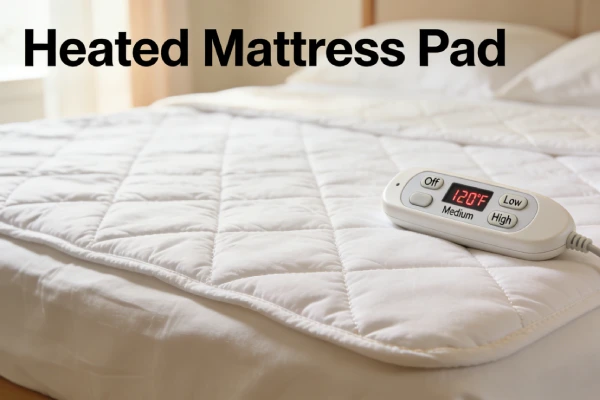
Heated Mattress Pad Remote Slides Off Nightstand
The remote control won’t stay put on the nightstand.
What’s happening: The cables pull in different directions, and the rubber feet don’t provide enough grip.
The cause: Design issue—the remote is lightweight and cables create tension.
Can it be fixed? Yes. Double-sided tape works well to secure it. Some users also reposition the remote to reduce cable pull.
What users report: “It is difficult to keep the remote head stable on the table. The rubber stoppers did little to keep the remote on the table. I used double stick tape to keep the remote in one location.”
How to Diagnose Heated Mattress Pad Problems
Step 1: Identify which side is affected
- If only one side isn’t heating, swap the controllers between sides
- If the problem moves with the controller → controller is bad
- If the problem stays with the same side → pad wiring is bad
Step 2: Check the controller behavior
- Blinking lights that won’t stop → try unplugging for 5 minutes to reset
- If reset doesn’t work, controller likely failed
- See if the manufacturer sells replacement controllers
Step 3: Test for power-on after outage
- Unplug while pad is on, wait 1 minute, plug back in
- If it turns on automatically, that’s how it’s designed
- Unplug when not in use for safety
Step 4: Inspect the connectors
- Plug in each side; listen for a click
- Gently tug to ensure it’s secure
- Loose connections may need temporary securing
Step 5: Evaluate heating performance
- Time how long it takes to warm up
- Feel for cold spots or uneven areas
- Compare to expectations—some pads are simply slower
Common Failure Causes
Controller Electronics Failure
- Component: Control unit PCB, switches
- Trigger: Power surges, manufacturing defects, normal use
- Result: Blinking lights, unresponsive buttons, complete failure
- Typical timeline: Months to 2 years
Heating Wire Breakage
- Component: Resistive wires in pad
- Trigger: Folding, body weight, adjustable bed movement
- Result: One side stops heating; pad needs replacement
- Typical timeline: 2-5 years
Connector Wear
- Component: Plug and socket
- Trigger: Repeated connecting/disconnecting, tension
- Result: Loose fit, intermittent operation
- Typical timeline: 2-4 years
Design-Related Issues
- Component: Controller logic, wire layout
- Trigger: Power outages (auto-on), power entry location (uneven heat)
- Result: Safety concerns, user dissatisfaction
- Typical timeline: From first use
Heated Mattress Pad Lifespan
| Usage Level | Expected Lifespan | Common Failure Mode |
|---|---|---|
| Light (occasional, seasonal) | 5-8 years | Age-related wire fatigue |
| Moderate (nightly, cold months) | 4-6 years | Controller or wire failure |
| Heavy (year-round, nightly) | 3-5 years | Wire breakage, controller issues |
| Adjustable bed use | 2-4 years | Wire fatigue from flexing |
What affects lifespan:
- Frequency of use
- Storage practices (folding vs rolling)
- Body weight and movement
- Adjustable bed compatibility
- Quality of components
Repair vs Replacement
When replacement is the better option:
- Heating wires failed (one side dead)
- Pad is more than 3-5 years old
- Controller failed and replacement not available
- Multiple issues present
When repair might work:
- Controller failed and manufacturer sells replacements
- Pad is relatively new and under warranty
- Simple connector issue that can be secured
What it costs:
- Replacement controller: $30-60 (if available)
- New heated mattress pad: $80-300
- Most failures under 3 years are covered by warranty
What to Look for When Buying
Features that matter for reliability:
- Replaceable controllers – Extends pad life when electronics fail
- Even heating design – Fewer complaints about hot/cold spots
- Secure connectors – Positive click when plugged in
- Safety certifications – UL or ETL listed
- Good warranty – 3-5 years indicates manufacturer confidence
- Adjustable bed compatible – If you have or plan to get one
Common complaints to check in reviews:
- “One side stopped working”
- “Controller started blinking”
- “Turns on by itself”
- “Plug doesn’t click in”
- “Feet are too warm”
Technician Notes
Based on repair observations:
- Controller failures are common in the first 2 years. Some fail within months. If the pad is still good, check if the manufacturer sells replacements.
- One side dead usually means a broken wire in the pad. Swapping controllers confirms it. The pad needs replacement.
- Pads that turn on after power outages are a known issue. Unplug them when not in use, especially during storms.
- Loose connectors are often manufacturing defects. A little electrical tape can help, but it’s a sign of poor quality.
- Feet warmer is normal. The power has to enter somewhere, and the foot of the bed is the most common place.
- Slow heating is by design. Some pads are just slower. Check specs if quick warmth matters to you.
- Remotes that slide off nightstands are annoying but fixable. Double-sided tape works well.
- Heated mattress pads have a limited lifespan. 3-6 years is typical. Don’t expect them to last forever.
Frequently Asked Questions
Why is my heated mattress pad not working on one side?
The most likely cause is a broken heating wire inside the pad. Swap controllers between sides—if the problem stays with the same side, the pad wiring has failed and the pad needs replacement.
Why is my heated mattress pad controller blinking?
The controller electronics may have failed. Try unplugging for 5 minutes to reset. If it still blinks, the controller needs replacement. Check if the manufacturer sells them separately.
Why does my heated mattress pad turn on by itself after a power outage?
The controller is designed to return to its last state. If it was on before the outage, it turns back on. This is a safety concern—unplug the pad when not in use.
Why is the plug loose and won’t click in?
Manufacturing tolerances can cause connectors to fit poorly. Try repositioning or using a small piece of tape to secure it temporarily. If it’s a persistent problem, consider replacement.
Why are my feet warmer than the rest of the bed?
The power cord typically enters at the foot of the bed. That area may warm up faster or have slightly more heat. This is normal for many designs.
Why does my heated mattress pad take so long to heat up?
Lower wattage pads or thicker materials take longer to reach temperature. Some require 30-40 minutes of preheat. This is a design characteristic, not a defect.
How long do heated mattress pads last?
Typically 3-6 years with regular use. Controller failures often happen in the first 2 years. Heating wire failures usually occur after 3-5 years.
Can I repair a heated mattress pad with one side dead?
No. The heating wires are embedded in the pad and cannot be repaired. Replacement is the only option.
Should I buy a replacement controller or a new pad?
If the pad is less than 3 years old and in good condition, a replacement controller (if available) can extend its life. If the pad is older or has other issues, replacement is usually better.
Are dual-zone pads reliable?
They have twice the components, so twice the potential failure points. However, they’re essential for couples with different temperature preferences. Look for models with good reviews and warranties.
Summary
Heated mattress pads typically fail in predictable ways:
- One side dead → broken wire in the pad → replace the pad
- Controller blinking/unresponsive → electronics failed → replace controller if available
- Turns on after power outage → design flaw → unplug when not in use
- Loose connector → manufacturing issue → tape or replace
- Slow to heat → low wattage design → normal; preheat earlier
- Feet warmer → power entry location → normal
Most pads last 3-6 years with regular use. Controller failures can happen early; heating wire failures happen later. When one side dies, the pad needs replacement. If the controller fails and replacements are available, that’s a more economical fix.
Understanding these patterns helps you diagnose problems quickly and decide whether to repair or replace your heated mattress pad.