
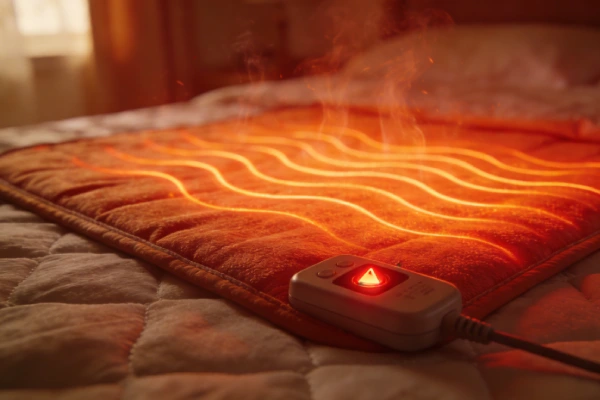
Quick Diagnosis: Is Your Heated Mattress Pad Overheating or Just Running Warm?
| Symptom | Normal | Problem |
|---|---|---|
| Low setting warm and comfortable | ✔ | — |
| Low setting too hot, unusable | — | ✔ |
| Heat increases gradually over time | — | ✔ (regulation failure) |
| Sudden intense heat | — | ✔ (unsafe) |
| Comfortable sleep without waking | ✔ | — |
| Wakes you sweating | — | ✔ |
| Only hot in some spots (hot spots) | ⚠️ Design limitation | — |
| Burning sensation or pain | — | ✔ STOP IMMEDIATELY |
Heated Mattress Pad Overheating? Quick Answer
If your heated mattress pad is too hot even on the lowest setting, burning you, or waking you up sweating, you’re facing a common but serious issue. If the lowest setting is already too hot, the product is effectively unusable for sleep—this is not something you can fix. Return it if possible. If you experience burning sensation, pain, or redness, stop using immediately.
Search Intent Opening
If your heated mattress pad is too hot on the lowest setting, burns you at higher settings, or leaves you waking up drenched in sweat, you’re facing one of the most frustrating—and potentially unsafe—issues with heated bedding. Owners searching for “heated mattress pad too hot,” “heated mattress pad burning me,” or “electric mattress pad gets too hot at night” are often dealing with poorly calibrated temperature settings that make the product unusable.
This guide is based on appliance repair technician reports and user feedback from multiple heated mattress pad brands, including Sunbeam, Biddeford, and Beautyrest.
Safety Warning: If your mattress pad causes burning sensation, pain, or skin redness, stop using immediately. Prolonged exposure to excessive heat can cause burns, especially for users with reduced sensitivity, diabetes, or circulation issues.
Author: Appliance Repair Technician | Experience: 12 years in small appliance diagnostics
Heated Mattress Pad Too Hot on Low Setting (Most Common Complaint)
If the lowest setting is already uncomfortably hot, the pad has poor heat calibration. This is a design choice, not a defect—but it makes the product unusable for sleep.
- Component: Temperature calibration, controller settings
- Mechanism: Heat settings are scaled too high; low setting may be equivalent to medium or high on other pads
- Trigger: Design choice
- Result: User cannot find a comfortable temperature; pad is either too cold or too hot
What users report: “after a few nights of testing, we’re both maxed out at 2-3. Anything more, & you’ll burst into flames.” “Lvl 1 was a very comfortable warmth… but anything higher in my opinion is just overwhelming for any duration of time.”
If the lowest setting is already too hot, the product is effectively unusable for sleep—return it.
Heated Mattress Pad Burning Me – Is It Dangerous?
Yes. If your pad feels like it’s burning you, this is a safety hazard.
Immediate actions:
- Unplug the pad immediately
- Check for visible damage, discoloration, or melting
- If any damage is present, discard the pad
- If no visible damage but heat is excessive, discontinue use
When to replace:
- Pad consistently too hot even on lowest settings
- You experience burning sensation or pain
- Any burning smell or discoloration
- Redness or irritation after use
Safety Standards: When Is a Heated Mattress Pad Too Hot?
Certified pads (UL / ETL) are designed with safety limits, but individual sensitivity varies.
Temperature guidelines:
- Most certified pads operate below ~115°F (46°C)
- Skin discomfort can occur above ~105°F (40°C) with prolonged exposure
- Pain or burning sensation typically occurs above ~115-120°F
Safe vs Unsafe:
| Sensation | Assessment | Action |
|---|---|---|
| Warm and comfortable | Normal | Continue use |
| Hot but tolerable | Check setting | Lower setting |
| Painful / burning sensation | Unsafe | STOP using immediately |
| Skin redness after use | Unsafe | Discontinue; consult doctor if persistent |
Electric Mattress Pad Gets Too Hot at Night
If the pad starts comfortable but gets progressively hotter, this indicates temperature regulation failure.
- Component: Temperature sensor, control logic
- Mechanism: Pad heats continuously without cycling off
- Trigger: Faulty regulation, component failure
- Result: Temperature climbs progressively during use
What users report: “It starts comfortable, but after an hour I’m sweating and have to turn it down.”
This is unsafe. If heat increases over time without stabilizing, discontinue use.
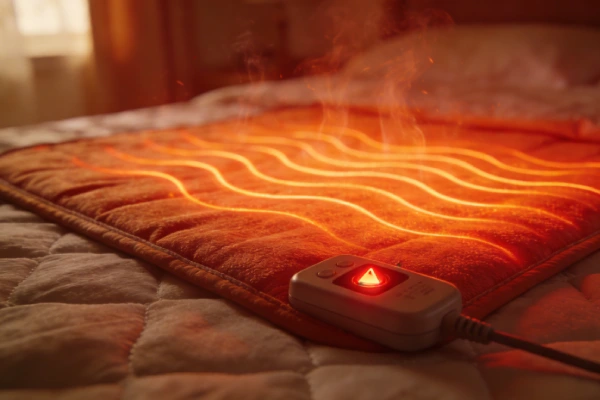
Why Does My Heated Mattress Pad Overheat?
1. Poorly Scaled Heat Settings
Low setting is too hot; medium and high are unusable. This is a design choice—return the pad.
2. No Temperature Regulation
Pad heats continuously without cycling off. This is unsafe—discontinue use.
3. Heat Concentrated in Spots (Hot Spots)
Wires may be closer together in some areas, creating localized overheating. This is often a design limitation but may be tolerable.
4. Cold Feet Causing Overcompensation
Feet are cold (no wires), so user turns up heat to warm feet, causing rest of body to overheat. Wear socks or choose a full-surface pad next time.
5. Controller Failure
Faulty controller may send too much power to heating elements. Replace controller if available.
6. No Memory Function
After auto-shutoff, pad resets to default setting (often higher). Reset manually; look for memory function next time.
Electric Blanket Overheating vs Running Warm
| Symptom | What It Means | Action |
|---|---|---|
| Comfortable warmth | Normal | OK |
| Too hot on lowest setting | Poor calibration | Return |
| Gets hotter over time | Regulation failure | Unsafe; replace |
| Sudden intense heat | Electrical fault | STOP; replace |
| Localized hot spots | Wire layout issue | Tolerate or replace |
| Burning sensation | Unsafe | STOP; discard |
Brand-Specific Overheating Complaints
Sunbeam Heated Mattress Pad Too Hot
- Reports of low settings being too hot
- Controllers sometimes poorly calibrated
- Some models have better temperature control than others
- Replacement controllers available ($20-40)
Biddeford Heated Mattress Pad Overheating
- More complaints about uneven heating
- Some users report sudden temperature spikes
- Replacement controllers harder to find
Beautyrest Heated Mattress Pad
- Better temperature control overall
- Slower heat response (may be intentional)
- Fewer overheating complaints
Generic / Store Brands
- Most complaints about poor temperature calibration
- Often no replacement parts available
- Return if overheating
Field Verification Tests (No Tools)
Test 1: Lowest Setting Test
- Run on lowest setting for 30 minutes
- Expected: Subtle, comfortable warmth
- Fail: Uncomfortably hot — poor calibration, return
Test 2: Progressive Heating Test
- Run on medium for 1 hour
- Monitor if temperature climbs over time
- Expected: Stable temperature
- Fail: Progressive increase — regulation failure, unsafe
Test 3: Hot Spot Detection
- Run on high for 20 minutes
- Feel across entire surface
- Expected: Even warmth
- Observation: Localized hot spots may be tolerable
Test 4: Foot Zone Test
- Run on high for 30 minutes
- Check foot area temperature
- Expected: Warmth extends to foot area
- Fail: Feet cold while rest hot — design limitation
Test 5: Skin Reaction Test
- After use, check skin for redness
- Expected: No redness
- Fail: Redness or irritation — discontinue use
Real-World Usage Failure Scenarios
Scenario 1: The “Burst Into Flames” Experience
- User: Couple, nightly use
- Timeline: First use
- Issue: Setting 3-4 causes excessive sweating, discomfort; setting 2 too hot
- Cause: Poorly scaled heat settings
- Outcome: Returned pad
Scenario 2: The Progressive Overheat
- User: Single user
- Timeline: 6 months
- Issue: Pad starts comfortable, gets hotter over 2 hours
- Cause: Temperature regulation failure
- Outcome: Discontinued use; replaced pad
Scenario 3: The Cold Feet Paradox
- User: Cold-sensitive
- Timeline: First use
- Issue: Feet freeze while upper body overheats
- Cause: No heating wires in foot area
- Outcome: Wears socks; accepts limitation
Scenario 4: The Burning Sensation
- User: Elderly, reduced sensitivity
- Timeline: First use
- Issue: Felt burning sensation on lower back
- Cause: Pad running too hot
- Outcome: Immediate discontinuation; returned
Scenario 5: The Sunbeam Too Hot
- User: Nightly use
- Timeline: First use
- Issue: Even setting 1 is too warm; setting 2 unbearable
- Cause: Poor calibration
- Outcome: Returned; bought different brand
Scenario 6: The Auto-Shutoff Reset
- User: Nightly use
- Timeline: Ongoing
- Issue: Pad resets to default (high heat) after shutoff
- Cause: No memory function
- Outcome: Resets manually each night; accepts
Common Misdiagnosis Patterns
Misdiagnosis 1: “Pad is defective” → Poor heat calibration
- Symptom: Too hot even on low
- Actual cause: Design choice (settings scaled too high)
- Verification: Test lowest setting; if too hot, design issue — return
Misdiagnosis 2: “Pad overheats” → Cold feet causing overcompensation
- Symptom: Feet cold, rest hot
- Actual cause: No foot heating by design
- Verification: Check foot area; if cold while rest hot, design issue
Misdiagnosis 3: “Controller is broken” → No memory function
- Symptom: Resets to default after shutoff
- Actual cause: Intentional design (no memory)
- Verification: Check manual; if no memory mentioned, normal
Misdiagnosis 4: “Pad burns me” → Connector pressure point
- Symptom: Localized discomfort
- Actual cause: Connector placement on top of pad
- Verification: Feel for hard connector; if present, design issue
Misdiagnosis 5: “Temperature control broken” → Progressive heating
- Symptom: Gets hotter over time
- Actual cause: Regulation failure — unsafe
- Verification: Monitor over 1 hour; if climbs, discontinue use
Heated Mattress Pad Lifespan and Overheating Risk
| Usage Level | Expected Lifespan | Overheating Risk |
|---|---|---|
| Light (occasional, seasonal) | 5-8 years | Low if settings usable |
| Moderate (nightly, cold months) | 3-5 years | Moderate; poor calibration may cause discomfort |
| Heavy (year-round, nightly) | 2-4 years | Higher; components may degrade |
What affects overheating:
- Heat calibration quality
- Foot area coverage
- Temperature regulation
- Controller memory function
Repair vs Replace Decision Logic
Consider replacement if:
- Pad too hot even on lowest setting (unusable)
- Heat increases progressively over time (unsafe)
- Burning sensation or skin redness
- Pad is under warranty and unusable
- Any visible damage, melting, or burning smell
Consider continuing use if:
- Low setting is comfortable (even if higher settings too hot)
- Hot spots are tolerable
- Cold feet are manageable with socks
- No safety concerns
Note: If the lowest setting is already too hot, the product is effectively unusable for sleep — this is not something you can fix. Return it.
What to Look for When Buying (To Avoid Overheating)
Features that matter for safe, comfortable heat:
- Adjustable heat range – Look for pads with usable low settings
- Full-surface heating – Heats foot area, preventing overcompensation
- Memory function – Returns to previous setting after shutoff
- Side-mounted connectors – No pressure points
- UL / ETL certification – Independent safety testing
- Good reviews for temperature control – Read about heat calibration
Questions to ask before buying:
- Is the lowest setting actually low?
- Does it heat the foot area?
- Does it remember settings after auto-shutoff?
- Where are the connectors located?
- Is it UL or ETL certified?
- Do reviews mention overheating?
Technician Notes
Based on repair observations:
- If the lowest setting is too hot, the pad is unusable. Return it. This is not fixable.
- Progressive heating (gets hotter over time) is unsafe. Discontinue use immediately.
- Burning sensation is a red flag. Stop using and check for damage.
- Cold feet while rest overheats is a common design flaw. Some pads simply don’t heat the foot area.
- No memory function is intentional. Some manufacturers expect you to reset nightly.
- Connectors on top of the pad create pressure points. Look for side or bottom connectors.
- UL / ETL certification matters. Certified pads have safety limits.
- If it’s too hot at any setting, it’s not going to get better. Return it.
Frequently Asked Questions
Why is my heated mattress pad too hot on low setting?
The manufacturer may have calibrated the heat settings too high. Some pads have low settings that are equivalent to medium on other pads. If the lowest setting is already too hot, the product is unusable—return it.
Is it normal for a heated mattress pad to get hotter over time?
No. If the pad starts comfortable but gets progressively hotter, this indicates temperature regulation failure and is unsafe. Discontinue use.
Why does my heated mattress pad burn me?
If the pad feels like it’s burning, unplug immediately. This could be due to poor heat calibration, regulation failure, or electrical fault. If any visible damage is present, discard the pad.
Why are my feet cold while the rest of the pad is hot?
Many pads do not have heating wires in the foot area. This is a cost-cutting design choice. Users then turn up the heat to warm their feet, causing the rest of the pad to overheat. Wear socks or choose a pad with full-surface heating.
Why does my heated mattress pad reset to high heat?
Many pads have no memory function. After auto-shutoff or power cycle, they may default to a default setting—often higher than desired. This is intentional design, not a defect.
Can a heated mattress pad cause burns?
Yes. Prolonged exposure to excessive heat can cause burns, especially for users with reduced sensitivity, diabetes, or circulation issues. If you experience burning sensation, pain, or redness, stop using immediately.
How do I know if my heated mattress pad is safe?
Look for UL or ETL certification. These independent safety standards verify that the pad has been tested for fire and electrical safety. However, even certified pads can be poorly calibrated.
What should I do if my heated mattress pad is too hot?
Use the lowest setting. If that’s still too hot, the pad is not suitable for you. Return it if possible. There’s no user fix for poor heat calibration.
How long do heated mattress pads last?
Typically 3-5 years with regular use. Overheating issues are often present from day one—they don’t develop over time.
What should I look for to avoid overheating in a new pad?
Look for pads with usable low settings, full-surface heating (heats foot area), memory function, and UL/ETL certification. Read reviews specifically about temperature control.
Summary
Heated mattress pads that overheat typically have one of these issues:
- Too hot on low setting → poor calibration → return (unusable)
- Gets hotter over time → regulation failure → unsafe; replace
- Cold feet, rest hot → no foot heating → wear socks; choose full-surface next time
- Localized hot spots → wire layout → tolerable or replace
- Burning sensation → unsafe → STOP; discard
Quick Troubleshooting Steps:
- Test the lowest setting — if too hot, return it
- Monitor over 1 hour — if heat increases, unsafe
- Check foot area — if cold while rest hot, wear socks
- Feel for burning or pain — STOP if present
- Look for UL/ETL certification
Most “overheating” complaints are design choices, not defects. Some pads simply run hot. If you can’t find a comfortable temperature, the pad isn’t right for you. If the lowest setting is already too hot, the product is effectively unusable for sleep — this is not something you can fix. Return it and look for a model with better temperature calibration, full-surface heating, and memory function.