
A portable ice maker can produce its first batch quickly without producing enough ice for your needs. The advertised cycle time, the amount of ice per batch, the total output over several hours, and the amount of ice stored in the basket are different measurements. Check your model’s specifications and actual output before deciding whether the machine is underperforming.
This guide covers both portable ice maker and countertop ice maker units sold for home use, since the two terms are often used for the same class of machine. It explains why fast cycles and small batches are not the same thing, how to measure whether your output matches your needs, and when to contact support. It is not a repair guide for the refrigeration system.
Note on model differences: Cycle time, batch size and daily output vary by model and brand. Use the specification sheet and the owner’s manual for your exact unit; do not apply figures from one model to the whole category.
Common Signs You May Be Short on Ice
These are the portable ice maker problems owners most often describe when the machine is working but the supply is not enough:
- Each cycle drops only a few cubes, and the basket is never full when you need it.
- You run the unit for a long time and still do not have enough ice for one round of drinks.
- Ice in the basket melts before the basket fills.
- The machine used to keep up and now seems slower than before.
- The rated daily output looks fine on paper, but your gathering-day need is higher.
If several of these match, the sections below separate a capacity limit from an actual slowdown.
What Does “Ice in 6 Minutes” Actually Mean?
“Ice maker quick ice” advertising refers to a cycle time on a specific model under specific test conditions. It does not mean the machine produces a full basket of ice in six minutes.
| Measurement | What it actually means | What to check |
|---|---|---|
| First-batch time | How long after startup the first ice drops | The manual’s test conditions for your model |
| Cycle time | How long one freeze-and-harvest round takes | The manual or product specifications |
| Batch size | How much ice one cycle produces | The rated output for your specific model |
| Daily ice production | Rated output over a day | The rated conditions and how they are measured |
| Basket capacity | How much ice the basket holds | The basket volume, which is not the same as daily output |
Rated conditions usually refer to a stated room temperature, a stated water temperature and continuous running for the test period. If you measure under different conditions, your numbers will not match the rating exactly. That is why the check section below asks you to record the conditions alongside the result.
The key point: a short cycle time tells you how often ice drops, not how much ice you get over an hour.
Batch Size vs. Total Ice Production
Batch size is the ice from one cycle. Total production is batch size multiplied by the number of cycles the machine completes in the time you run it, minus what melts in the basket.
A machine with a short cycle and a small batch can produce less usable ice over an evening than a machine with a longer cycle and a larger batch. To compare two machines fairly, measure the same thing for both: usable ice per hour under the same room conditions, counting only ice that is still usable when you need it.
A simple way to picture it: if a unit drops a small batch every few minutes but the basket is not refrigerated, part of what it makes is gone by the time you use it. The number that matters for a party is the ice still usable at the moment you need it, not the number of cycles the machine completed.
Why You May Not Have Enough Ice
Each Cycle Produces Only a Small Batch
Many portable ice makers produce a modest number of cubes per cycle, and that number is normal for the model. Check your manual’s rated batch size. If your expectation was based on the cycle time alone, the batch size is the part you were not told.
The Daily Output Is Lower Than Your Needs
Daily output is rated under stated conditions and does not include the ice that melts in the basket while you wait. Compare two figures: your need, and the rated daily output minus the melt you actually see. If your need is above that adjusted figure, the machine is undersized for the job even if each cycle is quick.
Ice Melts in a Non-Refrigerated Storage Bin
Many portable ice makers use an insulated basket, not a refrigerated bin. Ice in that basket melts over time. That is a storage limitation, not a production fault. This is the same issue owners describe as ice maker ice melts too fast or ice maker melts ice too fast: the machine is making ice, but the basket is not holding it. If the basket melts faster than it fills, the usable supply is smaller than the rated output suggests. Transferring ice to a freezer as it is produced is the usual workaround.
Room Temperature or Poor Ventilation Affects Production
A hot room or blocked vents can slow production. Check the manual’s stated operating temperature range and the required clearance around the unit. Move the unit away from heat sources and confirm the vents are not blocked.
The Machine Has Become Slower Than Before
If production has slowed compared with when the unit was new, check the operating conditions first: room temperature, vent clearance and water supply as the manual directs. Then follow the manual’s user-serviceable cleaning steps. Do not open the refrigeration system or electrical parts. If the slowdown continues after those checks, contact the manufacturer.
How to Check Whether Your Ice Maker Is Underperforming
Record these four measurements and the conditions at the same time:
- Cycle time: time one full cycle from freeze start to ice drop, and compare with the manual’s rated cycle time for your model.
- Batch size: count or weigh the ice from one cycle, and compare with the rated batch size.
- Usable ice per hour: run the unit for one hour under the manual’s stated conditions and measure the ice still usable at the end, allowing for melt.
- Conditions: record room temperature, vent clearance and water temperature, so the result can be compared with the rating.
A practical way to measure usable ice per hour: start with an empty, dry basket, run the unit for exactly one hour, then tip the basket into a bowl and weigh or estimate what is still solid. Do this twice, once in the morning and once in the afternoon, so a single unusual hour does not mislead you.
If the manual does not state a rated cycle time or batch size, contact the manufacturer for those figures before judging the unit.
Then use this table to interpret the result:
| Test result | What it suggests | Next step |
|---|---|---|
| Cycle time and batch size close to the rating; hourly usable ice is low | Capacity limit for your need, not a fault | Adjust how you run it, supplement, or choose a higher-output model |
| Cycle time clearly longer than rated under the stated conditions | Production is slower than it should be | Check room temperature and vent clearance, then the manual’s user-serviceable cleaning steps; if it persists, contact the manufacturer |
| Batch size clearly below rated | Production is below the rating | Confirm the correct mode and water level per the manual; if it persists, contact the manufacturer |
| Ice melts in the basket before you use it | Storage limitation, not production | Transfer ice to a freezer as it is produced |
| No ice at all, or the unit stops mid-cycle | Operational fault | Contact the manufacturer |
For “close,” use your own measurement tolerance: if the result is within roughly ten percent of the rating under the stated conditions, treat it as normal performance and look at the capacity question instead.
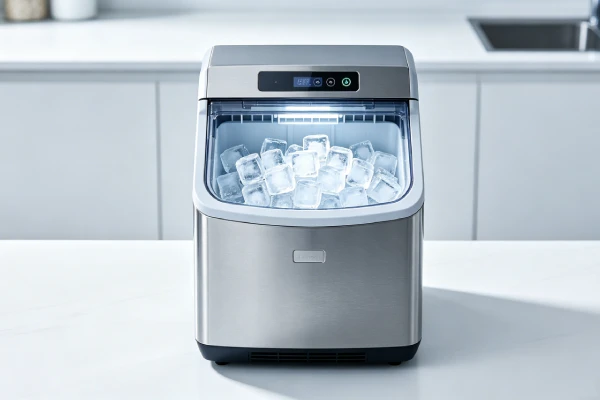
How to Get Enough Ice from a Portable Ice Maker
- Start the unit earlier than you think you need to, so several cycles run before you use the ice.
- Transfer ice to a freezer as it is produced instead of letting it sit in the basket.
- Check the manual’s vent clearance and keep the unit away from heat.
- Use the water type the manual specifies. If it does not specify one, ask the manufacturer rather than assuming distilled or tap.
- Match the machine to the need: for a large gathering, one portable unit may not be the right tool regardless of its cycle time.
- If you plan to run two units at once, check that the room, the circuit and the counter space can support both; two units do not simply double the usable output in a hot room.
Getting Ice Ready for a Gathering
- Two days before: confirm the rated daily output and your expected need, and decide whether to supplement.
- The night before: run a test hour and note how much usable ice you get, so your plan is based on your unit, not on the box.
- The morning of: start the unit early, empty the basket into freezer bags every 20 to 30 minutes, and keep the bags sealed.
- During the event: keep the machine running for refills and keep transferring to the freezer.
How Much Ice Do You Need Per Day?
Estimate your need before judging the machine:
- Count how many glasses or servings of ice you use on a typical day and on a gathering day.
- Convert that to a rough weight. As a reference, a standard bag of ice sold in a store is a useful anchor for “how much is a lot” in your area.
- Compare that figure with the rated daily output for your model, minus the melt you actually see in the basket and adjusted for the hours you run the unit.
If the rated daily output is below your gathering-day need, plan to supplement with bagged ice or a second unit, or choose a machine with a higher rated output. A fast cycle alone does not close that gap.
When to Contact Support or Consider a Different Machine
Contact the manufacturer or a qualified service technician if:
- The unit produces no ice at all, or stops producing ice during a cycle. That is an ice maker not making ice situation, not a capacity issue.
- Measured cycle time or batch size is clearly below the manual’s ratings under the stated conditions, after the checks above.
- You see a leak, unusual noise, a burning smell or damage to the cord or plug.
- The manual’s user-serviceable cleaning steps do not restore production.
Consider a different machine if the rated output, minus the melt you actually see, is consistently below your need over several typical days and on gathering days. Repeated measurements over more than one day are what “consistently” means here.
Two separate symptoms are sometimes confused with “not enough ice.” If the ice comes out wet or soft rather than too little, that is an ice maker makes slushy ice or ice maker water in basket issue, and it is handled by checking the water and cycle settings in the manual, not by buying a bigger machine. If the basket simply does not hold ice, that is an ice maker not keeping ice frozen question, covered above.
If you have decided the machine is the wrong size and you are comparing replacements, that is a buying decision rather than a repair, and an ice maker buying guide is the better place to compare rated output and basket type.
Frequently Asked Questions
How long does a portable ice maker take to make ice?
Cycle time is stated per model in the manual or specification sheet. “Ice in 6 minutes” on one model is a cycle time under stated test conditions, not a promise that a full basket appears in six minutes.
Why does my ice maker make only a few cubes at a time?
Batch size is set by the model’s design. Check the rated batch size in your manual. A short cycle with a small batch is normal for many portable units; if you need more ice per hour, the batch size and daily output matter more than the cycle time.
Why does the ice melt before the basket fills?
Many portable units use an insulated basket rather than a refrigerated bin, so ice melts over time. Transfer ice to a freezer as it is produced if you need to build a supply.
How can I make enough ice before a party?
Start the unit well ahead of time, transfer ice to a freezer as it is produced, and check the rated daily output against how much ice you expect to use. If the rated output is below your need, plan to supplement with bagged ice or a second unit.
How much ice does a portable ice maker make per day?
Daily output is rated per model under stated conditions. Check the specification sheet for your unit, subtract the melt you actually see, and compare with your own daily need.