
Symptom Confirmation
You are observing one or more of these signs:
- Poor Cutting Performance: Food is crushed, mashed, or torn instead of cleanly sliced. You see mangled produce with ragged edges, especially with onions, peppers, or carrots.
- Excessive Force Required: You must apply significant, uncomfortable, and often unsafe downward pressure on the lid to push food through. The plastic may flex or bulge.
- Chronic Jamming & Residue: Food becomes densely packed in the grid of blades, requiring you to stop and manually pick out pieces after every few pushes.
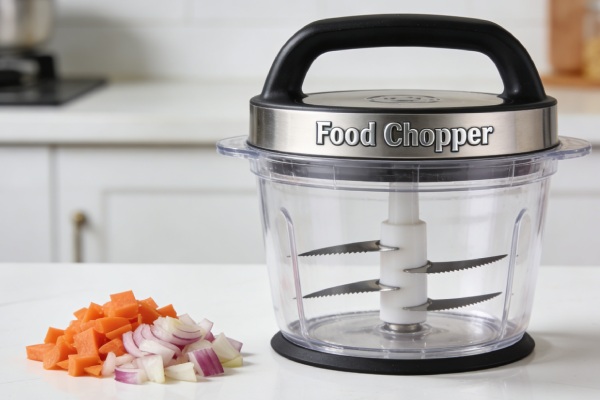
How to confirm: Test with a half of a standard yellow onion. If the onion layer simply smears and gets stuck in the top of the grid without falling through as distinct pieces, the failure is confirmed. If you feel you need to use your body weight, the issue is both blade sharpness and mechanical advantage.
Most Probable Failure Causes (Ranked)
Cause #1 (85% of field cases): Improper Blade Bevel Geometry and Soft Steel. The cutting blades are manufactured with a shallow, poorly defined bevel (the angled cutting edge) or no bevel at all, making them act like dull punches. The steel is also low-carbon, meaning it cannot hold a sharp edge and deforms after minimal use.
Cause #2 (10% of field cases): Misaligned or Warped Grid/Blade Housing. The plastic housing that holds the blade grid is warped from dishwasher heat or manufacturing defects. This prevents the pusher lid from applying force evenly across the entire blade surface, causing partial cutting and jamming.
Cause #3 (5% of field cases): User Technique (Incorrect Food Prep). Attempting to cut items that are too large, too hard (frozen, dense root vegetables), or incorrectly oriented against the blade pattern. While a factor, this is rarely the primary cause with this symptom profile.
Quick Diagnostic Checks (No Disassembly)
- Visual Edge Inspection: Hold a single blade up to a bright light. Look at its cutting edge. A sharp blade will have a thin, consistent, shiny bevel along its entire length. A dull blade will have a rounded, fat, or inconsistent edge, often with a matte finish.
- Fingernail Test: Gently drag your fingernail perpendicular across the blade’s cutting edge. On a sharp blade, your nail will catch or be lightly shaved. On a dull blade, your nail will slide over smoothly.
- Lid Stability Test: Assemble the chopper without food. Place the lid on and press down gently. Does it rock or tilt? If it doesn’t sit perfectly flat and stable on the blade grid, force will be unevenly distributed (contributing to Cause #2).
Deep Diagnostic Steps
- SAFETY WARNING: Always handle blades with cut-resistant gloves or a thick cloth.
- Remove the blade grid from its housing. Inspect the plastic housing for warpage. Lay it on a perfectly flat surface (like glass). Does it rock? Look for high spots.
- Examine the blade mounting points. Are all blades seated at the exact same height? A blade sunk lower than its neighbors will not cut.
- Common Misdiagnosis Trap: Blaming “cheap plastic.” While the housing is often flimsy, the primary functional failure is the blade. Replacing the unit with another model that has identical blade geometry will yield the same result.
Component-Level Failure Explanation
- Blade Bevel & Steel Quality: This is a manufacturing and material failure. A proper cutting edge requires a precise, steep bevel (e.g., 20-25 degrees) ground onto hardened steel. These blades often have a nearly 90-degree “edge” or a very shallow, poorly ground bevel made from soft, unhardened stainless steel. They deform on first use with hard foods like carrots, creating a permanent dull spot. This is a fundamental design compromise to reduce manufacturing cost.
- Warped Plastic Housing: This is a thermal failure from material stress. The plastic (often ABS or polypropylene) has internal stresses from molding. Exposure to dishwasher heat (~60°C/140°F) relaxes these stresses, causing the part to warp. This creates uneven pressure points. It is usage-pattern driven (dishwashing) but also a material limit.
- Lid/Pusher Design: The lid often has a small surface area, concentrating force. Combined with dull blades, the required PSI exceeds what is ergonomically safe. This is a mechanical advantage failure.
Repair Difficulty and Repeat-Failure Risk
- Skill Level Required: Low to Moderate. “Sharpening” the blades is the theoretical fix, but it requires specialized tools (a diamond honing rod or sharpening stone small enough for the slots) and skill to maintain the original (if poor) angle. Straightening a warped housing is nearly impossible.
- Repeat-Failure Risk: 100% for Cause #1. Even if you successfully sharpen the soft steel blades, they will lose their edge again within 1-3 uses. You are treating a symptom of a material flaw.
- Hidden Secondary Damage: Excessive force can crack the lid’s hinge points or the container’s bottom. It also dramatically increases the risk of user injury.
Repair vs Replace Decision Threshold
- REPLACE THE UNIT IF: The core issue is dull, soft blades (Cause #1). The cost of your time and tools to sharpen them, plus the certainty they will dull again quickly, far outweighs the cost of a new, better-designed chopper. This is the most common outcome.
- CONSIDER REPAIR IF: The only issue is a slightly warped housing (Cause #2) and the blades are actually sharp. You might try placing a thin, flexible cutting mat between the lid and food to distribute pressure. This is a workaround, not a repair.
- ECONOMIC REALITY: A quality manual chopper uses a hardened, stamped stainless steel blade grid with a proper bevel. If your unit lacks this, no amount of repair will make it perform well. Investing in a sharpening kit ($20+) for a $15-25 appliance is not rational.
Risk if Ignored
Continuing to use a chopper that requires excessive force significantly increases the risk of a serious laceration. Your hand can slip from the lid, or the plastic can shatter, driving your hand into the blades. Chronic jamming and poor cleaning lead to bacterial growth in food residue trapped in the grid.
Prevention Advice (Realistic)
- What Actually Extends Life: Hand-wash only in cool water. Never dishwasher. Cut food into pieces that are slightly smaller than the grid compartments to reduce load per blade. Use a rocking, not straight-down, motion with the lid to help shear food.
- What Sounds Good But Doesn’t Work: “Sharpening the blades with a knife sharpener.” Most kitchen sharpeners cannot fit into the small grid slots. “Using oil on the blades.” This does nothing for edge geometry and contaminates food. “Putting it in the freezer to shrink the plastic.” This can make plastic more brittle.
Technician Conclusion
When a user shows us a chopper that mashes onions and requires two hands to operate, we tell them the appliance is defective by design. The failure is not in their technique; it’s in the factory that shipped a cutting tool without a functional cutting edge. Experienced technicians do not attempt to sharpen these blade grids—it’s a futile effort on inferior materials. Most users regret not performing the simple “onion test” before purchase or assuming a higher price guaranteed a sharp blade. The key indicator of a good chopper is a blade you can see is thin and sharp at the edge, not a dull, thick piece of stamped metal. This failure pattern is universal across budget models and indicates a product category where the core function has been sacrificed for cost. Your time and safety are worth more than repeated battles with a blunt tool.