
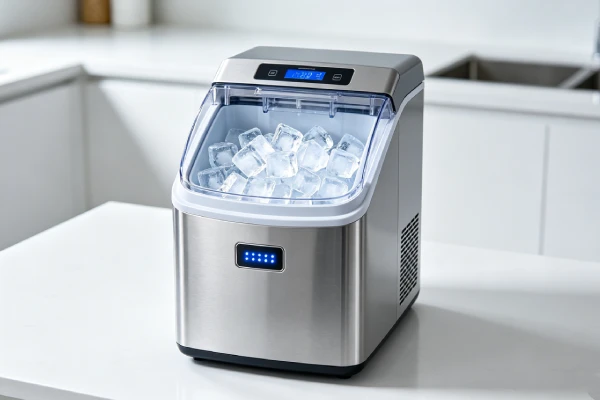
An Ice Maker Making Wet Ice is not automatically a fault, and it is not automatically caused by auto defrost. Wet ice has several common causes, and the one that applies depends on whether the ice is wet when it drops, wet after it has sat in the basket, or soft and clumped from the start.
This guide covers why ice comes out wet, how to tell a normal harvesting condition from a fault, what auto defrost actually does, how wet ice differs from soft and cloudy ice, and the checks a user can do without opening the machine.
Why Is My Ice Maker Making Wet Ice?
Moisture Left on Ice During the Harvest Cycle
Ice that has just dropped can carry surface moisture from the release process. On many models the cube is released by a brief warming of the evaporator, and the warmed surface carries a film of water when the cube drops. The amount of surface moisture depends on the harvest design and is not a sign of a fault on its own. This mechanism is the same one described under “Does Auto Defrost Cause Wet Ice?” below.
Ice Melting Inside the Storage Basket
The storage basket on a portable ice maker is not a freezer. It is an insulated bin at best. Ice that sits in the basket melts, and the meltwater coats the remaining cubes. The longer the ice stays in the basket, and the warmer the room, the wetter the ice becomes. This is the most common reason a user finds wet ice in the basket, and it is a storage condition rather than a freezing fault.
High Room Temperature
A warm room accelerates melting in the basket and can also slow the freezing cycle. The manual states the recommended ambient range for the model, and a room outside that range produces wetter ice than the same unit in a cooler room.
Water Temperature and Ice-Making Conditions
Warm water takes longer to freeze and can produce a cube that is less firm at the harvest moment. The manual states the water temperature the unit is designed for, and using water that is warmer than that produces softer cubes and more surface moisture.
Ice-Making Cycle Problems
A cycle that is too short can produce a cube that is not fully frozen when it is released. A cycle that is too long can produce a cube that is over-frozen and harder to release, which in turn produces more surface moisture during harvest. The manual states the normal cycle for the model.
Ice Maker Making Soft Ice covers the soft-cube case, and Ice Maker Ice Melts Too Fast covers the fast-melting case.
A Problem With the Ice Maker
If the ice is wet, soft, and clumped even with a cool room, cool water, a correct cycle, and a basket that is emptied promptly, the unit may have a fault. Ice Maker Not Making Ice covers the no-ice case. Ice Maker Frozen covers the freeze-over case. Both are different faults from wet ice alone.
Is Wet Ice Normal for a Portable Ice Maker?
Wet Ice Immediately After Harvesting
Surface moisture on a freshly dropped cube is normal on many models. It is the result of the harvest method, not a fault.
Ice That Gets Wet After Sitting in the Basket
Ice that starts dry and becomes wet after sitting in the basket is melting. The basket is not refrigerated, and the meltwater coats the remaining cubes. This is a storage condition.
When Wet Ice May Indicate a Problem
Wet ice may point to a fault if:
- The ice is wet, soft, and clumped even in a cool room with a promptly emptied basket.
- The ice is wet and the unit is also producing less ice than usual.
- The ice is wet and the unit shows an error indicator.
- The ice is wet and the unit runs continuously or cycles unusually often.
When two or three of these symptoms appear together, the order of checks is: room and water temperature first, then cycle time, then the error indicator. That order moves from the cheapest check to the most expensive one.
Does Auto Defrost Cause Wet Ice?
How the Ice Harvest Cycle Works
A portable ice maker releases cubes by briefly warming the evaporator, by reversing the refrigeration cycle, or by a mechanical action that lifts the cube off the mold. The method depends on the model. In all three, the cube leaves the mold with some surface moisture.
Why Ice May Have Surface Moisture After Harvesting
The surface moisture is the result of the release method. A cube released from a warmed surface carries water. A cube released mechanically carries less. The amount of surface moisture is a design characteristic, not a defect.
How to Tell Normal Harvesting From a Possible Fault
Normal harvesting produces cubes that are wet on the surface but firm inside. A possible fault produces cubes that are soft through the center, cubes that clump in the basket even when the basket is emptied promptly, or cubes that are wet and the unit also shows another symptom such as reduced output or an error indicator.
Ice Maker Making Soft Ice covers the soft-cube case separately.
Why Does My Ice Maker Make Soft or Clumped Ice?
Why Ice Cubes Stick Together
Cubes stick together when surface moisture freezes between them. This happens when wet cubes sit in a cold basket, or when cubes are stored in a freezer without being separated first. It is a storage condition, not a freezing fault.
Why Ice Cubes Feel Soft
Soft cubes come from a cycle that is too short, water that is too warm, or a freezing system that is not reaching its normal temperature. The first two are operating conditions; the third is a service item.
Why Ice Melts Quickly After Production
Ice melts quickly when the basket is warm, the room is warm, or the ice sits in the basket for a long time. It is a storage condition, not a freezing fault.
Wet Ice vs. Cloudy Ice vs. Soft Ice
- Wet ice: surface moisture on a firm cube.
- Soft ice: a cube that deforms under light pressure.
- Cloudy ice: a cube that is white or hazy inside.
The three have different causes and different checks. Why Is My Ice Cloudy covers the cloudy case.
How to Fix an Ice Maker Making Wet Ice
Empty the Ice Storage Basket
Empty the basket as soon as it fills and transfer the ice to a freezer. This is the single most effective step for reducing wet ice in the basket.
Check the Room Temperature
Confirm the room is within the range the manual states for the model. The common range in portable ice maker manuals is about 60–80°F, but the manual for your model is the authority.
Check the Water Level and Water Temperature
Confirm the reservoir is filled to the marked line and the water is at the temperature the manual recommends. Most manuals specify cool water, not warm tap water.
Check the Ice-Making Cycle
Compare the current cycle against the normal cycle stated in the manual. The batch time varies by model, so use the manual figure rather than a generic number. A cycle that is noticeably shorter or longer than the manual figure points to a control or sensor issue.
Clean the Ice Maker According to the Manual
Scale on the evaporator changes how the cube releases and how much surface moisture it carries. How to Descale Ice Maker covers the descaling steps, and Ice Maker Maintenance covers the routine care. Ice Maker Hard to Clean and Ice Maker Easy to Clean help you judge how much attention the model needs.
Check for Error Indicators
An error indicator alongside wet ice points to a fault rather than a storage condition. Ice Maker Error Codes covers the common codes.
How to Keep Ice From Getting Wet
Remove Ice From the Basket Regularly
Empty the basket as it fills. Ice that sits in the basket melts and wets the rest.
Avoid Leaving Ice in the Machine for Too Long
The basket is not a freezer. Ice left in the machine overnight will melt and refreeze into a clump.
Use the Ice Maker in Its Recommended Environment
Follow the ambient temperature range and the clearance in the manual. A unit in a hot, enclosed space produces wetter ice than the same unit in a cool, ventilated space.
Store Ice in a Freezer When Necessary
Transfer finished ice to a freezer bag or container. Ice Maker Not Keeping Ice Frozen and Ice Maker Ice Melts Too Fast cover the storage-side cases in more detail.
When Should You Contact an Ice Maker Technician?
Contact service if:
- The ice is wet, soft, and clumped even with a cool room, cool water, a correct cycle, and a promptly emptied basket.
- The unit shows an error indicator alongside the wet ice.
- The unit runs continuously or cycles unusually often.
- The unit produces no ice or produces noticeably less ice than before.
Before calling, record:
- The full model code.
- The room temperature at the time of the symptom.
- The water temperature at the time of the symptom.
- The cycle time you measured, and whether it matches the manual.
- The error indicator state, if any.
- A short description of the ice: wet on the surface, soft through the center, or clumped.
Ice Maker Not Making Ice and Ice Maker Frozen cover the two most common fault cases that produce wet ice as a secondary symptom.
Frequently Asked Questions
Why is my ice maker making wet ice?
Surface moisture after harvest, melting in the basket, a warm room, warm water, a cycle that is too short or too long, and a fault in the unit are the common causes. The location of the wetness — on the freshly dropped cube or in the basket — points to which one applies.
Is wet ice normal when it comes out of an ice maker?
Surface moisture on a freshly dropped cube is normal on many models. It is the result of the harvest method, not a fault.
Does auto defrost make ice wet?
Auto defrost releases the cube by briefly warming the evaporator, which leaves surface moisture. This is a design characteristic. It is not a fault, and it is not the only cause of wet ice.
Why does my portable ice maker make soft ice?
A cycle that is too short, water that is too warm, or a freezing system that is not reaching its normal temperature. Ice Maker Making Soft Ice covers the soft-cube case.
Why does ice melt in the ice maker basket?
The basket is not a freezer. Ice that sits in the basket melts, and the meltwater coats the remaining cubes. Emptying the basket as it fills is the fix.
Why are my ice cubes sticking together?
Surface moisture freezes between the cubes when wet cubes sit in a cold basket or are stored in a freezer without being separated first.
How do I make ice cubes harder?
Use water at the temperature the manual recommends, keep the room within the recommended range, and let the unit complete its full cycle before harvesting. Ice Maker Making Soft Ice covers the cases where these steps do not resolve the softness.
Should I replace an ice maker that makes wet ice?
Not on the basis of wet ice alone. Check the basket, the room temperature, the water temperature, the cycle, and the error indicators first. If the ice is wet, soft, and clumped even with all of those correct, the unit may have a fault and should be checked under warranty.