
A quiet ice maker for a meditation retreat must meet two requirements: produce enough ice for guests and operate without repeatedly disturbing meditation, yoga, sleep, or relaxation sessions. A machine that works well in a busy kitchen may not be suitable when placed near a quiet room.
A noise rating below 45 dB can be a useful starting point when comparing models, but it should not be treated as a universal requirement. The measurement distance, operating conditions, compressor, fan, water pump, and ice-release mechanism all affect the sound guests actually hear.
The right choice depends on more than the advertised noise level. You also need to compare daily ice production, storage capacity, ice type, cleaning requirements, installation conditions, and service availability.
This guide explains how to evaluate a quiet ice maker for retreat centers, yoga studios, wellness facilities, and other peaceful environments.
What Makes an Ice Maker Quiet Enough for a Retreat?
An ice maker does not produce just one type of sound. Its refrigeration system, fan, water pump, and ice-release mechanism can all contribute to operating noise. A machine may have a relatively quiet compressor but still produce noticeable sounds during other stages of the ice-making cycle.
Understanding Ice Maker Noise Levels and Decibel Ratings
Manufacturers generally express appliance noise using decibels (dB), sometimes with A-weighting (dBA). Both describe sound levels, but dBA applies a frequency weighting that better reflects the sensitivity of human hearing to different frequencies.
When comparing an ice maker noise level, check more than the number itself:
- Measurement unit: Is the rating expressed in dB or dBA?
- Measurement distance: Was the sound measured close to the machine or farther away?
- Operating condition: Was the ice maker producing ice, starting up, or in standby mode?
- Measurement method: Is the figure a typical operating level or a maximum reading?
- Sound sources: Does the measurement include the compressor, fan, pump, and ice dropping into the basket?
A product listing that simply says “45 dB quiet operation” without explaining these conditions provides limited information. It may help narrow down options, but it is not enough to establish that the machine is suitable for a meditation environment.
Is an Ice Maker Under 45 dB Really Quiet?
An ice maker advertised below 45 dB is worth considering, especially when low operating noise is a priority. However, there is no universal 45 dB pass-or-fail standard for meditation retreats.
A steady low hum may be less distracting than repeated clicking, rattling, or ice dropping into a hard collection basket. Room acoustics also matter. A machine placed on a hollow countertop or near a wall may sound more noticeable because the surrounding surfaces transmit or amplify vibration.
Use 45 dB as an initial comparison point, not a guarantee of silent operation. For a retreat with strict quiet hours, the most useful test is whether the machine can be heard from the actual meditation or sleeping area during a complete production cycle.
Four Sources of Ice Maker Noise
Understanding where the sound comes from makes it easier to compare quiet ice makers and identify unsuitable installation locations.
Compressor noise: The refrigeration system produces a hum while cooling. Its sound may become more noticeable when the compressor starts or changes operating state.
Fan noise: The condenser fan moves air through the cooling system. Depending on the design, it may produce a steady whirring sound or become louder when airflow is obstructed.
Water pump noise: Some machines use a pump to move water through the system. Pump startup, water circulation, and drainage can create intermittent sounds.
Ice-drop noise: Ice falling into a collection basket can produce sharp impacts. This is particularly relevant in quiet rooms because the sound may occur repeatedly even when the compressor is not especially loud.
When evaluating an ice maker making noise, consider the complete sound profile rather than judging the machine by its compressor alone.
Which Type of Ice Maker Is Best for a Meditation Retreat?
Different ice maker designs offer different combinations of production capacity, storage, installation requirements, and operating noise. No single type is automatically the quietest.
Quiet Countertop Bullet Ice Makers
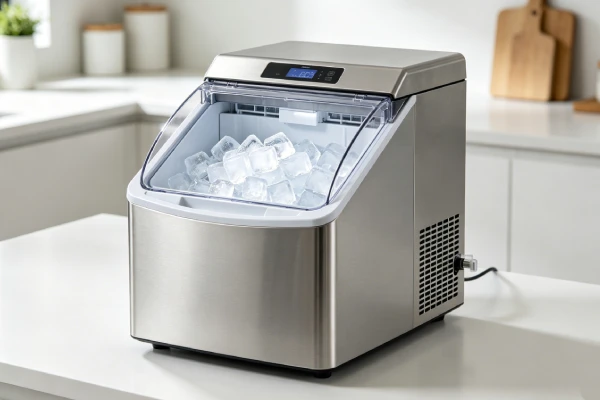
A quiet countertop ice maker is often a practical option for a small retreat with limited daily ice demand. Bullet ice makers produce small, rounded ice pieces and generally have a compact footprint.
Their main advantages are relatively simple installation, portability, and suitability for occasional drink service. However, countertop models often have limited ice storage and may need frequent water refilling or basket emptying.
Before choosing a quiet portable ice maker, check:
- Advertised daily ice production
- Ice basket capacity
- Compressor and fan noise
- Water filling and ice-release sounds
- Whether melted ice returns to the reservoir
- Cleaning, drainage, and descaling requirements
A compact machine is not automatically a quiet machine. Read the specifications and look for owner feedback that specifically discusses noise during operation.
Nugget Ice Makers and Their Operating Noise
Nugget ice makers produce small, chewable ice pieces that some guests prefer for smoothies and cold drinks. Their internal mechanisms can differ from those used in conventional bullet ice machines.
Some models use an auger or related mechanical assembly to form and move ice. Buyers should therefore consider mechanical operating sounds as well as compressor, fan, and water pump noise.
This does not mean nugget ice makers are always louder than bullet ice makers. Actual performance depends on the model, construction, installation, and operating conditions. Compare specific machines rather than assuming that one ice type is inherently quieter.
If a retreat mainly serves ordinary cold drinks, a conventional bullet ice maker may be sufficient. If guests regularly request chewable ice, a nugget model may be worth considering, provided its noise and maintenance requirements are acceptable.
Freestanding Ice Makers
Freestanding ice makers can provide more production and storage options than small countertop machines. They may be suitable for medium-sized retreats that serve guests throughout the day.
Installation requirements vary. Some models need a dedicated water supply and drain, while others require manual filling and emptying. Ventilation clearance and electrical requirements should also be checked before purchase.
A freestanding design does not automatically mean quieter operation. Review the manufacturer’s noise information and consider whether the machine can be installed away from meditation and sleeping areas.
Commercial Ice Makers for Larger Retreat Centers
A commercial ice maker may be more appropriate when a retreat regularly hosts large groups, operates a busy beverage service, or needs a dependable supply throughout the day.
Commercial equipment is generally selected for production capacity, operating demands, storage arrangements, and serviceability. These characteristics do not guarantee low noise.
Before purchasing a commercial ice maker, verify its rated daily production, storage bin capacity, operating noise, ventilation requirements, water supply, drainage, warranty, and local repair support.
For larger facilities, the best arrangement may be a commercial machine in a separate utility or service area, with ice transferred to suitable storage before guest activities begin.
How Much Ice Does a Retreat Center Need?
Choosing an ice maker based only on its advertised production capacity can lead to a poor purchase. A machine may produce enough ice over a full day but struggle when many guests need drinks at the same time.
Estimate Daily Ice Demand
Start with the number of guests and their expected ice consumption.
For example, consider a retreat with 30 guests. If each guest has two ice-containing drinks per day and each drink uses approximately 150 grams of ice:
30 guests × 2 drinks × 150 g = 9,000 g
That equals approximately 9 kg of ice per day.
This is an illustrative estimate, not a universal consumption standard. Actual demand depends on the menu, climate, drink size, guest habits, staff use, and event schedule.
For a more accurate estimate, consider:
- Maximum guest occupancy rather than average occupancy
- Expected ice use per guest
- Staff and kitchen requirements
- Additional demand during group events
- Seasonal changes in cold-drink consumption
- Whether ice is needed throughout the day or mainly during meal periods
If the retreat already operates, use actual consumption records whenever possible.
Compare Actual Production With Storage Capacity
Daily production and storage capacity are different specifications.
Daily production describes how much ice a machine can make over a stated period under specified conditions. Storage capacity describes how much ice it can hold at one time.
A countertop ice maker may advertise a relatively high daily output but have a small collection basket. If 20 guests request cold drinks within a short period, the machine may not have enough ice ready even if its advertised daily production appears sufficient.
Also, many portable ice makers do not have a freezer compartment. Their baskets are designed to collect ice temporarily, not preserve it indefinitely. Ice can melt while waiting to be used.
This is important if guests expect ice to remain frozen throughout a long service period. Consider whether a separate freezer or dedicated storage bin is needed.
Plan for Peak Demand
Do not size equipment only around a typical quiet day if the retreat regularly hosts full-capacity events.
Estimate how much ice is needed during the busiest service period. Consider whether the machine can replenish its supply quickly enough and whether the storage basket can hold enough ice between production cycles.
For some facilities, a machine with moderate production and adequate separate storage may be more practical than a larger machine operating continuously near guest areas.
Why Ice Storage Matters
Storage capacity can reduce the need to operate an ice maker during meditation or rest periods.
A practical arrangement is to produce ice before activities begin, transfer it to a suitable freezer, and serve it when required. This separates the noisy production process from guest-facing service.
Use clean, food-safe storage containers and dedicated scoops. Follow the storage equipment’s instructions to maintain appropriate frozen conditions and prevent contamination.
How to Evaluate an Ice Maker Before Buying
Product descriptions often use phrases such as “quiet,” “low noise,” and “silent operation.” These descriptions are not enough to establish whether a machine will work in a retreat environment.
Check the Manufacturer’s Noise Rating
Look for a published noise rating and the conditions under which it was measured.
A specification that identifies the measurement unit, distance, and operating state is more useful than a bare number. If the manufacturer does not provide these details, ask for clarification before treating the rating as a reliable comparison.
When reviewing owner feedback, look for specific comments about:
- Compressor hum
- Fan noise
- Water pump noise
- Ice dropping into the basket
- Vibration on countertops
- Changes in noise after extended use
General comments such as “quiet” or “a little loud” are less useful without information about the room and operating conditions.
Listen to the Full Ice-Making Cycle
If possible, listen to the machine operating rather than relying only on product specifications.
Pay attention to startup, compressor operation, water filling, ice release, and transitions between cycles. Some machines are relatively quiet for much of the cycle but produce a noticeable sound when ice drops into the basket.
If the retreat has strict quiet hours, test the machine in conditions similar to its intended location. A short demonstration may not reveal intermittent sounds that occur later in the cycle.
Check Vibration and Installation Requirements
An ice maker may sound louder when placed on an unstable countertop, hollow cabinet, or surface that resonates during operation.
Before using the machine:
- Place it on a level, stable surface.
- Check that all feet or supports sit securely.
- Avoid direct contact with walls or loose furniture.
- Follow the manufacturer’s ventilation clearances.
- Confirm that the surface can support the machine’s operating weight.
A suitable rubber mat may reduce some vibration transmitted through a countertop or floor. However, it will not eliminate internal compressor, fan, pump, or ice-drop noise. It must not make the machine unstable or block ventilation.
If an ice maker vibrating or rattling becomes noticeably louder, check its position and surroundings. Persistent unusual noise may require inspection rather than simply adding padding.
Review Cleaning and Maintenance Requirements
Low maintenance is important for a retreat with limited staff time. Before buying, check whether the machine is easy to empty, clean, drain, and descale.
Review the manufacturer’s instructions for:
- Cleaning the water reservoir and ice basket
- Descaling mineral deposits
- Cleaning accessible vents and filters
- Draining water before extended storage
- Restarting the machine after a long period of inactivity
- Replacing filters or other maintenance components
A machine that is difficult to clean may create unnecessary work and increase the risk of poor hygiene.
Use only cleaning agents approved by the manufacturer. Do not assume that vinegar, bleach, or hydrogen peroxide is suitable for every water system or internal component.
Check Reliability, Warranty, and Service Availability
The most reliable ice maker is not necessarily the one with the longest feature list. For a retreat, reliability also depends on whether the machine suits its workload and can be maintained properly.
Check the warranty period, covered components, availability of replacement parts, and local service arrangements. A retreat in a remote area should pay particular attention to repair access and the time required to obtain parts.
If equipment failure would disrupt guest services, consider keeping a backup supply of bagged ice or having an alternative storage arrangement.
Where Should You Place an Ice Maker in a Retreat?
Placement is one of the most effective ways to reduce the impact of operating noise. Even a relatively quiet ice maker may be distracting if it runs directly beside a meditation room.
Separate the Machine From Meditation Areas
Where possible, place the ice maker in a separate kitchen, utility room, or service area.
The location should remain convenient for staff and provide access to the required power, water, and drainage. Consider the distance to the beverage service area before finalizing the installation.
A separate room is often more practical than trying to make a noisy machine silent through modifications.
Maintain Proper Ventilation
Ice makers need to release heat from their refrigeration systems. Blocking the air inlet or outlet can interfere with cooling and may cause the machine to operate under unfavorable conditions.
Follow the exact clearance requirements in the product manual. Do not place the appliance inside a sealed cabinet or surround it with soundproofing material that restricts airflow.
A quiet location must still provide adequate ventilation.
Reduce Contact With Surfaces That Amplify Vibration
Place the machine on a firm, level surface. Avoid loose panels, hollow furniture, or unstable countertops that may amplify vibration.
Check whether the appliance touches a wall, cabinet, or another machine. Adjusting its position may reduce transmitted noise, but persistent mechanical rattling should be investigated.
Schedule Ice Production Outside Quiet Hours
For retreats with predictable schedules, advance ice production can be more effective than expecting a machine to run silently throughout the day.
A practical routine is to:
- Produce ice before the first meditation session.
- Transfer the ice to suitable frozen storage.
- Replenish supplies during kitchen or service hours.
- Avoid unnecessary production during quiet periods.
- Check stored quantities before group activities and meal service.
This approach can reduce disruption without requiring an unusually expensive appliance.
Portable vs. Commercial Ice Makers: Which Is Better for a Retreat?
The choice between portable and commercial equipment should reflect the retreat’s actual operating requirements.
When a Portable Ice Maker Is Enough
A portable ice maker may be sufficient for a small retreat with limited ice consumption, occasional cold drinks, and a suitable location away from quiet areas.
Its advantages include a compact footprint, relatively simple installation, and flexibility. Its limitations may include a smaller basket, frequent water refilling, and less suitability for sustained high demand.
A quiet portable ice maker is worth considering when its actual production, storage, operating noise, and cleaning requirements match the facility’s needs.
When a Commercial Ice Maker Makes More Sense
A commercial machine is worth evaluating when the retreat regularly serves many guests or needs a dependable ice supply throughout the day.
It may offer greater production capacity and a storage arrangement better suited to busy service periods. However, installation can be more demanding, and the machine may require dedicated plumbing, drainage, ventilation, and professional servicing.
Do not assume that commercial equipment is automatically quieter. Compare noise specifications separately from production capacity.
Compare Total Operating Costs
The purchase price is only one part of the decision.
Consider electricity use, water consumption, cleaning supplies, filters, maintenance labor, installation, and potential service costs. A lower-priced machine may become less practical if it requires frequent attention or cannot meet peak demand.
For a retreat, the best value is equipment that provides enough ice reliably while keeping noise and staff workload manageable.
How to Keep an Ice Maker Quiet and Reliable
Correct installation and routine care can help prevent avoidable noise and operating problems.
Keep the Machine Level
An uneven surface can contribute to vibration and rattling. Check that the appliance sits securely and that its feet or supports are correctly positioned.
If the machine becomes louder, check its position and surroundings before assuming that an internal component has failed.
Keep Air Vents Clear
Dust and obstructions can restrict airflow. Inspect accessible vents and clean them according to the manufacturer’s instructions.
Disconnect power before carrying out maintenance that requires access around moving parts. Do not remove sealed panels or attempt electrical or refrigeration repairs unless qualified to do so.
Clean and Descale the Water System
Mineral deposits can accumulate in machines that use hard water. Follow the recommended cleaning and descaling schedule and use only approved products.
Regular cleaning is particularly important when the machine is used intermittently or remains unused between retreats.
Follow the Correct Shutdown Procedure
When the retreat closes for an extended period, follow the manufacturer’s instructions for emptying, cleaning, draining, and storing the machine.
Before using it again, complete the recommended preparation and cleaning steps. Do not leave standing water in the system unless the manufacturer specifically permits it.
Frequently Asked Questions
Is 45 dB Quiet Enough for a Meditation Room?
It may be a useful starting point, but it is not a universal guarantee. Measurement distance, dB or dBA weighting, operating stage, room acoustics, and the type of sound all affect whether the machine is noticeable. Evaluate the complete ice-making cycle in conditions similar to the intended installation.
What Is the Quietest Type of Ice Maker?
There is no universally quietest type. Countertop bullet ice makers, nugget ice makers, and freestanding machines use different mechanisms and vary by model. Compare noise measurements under similar conditions instead of choosing based on ice type alone.
Are Nugget Ice Makers Louder Than Bullet Ice Makers?
Not necessarily. Some nugget ice makers use additional mechanical components that can produce operating sounds, while bullet ice makers also have compressor, fan, pump, and ice-release noise. The specific design and measured performance matter more than the category name.
Can a Countertop Ice Maker Run During Meditation?
It depends on its actual sound and the layout of the retreat. Even a machine with a relatively low noise rating may produce noticeable startup, pump, or ice-drop sounds. For strict quiet periods, producing ice in advance and storing it separately is usually a more dependable arrangement.
How Far Should an Ice Maker Be From a Meditation Room?
There is no universal minimum distance. Wall construction, doors, room layout, floor vibration, and the machine’s sound profile all affect how far noise travels. If possible, place the appliance in a separate, ventilated utility area and assess the sound from inside the meditation room.
Do Commercial Ice Makers Make Less Noise?
Not automatically. Commercial models are generally selected for production capacity, regular use, installation, and service requirements. Their noise levels vary. Check the manufacturer’s measurements and consider the installation environment before choosing one.
Can a Rubber Mat Reduce Ice Maker Noise?
A suitable mat may reduce some vibration transmitted through a countertop or floor. It will not eliminate noise generated internally by the compressor, fan, pump, or falling ice. Make sure the mat does not make the appliance unstable or interfere with ventilation.
Should I Turn Off an Ice Maker Overnight?
If the retreat does not need fresh ice overnight, switching the machine off may reduce unnecessary noise and energy use. Follow the manufacturer’s shutdown, water drainage, and restarting instructions. If ice is needed the next morning, produce it in advance and store it in a suitable freezer.
What Should I Do If My Ice Maker Gets Louder Over Time?
An ice maker getting louder may have a change in vibration, airflow, or mechanical operation. Check that it is level, has adequate ventilation, and is not touching nearby surfaces. Grinding, persistent rattling, or unusual buzzing should not automatically be dismissed as normal operating noise. Stop using the machine if there are signs of electrical damage, overheating, or other safety problems, and arrange qualified inspection when necessary.
Final Recommendation: Choose for Both Quiet Operation and Ice Demand
The best quiet ice maker for a retreat is not necessarily the smallest, largest, or most expensive model. It is the machine that meets the facility’s actual ice demand without repeatedly disturbing meditation, sleeping, or relaxation areas.
Start by checking the manufacturer’s noise rating and measurement conditions. Listen for compressor, fan, pump, and ice-drop sounds during a complete cycle. Then compare daily production, storage capacity, installation requirements, cleaning needs, warranty coverage, and local service availability.
For a small retreat, a carefully selected portable ice maker may be sufficient if it can operate away from quiet areas. For a larger center with frequent guest use, a freestanding or commercial machine may be more practical. In either case, advance ice production, separate frozen storage, and a ventilated utility location can reduce disruption more effectively than relying on a decibel figure alone.
The key is to match the machine to the retreat’s operating environment. A quiet ice maker that cannot meet peak demand is impractical, while a high-capacity machine that interrupts meditation is poorly suited to its location. Evaluate noise, production, storage, and maintenance together before making the purchase.