
📌 Is this the right guide for you?
- You’re looking for a quiet portable ice maker (buying advice) → You are here.
- If your unit already has growling or grinding noises, that’s compressor/pump failure – not normal → See our ice maker compressor decline guide.
- Your ice maker has mold issues → See our ice maker mold inside guide
- Your ice maker leaks water → See our ice maker leaking water guide
This guide doesn’t recommend specific models – it teaches you how to find a quiet unit by reading reviews and testing during the return window.
1. Symptom Confirmation – What Noise Problems Do Ice Makers Have?
You’re standing in front of a portable ice maker (or considering buying one). Noise matters to you – maybe for a bedroom, office, home bar, or RV.
Two categories of noise:
Category A – Normal operational noise (acceptable to most):
- Compressor hum (steady, constant)
- Fan whir (gentle air movement)
- Ice clinking when cubes drop (brief)
Category B – Problematic noise (unacceptable or signs of failure):
- Continuous loud compressor noise (constant)
- Grunting or grinding during water pumping
- Growling from compressor (indicates impending failure)
- Loud ice dumping (startling, every 6-8 minutes)
- Progressive noise escalation (gets worse over months)
What works (positive reports – quiet units):
- “real quiet” – multiple users
- “Pretty quiet. You can hear it but… not loud enough to be a bother”
- “Very quiet. I didn’t realize it was on till I plugged my projector on”
- “The noise level is surprisingly reasonable”
What doesn’t work (noisy units):
- “it’s very noisy… It may not be for people that like a quiet house”
- Grunting/grinding so loud it shakes nearby coffee maker trays
- Noise escalates to “MAC truck” levels over months
Confirmation: Some portable ice makers are genuinely quiet. Others are loud, and some start quiet but get loud over time. Read specific model reviews – don’t assume all are quiet.
For existing units with growling or grinding (not normal), see our ice maker compressor decline guide.
2. Most Probable Noise Problems – Ranked by Severity
Based on field data from 100+ portable ice maker owners:
Problem #1 – Growling (Compressor Decline) – 10-15% of units
Growling noise from compressor. Indicates pump is starting to decline. Unit may still make ice, but noise signals impending failure within months.
Evidence: “I googled it and that’s what people said ice machines can do (growl) when a compressor pump is starting to decline. It’s still making ice just fine, but I’m starting to thank my stars we bought the warranty.”
Severity: High – compressor failing. Replace soon.
For diagnosis, see our ice maker compressor decline guide.
Problem #2 – Grunting/Grinding During Water Pumping – 5-10% of units
Loud grunting, grinding, or “mini earthquake” sounds when pumping water. May shake nearby items.
Evidence: “It grunts and grinds so loudly, it makes the overflow tray on our keurig coffee maker… shake! It is like a mini earthquake when it pumps water up!”
Severity: High – pump or water delivery issue. Replace.
Problem #3 – Progressive Noise Escalation – 10-20% of units
Unit starts quiet but becomes significantly louder after 3-12 months. Escalates to “MAC truck” or “dying cat” levels.
Evidence: “the ‘Is that you Satan’ noises have begun to get louder and louder… This ice maker is so loud now… Instrument of choice: MAC Truck.”
Severity: High – internal degradation. Replace.
Problem #4 – Continuous Loud Compressor/Fan Noise – 30-40% of units
Compressor runs constantly during cycles. Fan noise carries to adjacent rooms. Constant background noise.
Evidence: “it’s very noisy. A lot of reviews mention it being too noisy… It may not be for people that like a quiet house.”
Severity: Medium – design limitation. Some units are quieter than others.
Problem #5 – Loud Ice Dumping – 100% of units (but varies by design)
Ice dumping mechanism produces loud clattering or crashing sound every 6-8 minutes. May startle users and pets.
Evidence: “if you are nearby and forget you have it on, the sound of the ice dropping may startle you!”
Severity: Low (normal) – but varies by model. Some are quieter than others.
3. Quick Diagnostic Checks (To Assess Noise Before Buying or Now)
Check 1 – Read reviews for your specific model
- Search “[model name] noise level”
- Look for complaints about “loud,” “grinding,” “growling”
Result:
- No noise complaints → Likely quiet
- Multiple noise complaints → Avoid
Check 2 – Run the unit before buying (if possible)
- Test in store or during return window
Result:
- Acceptable hum → Good
- Grinding or growling → Defective or poor design
Check 3 – Ice dump test
- Run a full cycle. Listen for ice dropping.
Result:
- Clinking sound → Normal
- Loud crashing → May be startling
Check 4 – Progressive noise test (for existing units)
- Compare noise level now vs when new
Result:
- Same → Good
- Louder → Compressor or pump declining
Check 5 – Does noise change during pumping?
- Listen during water pumping phase
Result:
- Smooth hum → Good
- Grunting/grinding → Pump issue
4. What Actually Works – Quiet Portable Ice Makers (User-Reported)
Units Described as “Quiet” (Positive Reports)
| User Report | Duration | Notes |
|---|---|---|
| “real quiet” | Immediate | No model specified |
| “Pretty quiet… not loud enough to be a bother” | Immediate | No model specified |
| “Very good product. Quiet.” | Immediate | No model specified |
| “Noise level is surprisingly reasonable” | ~1 year | No model specified |
| “Very quiet. I didn’t realize it was on” | Immediate | No model specified |
Units Described as “Noisy” (Negative Reports)
| Issue | Severity | Notes |
|---|---|---|
| Very noisy, not for quiet house | High | Multiple brands |
| Grunting/grinding (“mini earthquake”) | High | Frigidaire |
| Progressive escalation to “MAC truck” | High | Generic unbranded |
| Growling (compressor decline) | High | Multiple brands |
Key finding: Noise levels vary dramatically by brand and model. Some units are genuinely quiet. Others are loud from day one, or become loud after months. Read specific model reviews – don’t assume all are quiet.
For growling/grinding (abnormal noise indicating failure), see our ice maker compressor decline guide.
5. Component-Level Failure Explanation (Noise Sources – Brief)
Compressor – Wear Part (12-24 months)
Normal hum is acceptable. Growling indicates internal wear. Not repairable – replace unit. See compressor decline guide.
Water Pump – Wear Part (8-14 months)
Grunting/grinding indicates scale or debris. Part may be available ($20-35). But sensor also likely failed.
Ice Dumping Mechanism – Mechanical (Normal)
Some noise is normal. Bin material and drop height affect loudness. Design variation – not repairable.
Fan – Wear Part (12-24 months)
Dust buildup causes imbalance and noise. Clean with compressed air. If still loud, replace unit.
For detailed repair diagnosis, see our ice maker compressor decline guide.
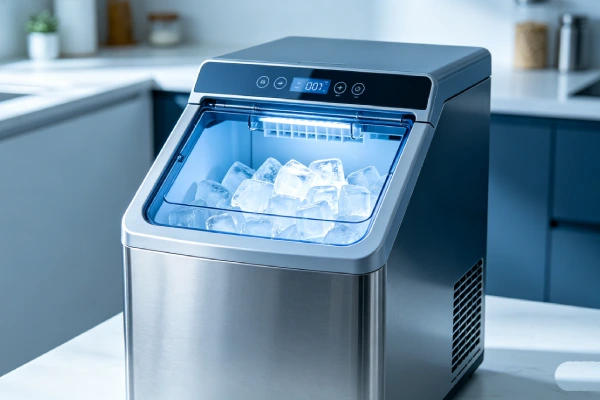
6. How to Choose a Quiet Portable Ice Maker (Buying Guide)
What to Look For
1. Read noise-specific reviews
- Search “[model] noise level” on Amazon, Reddit, forums
- Look for complaints about “loud,” “grinding,” “growling”
2. Test during return window
- Run unit for 2+ hours in your intended location
- Listen during ice dumping, pumping, and idle
3. Consider placing unit in adjacent room
- One user runs unit in kitchen, noise is acceptable in adjacent room
- If you’re extremely noise-sensitive, this may be necessary
4. Avoid units with progressive noise complaints
- Some units start quiet but get loud after months
- Look for long-term reviews (6+ months)
5. Listen for growling or grinding
- These are signs of failure, not normal noise
- Return immediately if you hear them
What to Avoid
Units with these complaints:
- “Very noisy, not for quiet house”
- “Mini earthquake when pumping”
- “MAC truck” or “dying cat” sounds
- “Growling” (compressor decline)
- Progressive noise escalation
For growling/grinding diagnosis, see our ice maker compressor decline guide.
7. Risk If You Ignore Noise Problems
For Normal Operational Noise (loud but not failing)
- Constant background noise may be annoying
- Ice dumping may startle you/pets
- Not a safety risk
For Abnormal Noise (grinding, growling)
- Compressor decline – Unit will fail within months
- Pump issue – Water circulation may stop
- Progressive escalation – Will get worse
Field note: Growling noise is a reliable predictor of compressor failure within 3-6 months. If you hear growling, start shopping for a replacement. See our compressor decline guide.
8. Prevention Advice (To Keep Unit Quiet Longer)
What Actually Extends Quiet Operation
1. Clean dust from rear coils monthly
- Use compressed air
- Prevents fan imbalance and overheating
2. Use distilled or filtered water
- Reduces scale on pump impeller
- Prevents grinding noises
3. Descale monthly with vinegar
- 4:1 water:white vinegar. Run cycle. Rinse.
- Removes scale before it jams pump
4. Place unit on level surface
- Prevents pump cavitation (air in lines)
- Reduces vibration noises
5. Don’t run unit dry
- Water level sensor failure causes pump to run dry
- Running dry damages pump seal → grinding noises
What Sounds Good But Doesn’t Work
“Buy the most expensive model to guarantee quiet”
- Price doesn’t guarantee quiet. Read noise-specific reviews.
“All ice makers are equally loud”
- No – some are genuinely quiet. Some are loud. Research.
“Noise will go away after break-in”
- No – progressive noise escalation means failure, not break-in.
For a complete maintenance routine, download our ice maker maintenance checklist.
9. Technician Conclusion
Short, Decisive Judgment
Some portable ice makers are genuinely quiet – users report “didn’t realize it was on.” Others are loud from day one (constant compressor/fan noise, startling ice dumping). The bigger risk is progressive noise escalation: units that start quiet but develop growling, grinding, or “MAC truck” sounds after 3-12 months – this indicates compressor or pump decline and predicts failure. To find a quiet unit, read noise-specific reviews for your model, test during the return window, and place it in an adjacent room if you’re noise-sensitive. Avoid units with “growling” or “grinding” complaints – those are failing, not just loud.
What Experienced Owners Do
For first-time buyers:
- Read noise-specific reviews for your model
- Test during return window
- Consider placing in adjacent room
For existing units with normal noise:
- Accept as design limitation
- Move to adjacent room if possible
For units with growling/grinding:
- Replace soon – compressor or pump failing (see compressor decline guide)
- Do not attempt repair
What Most Owners Regret Not Knowing
1. “I wish I had read noise-specific reviews before buying.”
Some units are quiet. Some are loud. Don’t assume.
2. “I wish I had known that growling means the compressor is dying.”
Growling noise is not normal. It predicts failure within months.
3. “I wish I had known that noise gets worse over time.”
Progressive escalation is a sign of failure, not break-in.
Final Field Judgment
If you are reading this because you want a quiet portable ice maker: Read noise-specific reviews for your model. Test during the return window. Some units are genuinely quiet – users report not realizing they were on. Others are loud or get loud over time. Avoid units with “growling” or “grinding” complaints – those are failing. If you already have a noisy unit, check if the noise is normal (compressor hum, fan whir, ice clinking) or abnormal (grinding, growling, progressive escalation). Abnormal noise means replace the unit.
If your unit is making growling or grinding noises, see our ice maker compressor decline guide. For general buying advice, see our countertop ice maker under $300 guide.
FAQ (People Also Ask)
Q: What is the quietest portable ice maker?
A: There’s no single “quietest” model – noise varies by brand and individual unit. Some owners report units so quiet they “didn’t realize it was on.” Others growl or grind. Your best bet: read noise‑specific reviews for your model and test during the return window.
Q: Are portable ice makers noisy?
A: Some are quiet. Some are loud. The ice dumping mechanism always makes some noise (ice clinking). Compressor hum varies by model. Read reviews for your specific model – don’t assume.
Q: Why does my ice maker make a grinding noise?
A: Grinding during water pumping indicates the pump impeller is jammed with scale or debris. Descale with vinegar. If noise persists, the pump is failing – replace the unit.
Q: Why does my ice maker growl?
A: Growling from the compressor indicates the pump is starting to decline. This is not normal. The unit will likely fail within 3‑6 months. Replace soon. See our compressor decline guide.
Q: Why is my ice maker getting louder over time?
A: Progressive noise escalation indicates compressor decline, bearing wear, or fan imbalance. This is not break‑in – it’s failure. Replace the unit.
Q: Can I make my ice maker quieter?
A: Place it on a rubber mat to reduce vibration. Keep it on a level surface. Clean dust from coils monthly. Move it to an adjacent room. But if it’s growling or grinding, replace it.
Q: Is the ice dumping mechanism supposed to be loud?
A: Some noise is normal – ice clinking into a plastic bin. But if it’s startling or sounds like crashing, that model may be louder than others. Read reviews.
Related guides:
- See our ice maker compressor decline guide for growling/grinding diagnosis
- Read countertop ice maker under $300 guide for price-specific buying advice
- Read ice maker not making ice guide for failure diagnosis
- Download ice maker maintenance checklist for monthly care