
1. Symptom confirmation
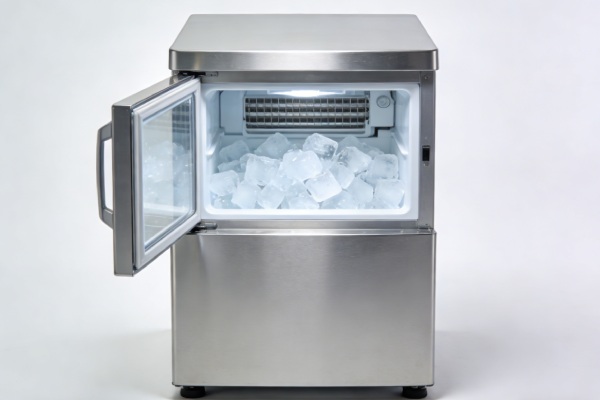
The machine runs a cycle and you hear ice drop into the basket. Upon inspection, the ice is not individual cubes or pellets. Instead, it’s a large, fused slab or several thick, connected plates that have frozen together in the basket. You cannot scoop loose ice. The mass must be broken apart with a tool (spoon handle, ice pick). The slab often has a cloudy, layered appearance, indicating water dripped and refroze on top of existing ice.
Confirm it’s this failure: This is not just “clumped” ice. True clumping occurs in the basket over hours from meltwater. This is fusion during the manufacturing process. The key test: Run a single cycle and immediately check the first ice produced. If the initial batch is already fused slabs, the failure is in the freezing mechanism, not storage.
2. Most probable failure causes (ranked)
- Cause #1 (80% of field cases): Evaporator Plate/Tray Temperature Control Failure. The thermoelectric cooling module (Peltier) or the sensor controlling it fails to cycle properly. It stays too cold for too long, allowing the entire water layer in the tray to freeze solid into a single sheet before the ejector mechanism attempts to twist and release “cubes.”
- Cause #2 (15%): Weak or Stuck Ejector Mechanism. The plastic fingers or the twisting mechanism that should push the ice free from the freezing tray is under-powered, misaligned, or binding. It only partially fractures the ice sheet, leaving it as connected plates that fall as a slab.
- Cause #3 (5%): Water Pump/Inlet Malfunction. The water pump delivers too much water per cycle, overfilling the freezing tray wells. The excess water bridges between cube divisions, creating a continuous sheet that freezes solid.
3. Quick diagnostic checks (no disassembly)
- The “First Cycle” Test: Empty the basket completely. Run one single cycle from start to ice drop. Catch the output immediately. If it’s a slab, the problem is Cause #1 or #2. If the first batch is good but later batches fuse, the problem is meltwater in the basket (a different issue).
- Listen to the Ejector Cycle: During the harvest phase, you should hear a distinct “crunch” or crackling sound as the tray twists and ice breaks free. If you only hear a smooth motor whir and a dull thud of a slab dropping, the ejector is not working (Cause #2).
- Observe the Water Fill: During the initial fill phase, watch the water inlet. A healthy machine will deliver a short, precise burst of water. If you see a prolonged stream that visibly floods the tray, suspect Cause #3.
4. Deep diagnostic steps
WARNING: Unplug the unit and drain all water before disassembly. Avoid touching the evaporator plate surface with bare skin; it can be extremely cold and cause frostbite.
- Access the Freezing Chamber: Remove the rear or top panel (varies by model) to expose the evaporator plate (the metal freezing surface) and the plastic ejector fingers.
- Manual Ejector Test: Manually rotate the ejector mechanism (often a plastic gear) through one full cycle. Feel for binding, grit, or points of high resistance. Look for cracked or warped plastic fingers.
- Check the Thermal Sensor: Locate the small sensor (usually a thermistor) attached to or near the evaporator plate. Check its wire connection for corrosion or damage. Common Misdiagnosis Trap: Users assume this is a “dirty tray” issue. Scaling can worsen it, but thorough descaling does not fix a failed temperature control cycle or a weak ejector motor.
These steps are for confirmation only, not repair.
5. Component-level failure explanation
The evaporator plate and its temperature control circuit are non-wear parts that should last. Failure is usage-pattern driven by thermal stress. The Peltier cooler undergoes massive temperature swings hundreds of times. Cheap thermal sensors drift out of calibration, causing the controller to “overshoot” the target temperature. The ejector mechanism is a wear part; its plastic gears and fingers become brittle from constant thermal cycling and can crack or deform. This is age and cycle-count related. Once the timing between “freeze” and “harvest” is off by even a few seconds, slab formation is inevitable.
6. Repair difficulty and repeat-failure risk
- Skill Level: Moderate to High. Requires disassembly to the core module, understanding of low-voltage DC circuits, and potentially sourcing proprietary control boards or Peltier units.
- Repeat-Failure Risk: Extremely High. Replacing the control board with an identical unit does not address the root cause of sensor drift or poor algorithm design. A repaired ejector mechanism will face the same thermal stress and likely fail again.
- Hidden Secondary Damage: A constantly over-freezing evaporator plate puts excessive strain on the compressor (in compressor models) or Peltier module, leading to its premature failure shortly after fixing the slab issue.
7. Repair vs replace decision threshold
Do not attempt repair if:
- The unit is out of warranty. The cost of a replacement control board or Peltier assembly is typically 60-80% of a new machine’s cost.
- The machine is over 12 months old. This symptom indicates systemic degradation; other failures (pump, fan) are likely imminent.
- You also have the metallic taste issue. This indicates material leaching, making the entire ice-making path suspect.
Repair may be justified if:
The unit is under warranty (file a claim) OR you are a technician with donor parts from an identical model. Even then, consider the labor time versus the low cost of a replacement appliance.
8. Risk if ignored
Continued use will not improve the situation. The machine will produce unusable ice, wasting water and electricity. The strain on the cooling system from improper cycles will lead to complete thermal system failure (no cooling at all). Attempting to break apart ice slabs inside the plastic basket often leads to cracks or punctures in the basket, creating leaks.
9. Prevention advice (realistic)
- What Actually Works: Nothing once it starts. This is a core design or component failure. You cannot recalibrate it through user actions.
- What Doesn’t Work: Descaling, running vinegar cycles, adjusting the size setting, or using filtered water. These address scale or taste, not the timing of the freeze/harvest cycle. Placing the unit in a colder room has minimal effect.
Failure Verdict
this is a terminal failure
not user-fixable
not maintenance-related
10. Technician conclusion
On-site, when we confirm slab formation on the first cycle, we declare the unit faulty. We do not perform board-level repairs on these because the success rate is low and the callback rate is near 100%. The most common regret we hear is, “I thought I just needed to clean it more often or use a different water filter.” This failure is mechanical/electronic, not maintenance-related. Our practical judgment: This specific symptom is a terminal diagnosis for the unit. It is not user-fixable. If in warranty, insist on a replacement (though the new unit may have the same flaw). If out of warranty, recycle it and replace with a different model from a different product line.