
Why Does My Electric Blanket Stop Heating? Quick Answer
If your electric blanket stops heating, the most common causes are heating element failure (after 3-5 years), controller malfunction (display issues or unresponsive buttons), or loose connections between the controller and blanket. Heating elements typically fail due to wire fatigue from repeated folding and use. Controllers often fail earlier, especially in budget models. Connection issues can occur at any time, often after washing or moving the blanket.
Search Intent Opening
If your electric blanket stopped heating after a few months, won’t turn on after washing, or only heats in some areas while leaving others cold, you’re facing common reliability issues with these products. Owners searching for “why does my electric blanket stop heating,” “electric blanket not working,” or “electric blanket heating element failed” are often trying to determine whether the problem is repairable or if replacement is necessary.
This guide is based on appliance repair technician reports and teardown observations from multiple electric blanket models. Heating element failure is the most common end-of-life issue, but controller problems and connection failures can occur much earlier.
Author: Appliance Repair Technician | Experience: 12 years in small appliance diagnostics
Why Does My Electric Blanket Stop Heating? 7 Common Causes
1. Heating Element Failure
The most common reason an electric blanket stops heating is failure of the internal heating wires.
- Component: Resistive heating wires embedded in the blanket
- Mechanism: Wires can break due to repeated flexing, folding, or age. Once broken, the circuit opens and that section—or the entire blanket—stops heating.
- Trigger: Frequent folding for storage, body weight and movement, washing, age (3-5 years)
- Result: Complete loss of heat or cold spots where wires have broken
What users report: “The blanket stopped working after a couple of months. Customer service sent me a new one. So far so good!!” “It worked fine for a while, but when I pulled it out after a few months, neither side worked.”
2. Controller Malfunction
The controller unit can fail, causing loss of display, unresponsive buttons, or complete loss of function.
- Component: Controller PCB, display, buttons
- Mechanism: Component failure, poor solder joints, or power surges damage the electronics
- Trigger: Normal use, power fluctuations, age (1-3 years)
- Result: Cannot adjust settings, display fails, blanket won’t turn on
What users report: “The display on the controller started to go out partially and a few weeks later, completely. I cannot see the numbers to determine the settings.”
3. Connection Issues Between Controller and Blanket
The connection point where the controller plugs into the blanket can become loose or damaged.
- Component: Connector pins, socket contacts, locking mechanism
- Mechanism: Poor contact interrupts power and signal flow; plastic locking tabs can break
- Trigger: Frequent connecting/disconnecting, washing, movement
- Result: Intermittent heating or complete failure to power on
What users report: “The power cord connection has a ‘lock’ feature to ensure it stays plugged in. Mine was so tight it would not lock in place.” “The plastic clip that locks the power cord in place is flimsy. It may break off if I unhook it.”
4. Decreased Heat Output Over Time
Some blankets gradually lose heating efficiency, becoming less warm even at maximum settings.
- Component: Heating elements, temperature regulation
- Mechanism: Wires may develop increased resistance over time; controller may not deliver full power
- Trigger: Age, wear, component degradation
- Result: Blanket feels less warm than when new, even on highest setting
What users report: “Even on the highest setting (level 10), you barely feel heat on your hand.” “The blanket doesn’t get as hot as I expected. Even on setting 10, the heat isn’t strong enough.”
5. Damage From Washing
Improper washing or inadequate drying can damage internal components.
- Component: Heating wires, insulation, connections
- Mechanism: Water damage, wire breakage from agitation, insulation degradation
- Trigger: Machine washing, improper drying, failure to follow care instructions
- Result: Blanket stops working entirely after washing
What users report: “I washed it delicately, but after washing and drying, the blanket stopped working entirely.” “I followed all the care instructions, but the heating function completely stopped after washing it.”
6. Inconsistent or Poor Heat Distribution
Some blankets develop uneven heating, with certain areas staying cold while others work normally.
- Component: Heating wires
- Mechanism: Individual wire breakage creates cold spots; wires may shift within blanket
- Trigger: Wire fatigue, folding damage, age
- Result: Uneven warmth, some sections cold
What users report: “I noticed the heat doesn’t spread evenly. Some parts of the blanket get really warm, while others stay cold.” “The blanket warms up well at first but after a while, certain parts cool down or stop heating altogether.”
7. Power Supply or Cord Issues
Problems with the power cord or connection to the wall outlet can prevent heating.
- Component: Power cord, plug, internal wiring
- Mechanism: Damaged cord, loose internal connections, faulty plug
- Trigger: Tugging, bending, pets chewing, outlet issues
- Result: No power to blanket, no heat
Why Does My Electric Blanket Stop Heating After Washing?
If your electric blanket stopped working after washing, the most likely causes are:
- Wire damage from agitation – The washing machine’s movement can break delicate heating wires
- Water damage to controller connections – Moisture in connectors
- Improper drying – Heat from dryer can damage insulation
- Folding or creasing – Sharp folds during washing can break wires
How to fix electric blanket not heating after washing:
- Ensure controller is completely dry before reconnecting
- Check for visible damage to wires or connections
- If blanket was machine dried on high heat, insulation may be damaged
- In most cases, washing damage requires blanket replacement
Prevention:
- Always disconnect controller before washing
- Use gentle cycle with cold water
- Air dry or use lowest heat setting
- Never fold sharply when wet
Why Does My Electric Blanket Only Heat on One Side?
If only one side of a dual-zone blanket stops heating:
- Swap controllers between sides
- If problem moves → controller issue (replace controller)
- If problem stays on same side → heating element failure in that zone (replace blanket)
This simple test takes 2 minutes and saves you from replacing the wrong component.
How to Fix Electric Blanket Not Heating: Step-by-Step
Step 1: Check Power at the Outlet
- Plug another device into the same outlet
- Ensure outlet is working and not on a tripped circuit
Step 2: Inspect the Controller Display
- Does the display light up?
- Can you see the numbers?
- Do buttons respond when pressed?
Step 3: Check All Connections
- Disconnect and reconnect controller from blanket
- Ensure firm click when connecting
- Check for damaged pins or broken locking tabs
Step 4: Inspect the Power Cord
- Look for cuts, kinks, or fraying
- Check where cord enters controller
- Examine plug for damage
Step 5: Feel for Heat Distribution
- Run blanket on high for 20-30 minutes
- Feel across entire surface
- Note any cold spots or uneven areas
Step 6: Test After Washing (if applicable)
- If blanket stopped working after washing, it may be damaged
- Inspect for visible damage to wires or connections
Step 7: Swap Controllers (dual-zone only)
- Swap controllers between sides
- See if problem moves or stays
Electric Blanket Heating Element Broken Fix
If your electric blanket’s heating element is broken, here’s what you need to know:
- Heating elements cannot be repaired – The wires are embedded in the blanket
- Cold spots are permanent – Once a wire breaks, that section will never heat again
- Replacement is the only option – When heating elements fail, the entire blanket needs replacement
Signs of heating element failure:
- Complete loss of heat
- Cold spots in specific areas
- Uneven heating
- Blanket works on one side only
Electric Blanket Controller Malfunction Troubleshooting
Symptoms of controller failure:
- Display doesn’t light up or is partially blank
- Buttons don’t respond
- Settings won’t change
- Blanket won’t turn on
Troubleshooting steps:
- Reset by unplugging for 10-15 minutes
- Check connections to blanket
- Test on different outlet
- If problem persists, controller likely needs replacement
Replacement options:
- Check if manufacturer sells replacement controllers ($20-50)
- Sunbeam, Beautyrest, and some other brands offer replacements
- Generic brands usually don’t have replacements available
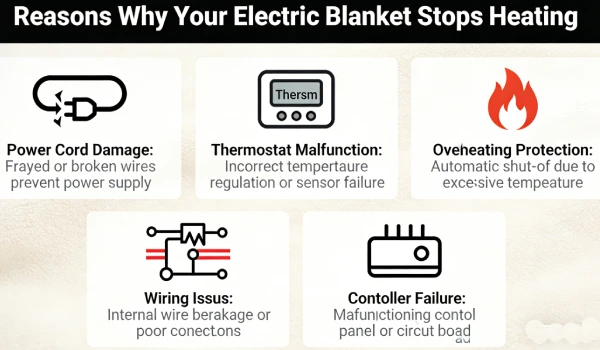
Electric Blanket Not Heating: Quick Diagnosis
| Symptom | Likely Cause | Solution |
|---|---|---|
| No heat at all, no lights | Dead controller or power issue | Check outlet; replace controller |
| No heat, but lights on | Heating element failure | Replace blanket |
| Heats in some areas, not others | Broken wires, cold spots | Replace blanket |
| Display failed, buttons work | Controller display issue | Replace controller |
| Won’t heat after washing | Water damage, wire breakage | Usually replace blanket |
| Less heat than when new | Element degradation | Replace if too cool |
| Intermittent heating | Loose connection | Check and secure connections |
| Only one side heats | Controller or element issue | Swap controllers to diagnose |
Field Verification Tests (No Tools)
Test 1: Power Test
- Plug blanket in, check for any lights on controller
- Pass: Lights illuminate
- Fail: No lights—power issue or dead controller
Test 2: Connection Test
- Disconnect and reconnect controller firmly
- Listen for click when fully seated
- Pass: Secure connection
- Fail: Loose or no click—connector issue
Test 3: Heat Distribution Test
- Run on high for 30 minutes
- Feel across entire surface
- Pass: Even warmth throughout
- Fail: Cold spots indicate wire breakage
Test 4: Controller Response Test
- Press each button, observe display changes
- Pass: All buttons work, display clear
- Fail: Unresponsive buttons, display faded
Test 5: Wash Damage Test
- If blanket stopped working after washing, inspect connectors
- Look for corrosion or moisture
- Pass: Clean, dry connections
- Fail: Corrosion indicates water damage
Test 6: Side Swap Test (dual-zone only)
- Swap controllers between sides
- Pass: Both sides work with either controller
- Fail: Problem moves with controller → controller issue; stays on same side → element issue
Real-World Usage Failure Scenarios
Scenario 1: The 3-Month Failure
- User: Nightly use
- Timeline: 3 months
- Issue: Blanket completely stopped heating
- Cause: Manufacturing defect in heating element
- Outcome: Replaced under warranty
Scenario 2: The Display Failure
- User: Occasional use
- Timeline: 1 year
- Issue: Controller display went out; buttons still work
- Cause: Display component failure
- Outcome: Living with it; considering replacement
Scenario 3: The Post-Wash Death
- User: Seasonal use
- Timeline: After first wash
- Issue: Blanket worked before wash, dead after
- Cause: Wire damage during washing
- Outcome: New blanket purchased
Scenario 4: The Uneven Heating
- User: Couple, nightly use
- Timeline: 2 years
- Issue: Cold spots developed on one side
- Cause: Heating wire breakage
- Outcome: Replaced blanket
Scenario 5: The Connection Problem
- User: Moves blanket frequently
- Timeline: 6 months
- Issue: Blanket cuts out when cord moved
- Cause: Loose connector contacts
- Outcome: Replaced controller; fixed
Scenario 6: The Diminished Heat
- User: Cold climate
- Timeline: 3 years
- Issue: Blanket no longer warm enough on high
- Cause: Heating element degradation
- Outcome: Replaced with new blanket
Common Misdiagnosis Patterns
Misdiagnosis 1: “Blanket is dead, need new one” → Connection issue
- Symptom: No heat, no lights
- Actual cause: Loose connection between controller and blanket
- Verification: Check and reseat connections
Misdiagnosis 2: “Controller is broken” → Display issue only
- Symptom: Can’t see settings, but heat works
- Actual cause: Display failed, controller still works
- Verification: Test if heat changes with button presses
Misdiagnosis 3: “Blanket is defective” → Normal wear
- Symptom: Less heat after years
- Actual cause: Normal degradation over time
- Verification: Compare to new; if older, expected
Misdiagnosis 4: “Washing ruined it” → May be preventable
- Symptom: Dead after wash
- Actual cause: Wire damage from agitation or drying
- Verification: Follow care instructions exactly
Misdiagnosis 5: “One side dead means replace whole blanket” → Could be controller
- Symptom: One side of dual-zone not heating
- Actual cause: May be that side’s controller
- Verification: Swap controllers; if problem moves, controller issue
Electric Blanket Lifespan and Reliability
| Usage Level | Expected Lifespan | Common Failure Mode |
|---|---|---|
| Light (occasional, seasonal) | 5-8 years | Age-related wire fatigue |
| Moderate (nightly, cold months) | 3-5 years | Heating element failure |
| Heavy (year-round, nightly) | 2-4 years | Controller issues, wire breakage |
What affects lifespan:
- Frequency of use
- Storage practices (folding vs rolling)
- Body weight and movement
- Washing frequency
- Quality of components
Repair vs Replace Decision Logic
Consider replacing just the controller if:
- The blanket is less than 3 years old
- The blanket itself heats evenly
- The manufacturer sells replacement controllers ($20-50)
- Only the display or buttons are faulty
Consider replacing the entire blanket if:
- Heating elements have failed (cold spots, no heat)
- Multiple issues are present
- The blanket is more than 3-5 years old
- Replacement controllers are unavailable
- Blanket was damaged during washing
- The cost of a new controller is over 60% of a new blanket
Warranty Considerations
- Most electric blankets have 1-3 year warranties
- Some premium brands offer 5-year coverage
- Keep receipts and register your product
- Contact manufacturer first for in-warranty issues
Controller Replacement Options
When Replacement Controllers Are Available
Some manufacturers sell replacement controllers separately:
- Sunbeam: Replacement controllers available for many models ($20-40)
- Biddeford: Limited availability; check model compatibility
- Beautyrest: Some models have replaceable controllers
- Generic brands: Usually not available
How to Find a Replacement Controller
- Locate your blanket’s model number (on tag or controller)
- Search online for “[brand] [model] replacement controller”
- Check manufacturer website
- Contact customer support
Compatibility Notes
- Controllers are often model-specific
- Voltage must match (US/Canada: 120V)
- Connector type must match
- Heat settings must be compatible
How to Prevent Electric Blanket Heating Failure
Proper Use
- Always lay blanket flat; never fold or bunch
- Don’t cover with heavy blankets or comforters
- Use the lowest effective heat setting
- Allow space for heat to dissipate
Storage
- Roll loosely, never fold sharply
- Store in cool, dry place
- Keep away from heavy items
Washing
- Always disconnect controller before washing
- Use gentle cycle with cold water
- Mild detergent only
- Air dry or use lowest heat setting
- Never dry clean
- Ensure completely dry before use
Regular Inspection
- Check connections before each season
- Look for visible damage to wires
- Test all settings periodically
- Replace at first sign of trouble
Technician Notes
Based on repair observations:
- Heating element failure is the most common end-of-life issue. Expect 3-5 years of regular use.
- Controller failures often happen earlier. Check if replacements are available.
- Washing damage is preventable. Follow care instructions exactly.
- Uneven heating means wire breakage. Once wires break, the blanket needs replacement.
- Diminished heat over time is normal. After 3-4 years, consider replacement.
- Connection issues are often fixable. Check and secure all connections first.
- Dual-zone blankets fail twice as often. More components, more failure points.
- If the blanket is over 5 years old and has issues, replace it. Age-related failures are inevitable.
Frequently Asked Questions
Why does my electric blanket stop heating?
The most common causes are heating element failure (after 3-5 years), controller malfunction, or loose connections. Check connections first, then test controller function.
Why does my electric blanket only heat on one side?
Swap controllers between sides. If the problem moves, the controller is bad. If it stays on the same side, the heating element in that zone has failed.
Why did my electric blanket stop working after washing?
Washing can damage heating wires through agitation or improper drying. Always disconnect controller, use gentle cycle, and air dry or use lowest heat.
Why does my electric blanket have cold spots?
Cold spots indicate broken heating wires. Once wires break, that section will never heat again. The blanket needs replacement.
Why is my electric blanket not as warm as before?
Heating elements degrade over time. After 3-4 years of regular use, reduced heat output is normal. Consider replacement.
How long do electric blankets last?
Typically 3-5 years with regular use. Heavy nightly use may reduce lifespan to 2-4 years. Controller issues can happen earlier.
Can I repair an electric blanket that stopped heating?
If the controller is the issue and replacements are available, yes. If the heating element has failed, replacement is the only option.
Why does my electric blanket display not work?
The display component in the controller may have failed. The blanket may still heat if buttons work. Replace controller if available.
How to fix electric blanket not heating after washing?
Ensure controller is completely dry, check connections, and test again. If still not working, wires were likely damaged during washing and blanket needs replacement.
Should I replace my electric blanket or just the controller?
Replace controller if blanket is less than 3 years old and heats evenly. Replace entire blanket if heating elements have failed or blanket is older.
Why does my electric blanket stop heating after a few months?
Early failure usually indicates a manufacturing defect. Contact manufacturer for warranty replacement.
Electric blanket heating element broken fix?
Heating elements cannot be repaired. Replacement is the only option.
Summary
Electric blankets stop heating for several predictable reasons:
- Heating element failure → after 3-5 years; replace blanket
- Controller malfunction → display fails, buttons unresponsive; replace controller if available
- Connection issues → loose or damaged connectors; check and secure
- Washing damage → improper care; usually replace blanket
- Decreased heat output → normal aging; replace when insufficient
- Uneven heating → broken wires; replace blanket
Quick Troubleshooting:
- Check power at outlet
- Inspect controller display and buttons
- Check all connections
- Feel for heat distribution
- If blanket stopped after washing, inspect for damage
- For dual-zone blankets, swap controllers to diagnose
Most heating element failures occur after 3-5 years of regular use. Controller issues can happen earlier. Washing damage is preventable with proper care. When heating elements fail, replacement is the only option.
Understanding these patterns helps you diagnose problems quickly and decide whether your electric blanket needs repair or replacement.
Have you experienced issues with your electric blanket? Share your experience in the comments below to help other readers identify common problems and solutions.