
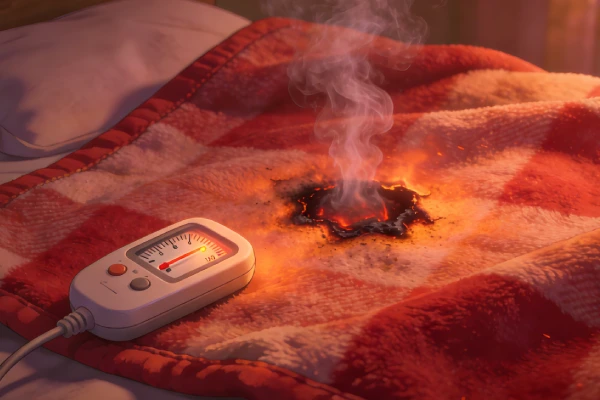
An electric blanket that becomes unusually hot, develops localized hot spots, or shows signs of scorching may have a safety problem. Possible causes include improper folding or covering, damaged heating elements, a faulty controller, or a damaged power connection.
If your electric blanket is overheating, stop using it and disconnect the power if you can do so safely. Do not turn it back on to test whether the problem has disappeared. If you notice a burning smell, melted fabric, exposed wires, or damage around the plug or connector, discontinue use and follow the manufacturer’s safety guidance.
This guide explains the warning signs to look for, common causes of overheating, and when an electric blanket should be replaced rather than used again.
Scope note: This page is a safety and decision guide, not a repair manual. It does not present repair statistics, fixed lifespans, failure-rate rankings, user testimonials, or predicted search rankings. Where a step depends on your specific model, follow the manufacturer’s instructions.
What to Do If Your Electric Blanket Is Overheating
- Stop using it and disconnect the power if you can do so safely.
- Do not switch it back on to test whether the problem has gone away. A blanket that has overheated once can overheat again.
- Check for visible damage: scorch marks, discoloration, melted fabric, exposed wires, or damage at the plug, cord, or connector.
- Let it cool completely before handling it further.
- Check whether the model appears in a recall notice. Search the CPSC recall database for your model, and check the manufacturer’s safety notice page. The CPSC has issued recalls for electric blankets and heated mattress pads whose internal heating elements can overheat, melt, or cause burns and fire in recent years.
- Follow the manufacturer’s safety guidance. If the blanket shows any of the danger signs in the table below, do not use it again.
What not to do: do not run the blanket on a low setting to “see if it still overheats”, do not feel across the surface while it is powered to find hot spots, and do not test the auto-shutoff by leaving it running. These checks require the blanket to stay energized, which is exactly what an overheating blanket should not do.
The CPSC’s consumer safety guidance on electric blankets advises against using blankets that show scorch marks, wear, exposed wires, or overheating at the power connection.
Overheating Symptoms, Risk, and Action
This table is the main reference for the rest of the page. The cause sections and the prevention section below refer back to it rather than repeating the same stop-use list.
| What you observe | What it suggests | What to do |
|---|---|---|
| Warmer than expected, but no other signs | Possibly a setting, preheat mode, or bedding issue | Check the manual’s settings and permitted bedding, and confirm the blanket is laid flat |
| Gets progressively hotter during use | Temperature regulation problem | Stop using it; do not test it by running it again |
| A localized area is clearly hotter than the rest | Damaged wire or bunched heating element | Stop using it; smoothing a bunched blanket is the only safe check, and only while unplugged |
| Burning smell, scorch marks, melted fabric, or exposed wire | Electrical or element damage | Stop using it immediately; do not repair and reuse |
| Plug, cord, or connector is unusually hot or discolored | Connection damage | Stop using it; contact the manufacturer to check for a recall or a warranty remedy |
| Auto-shutoff does not activate at the stated time | Controller fault | Stop using it; check the manual and the warranty |
| The model appears in a recall notice | Known product defect | Follow the recall instructions |
One rule covers most of the table: if the blanket is hotter than it should be, or if anything about it looks or smells wrong, stop using it.
6 Common Reasons an Electric Blanket Overheats
These are categories to help you identify what to check. They are not a ranking of how often each one occurs.
1. Folded, bunched, compressed, or improperly covered. Heat cannot dissipate when the blanket is folded, tucked under a mattress in a way the manual does not allow, covered with heavy bedding the manufacturer does not permit, or compressed by a pet or a person lying on a folded section. This is one of the most frequently reported user-side causes.
2. Damaged heating wires or internal components. Wires can be damaged by repeated folding along the same line, by washing in a way the manual does not permit, by age, or by a one-off event such as a pet chewing or a heavy object pressing on the blanket. Damaged wire can create a localized hot spot.
3. Faulty controller or temperature regulation. The controller regulates power to the blanket. If the thermostat or the control electronics fail, the blanket can keep heating past the set temperature. A blanket that gets progressively hotter during use is a regulation problem, not a comfort setting.
4. Damaged plug, cord, or blanket connector. A damaged plug, a frayed cord, or a loose or scorched connector can overheat at the connection point. This is a different risk from an overheating blanket surface, and it is visible before use.
5. Incorrect use or incompatible bedding arrangement. Using the blanket in a way the manual does not describe — under a mattress, over a waterproof mattress protector that traps heat, or with bedding the manufacturer says not to use — can cause overheating even on a blanket in good condition.
6. Product defect or safety recall. Some models have been recalled because the internal heating element can overheat. Check the CPSC recall search and the manufacturer’s safety notice page for your specific model before concluding the blanket is fine.
When to Stop Using and Replace an Electric Blanket
The stop-use signs are listed in the table above. This section explains what to do after you stop, and how to decide between replacing the controller and replacing the blanket.
A note on age: this page does not give a fixed lifespan after which a blanket becomes unsafe. A blanket that is a few years old but shows no damage and meets its manual’s requirements is not automatically unsafe, and a new blanket with a defect is not automatically safe. Condition, visible damage, and recall status are the relevant signals.
Controller replacement: some manufacturers sell replacement controllers for specific models. Whether that is an option depends on the model, the manufacturer’s parts policy, and where the fault is. A blanket that heats unevenly or develops hot spots points to the element rather than the controller, and a replacement controller will not fix it. Do not attempt to repair heating elements or wiring inside the blanket.
Warranty and recall: if the blanket is still under warranty or appears in a recall notice, contact the manufacturer before buying a replacement. A recall remedy may be a repair, a replacement, or a refund, depending on the notice.
How to Prevent Electric Blanket Overheating
Use it as the manual describes.
- Lay it flat; do not fold, bunch, or tuck it in ways the manual does not allow.
- Do not cover it with heavy bedding the manufacturer does not permit.
- Use the lowest effective heat setting.
- Follow the manual’s guidance on who should not use it.
Check it before each season.
- Look for scorch marks, wear, exposed wires, and damage at the plug and connector.
- Confirm the controller and cord are undamaged.
- Confirm the blanket lies flat and has no permanent creases along the same line.
- Check the CPSC recall search and the manufacturer’s safety notice page for your model.
Store it correctly.
- Roll it loosely rather than folding it sharply along the same line.
- Store it in a cool, dry place, away from heavy items.
Wash it only as the manual permits.
- Disconnect the controller first.
- Follow the manual’s washing instructions exactly.
- Make sure it is completely dry before use.
FAQ
Why is my electric blanket overheating?
The common causes are improper folding or covering, damaged heating wires, a faulty controller or temperature regulation, a damaged plug or connector, use that does not match the manual, or a product defect covered by a recall. Stop using the blanket and check for visible damage before deciding what to do next.
Is it normal for an electric blanket to feel very hot?
No. An electric blanket should provide gentle, consistent warmth. Unusual heat, progressive heating, or localized hot spots are reasons to stop using it, not settings to adjust around. The symptom table above shows which observations lead to which action.
Can a faulty controller be replaced?
Sometimes. Some manufacturers sell replacement controllers for specific models. Whether it is an option depends on the model and where the fault is. A blanket that heats unevenly or develops hot spots points to the element rather than the controller, and a replacement controller will not fix it. Check the manual and the manufacturer’s parts policy; do not attempt to repair the heating element.
What should I do if my blanket is under recall?
Follow the recall notice. Stop using the blanket and contact the manufacturer or the recalling agency for the remedy the notice describes. The remedy may be a repair, a replacement, or a refund, depending on the notice.
How do I find out whether my blanket has been recalled?
Search the CPSC recall database for your model number, and check the manufacturer’s safety notice page. The CPSC has issued recalls for electric blankets and heated mattress pads whose internal heating elements can overheat, melt, or cause burns and fire in recent years. Do this before each season, not only when something seems wrong.
Can an overheating electric blanket cause a fire?
Yes. Overheating can damage insulation and the heating element, which is why the CPSC has recalled blankets whose elements can overheat, melt, or cause burns. If your blanket overheats, stop using it and disconnect the power.
Related Topics
This page covers overheating, hot spots, and burn and fire risk. The guides below cover different faults, and each one keeps to its own symptom so the pages do not repeat each other.
- Why Does My Electric Blanket Stop Heating? – Causes and Fixes (blanket does not heat at all, or stops heating suddenly)
- Electric Blanket Only Heating One Side? – Causes and Fixes (one side heats, the other does not)
- Electric Blanket Burning Smell – Causes and Safety (smell without confirmed overheating)
- Electric Blanket Keeps Shutting Off – Causes and Fixes (auto-shutoff and intermittent operation)
- Electric Blanket Controller Not Working – Causes and Fixes (controller faults, including indicator behavior)
- Heated Mattress Pad Overheating – Causes and Safety