
If you open the grille or look through the intake and see the evaporator coils covered in white frost or solid ice, the unit is icing. That much is visible. What caused it is a separate question, and it is not answered by the ice alone.
Frost and ice on dehumidifier coils can come from three broad directions: operating the unit outside its designed temperature range, restricted airflow over the coils, or a fault in the defrost control or sealed refrigeration system. The first two are common and often resolved without parts. The third needs professional diagnosis. This guide helps you tell them apart safely, decide what you can check yourself, and know when to stop.
Important: This is a guide to likely causes and safe external checks, not a fault confirmation table. Visible ice pattern is a clue, not proof of a refrigerant leak or a failed sensor. Any internal testing — defrost sensor, control board, sealed system — should be done by a qualified technician with the service manual for your model.
What Does Normal Frost Look Like, and When Is It a Problem?
Not all frost is a fault. Dehumidifiers routinely form light frost on the coldest part of the coil during normal operation, and many models have a defrost cycle that clears it. The difference between frost and ice matters: frost is a light, temporary coating that the defrost cycle or a brief off-cycle can clear, while ice is a thicker, persistent buildup that keeps growing and starts blocking airflow.
| What you observe | Possible direction | Next step |
|---|---|---|
| Light frost on part of the coil, clears on its own while running within the manual’s operating range | Normal frost or normal defrost cycle | Monitor; no action unless it recurs heavily |
| Frost or ice builds steadily and does not clear | Airflow restriction, cold-room operation, or defrost fault | Check room temperature and filter first |
| Coils heavily iced, airflow reduced or stopped | Significant icing condition | Stop the unit, thaw safely, then diagnose |
| Ice returns repeatedly after thawing and cleaning | Internal defrost or refrigeration issue possible | Arrange professional diagnosis |
| Ice on coils plus ice around the fan blade | Icing has spread beyond the coil | Stop the unit and see Dehumidifier Freezing Up; check the fan only if airflow was already weak before icing started |
There is no universal “50% coverage” or “two hours of running” threshold that confirms a fault across all models. How much frost is normal depends on the model, the room conditions, and the defrost design. Use the pattern over time, not a single snapshot.
Check Room Temperature and the Manufacturer’s Operating Range
Room temperature is the first thing to check, but the specific limits vary by model.
Look up your model’s operating range. Most portable dehumidifiers are designed to run within a stated ambient temperature range, and many manuals also describe a defrost function and the conditions under which it operates. That manual figure is the reference for your unit — not a general 60°F or 65°F line applied to every machine. If you have seen a fixed temperature figure online and are about to use it as a pass/fail line, stop and check your manual instead. The same room temperature can be normal for one model and outside the designed range for another.
What low room temperature does. In a cooler space, the evaporator runs cold enough that moisture can freeze on the coil faster than the defrost cycle clears it. For some models this is expected behavior outside the designed range rather than a defect. For others, the unit may simply stop or perform poorly in the cold.
What to do:
- If the room is below the manual’s stated operating range, move the unit to a warmer space within range and let it thaw completely before judging whether a fault exists.
- If the room is within the manual’s operating range and the coils still ice heavily and repeatedly, continue to the airflow checks below.
- Do not modify the unit, add heat to the intake, or run it outside its stated range to “test” it.
Cold-room icing is common enough that it is worth ruling out first, but it should be confirmed against your manual rather than assumed. If the unit is also shutting off on its own, check whether that is a defrost pause or a separate fault — see Dehumidifier Keeps Shutting Off and Dehumidifier Freezing Up.
Restricted Airflow from a Dirty Filter or Blocked Intake
Restricted airflow is one of the most common and most fixable contributors to coil icing. When less warm room air moves across the evaporator, the coil runs colder, moisture freezes faster, and ice further blocks airflow.
What you can safely check and clean:
- Air filter. Remove it and hold it up to a light. If light barely passes through, clean or replace it per the manual. In dusty basements or homes with pets, filters may need attention every few weeks.
- Intake and exhaust clearance. Keep the clearance stated in the manual — commonly around 12 inches — on all sides. Curtains, boxes, and corner placement restrict airflow.
- Visible dust on the intake grille. Vacuum or wipe the user-accessible grille. Do not reach into the cabinet or bend the coil fins.
What you should not do: Do not spray cleaners into the unit, do not use compressed air on the fan, and do not attempt to clean the coil fins beyond what the manual permits. If the coils are visibly coated in dust and the manual does not describe user cleaning, that is a service task.
If airflow is restored and the unit stops icing within its operating range, airflow was the cause. If heavy icing returns after the filter and intake are clean, continue below.
Could a Fan Problem Be Causing the Coils to Freeze?
Yes — a fan that is not moving enough air can contribute to coil icing, because reduced airflow over the evaporator has the same effect as a clogged filter.
But a fan fault is a separate diagnostic path, and this guide does not cover motor, starting-component, or control board testing. If your main symptom is that the unit runs but produces little or no airflow, that is the fan question, not the coil question. See Dehumidifier Fan Not Working, Dehumidifier Fan Not Spinning But Humming, and Dehumidifier Fan Running but No Water for the fan-specific checks. A unit that moves air normally but removes no moisture is a different path again — see Dehumidifier Not Collecting Water and Dehumidifier Running but No Water.
If airflow seems normal and the coils still ice heavily within the operating range, the fan is unlikely to be the main cause — move on to the defrost and refrigeration question.
When Could a Defrost Control or Refrigeration Problem Be Involved?
If the room is within the manual’s operating range, the filter and intake are clean, and the coils still ice heavily or repeatedly, the cause may be internal.
Defrost control side. The unit relies on a temperature sensor and control logic to initiate defrost. If the sensor does not detect ice buildup, or the control board does not cycle the compressor into defrost, ice can accumulate. A technician may check the defrost sensor, its wiring, and the control board behavior — using the service manual for your specific model, as these checks vary by unit. Repeated icing reported as Dehumidifier Coils Freezing, Dehumidifier Coils Freezing Up, or Dehumidifier Freezes Up often ends up here once airflow is ruled out.
Refrigeration side. A sealed-system fault can change the icing pattern — for example, ice concentrated in one area of the coil rather than evenly. But ice pattern alone does not confirm a refrigerant leak. Localized icing can have other causes, and confirming a sealed-system problem requires gauges, leak detection, and model-specific specifications.
What this means for you: Repeated heavy icing within the operating range, after airflow is ruled out, is a reason to arrange professional diagnosis — not a reason to order a sensor or assume a leak. Units that also shut down, beep, or show a code alongside the icing should have that code checked first; see Dehumidifier Error Codes, GE Dehumidifier Error Codes, Hisense Dehumidifier Error Codes, and Midea Dehumidifier Error Codes. If the unit is visibly leaking water while iced, address the moisture and check Dehumidifier Leaking Water and Dehumidifier Leaking Water from Bottom before diagnosing further.
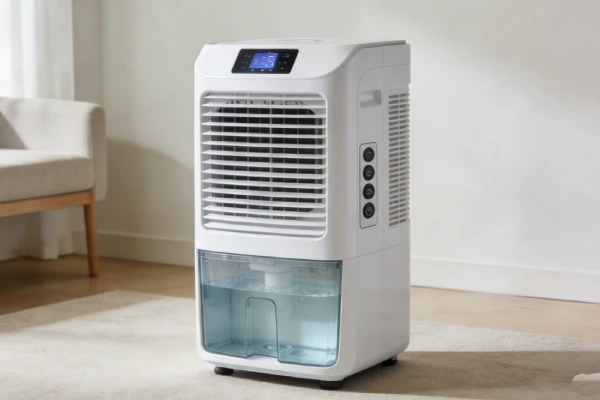
What to Do When the Coils Are Frozen
- Turn the unit off and unplug it. Keep it unplugged throughout the thaw.
- Let the ice melt completely. Follow the manual for the allowed method — most manufacturers advise passive thawing in a warm room, and heavy ice may take many hours or overnight.
- Do not chip, scrape, or pry ice off the coils or fan. The aluminum fins bend and crush easily, and damage is permanent.
- Do not use a hair dryer, heat gun, or any other heater to speed thawing. Concentrated heat can damage the coils, wiring, and plastic housing.
- Do not restart the unit repeatedly while ice is present. Repeated start attempts with a blocked fan or iced coil stress the motor and compressor.
- Dry the interior before plugging back in, and check for water that has dripped onto electronics or the floor.
- Fix the environment or airflow first — move the unit within its operating range, clean the filter, restore clearance — before running it again.
If water has leaked onto the floor or into the cabinet, stop and address the moisture before powering the unit. See Dehumidifier Leaking Water and Dehumidifier Leaking Water from Bottom.
When to Repair or Replace a Dehumidifier with Recurring Ice
There is no fixed age or cost line that applies to every unit. Decide using confirmed facts.
| Factor | What to check | How it affects the decision |
|---|---|---|
| Cause | Has the icing cause been confirmed — environment, airflow, defrost, or sealed system? | Do not replace parts on an unconfirmed cause |
| Operating range | Is the unit being run within the manual’s stated range? | Icing outside the range may not be a defect |
| Warranty | Is the unit covered, and is this failure included? If a sealed-system fault is suspected, check whether the warranty covers it before pricing a repair | A covered repair changes the math, including on sealed-system work |
| Part availability | Are the defrost sensor or board available for your model? | No part means replacement is the only path |
| Repair quote | Total parts and labor for the confirmed fault | Compare against a comparable new unit |
| Sealed system | Does a technician confirm a refrigeration fault? | Sealed-system work needs specialized equipment and qualified labor; weigh the quote against replacement and warranty coverage |
| Unit condition | Rust, leaks, fin damage, or prior repairs? | A unit with other problems is a poor repair candidate |
A cheap sensor or board replacement on a unit in good condition and within warranty may be reasonable. A sealed-system repair on an older budget unit usually is not, but confirm the quote and warranty position before deciding. Repair costs vary by brand — GE Dehumidifier Repair Cost, Frigidaire Dehumidifier Repair Cost, Midea Dehumidifier Repair, Hisense Dehumidifier Repair, Haier Dehumidifier Repair Cost, Whirlpool Dehumidifier Repair Cost, and Black+Decker Dehumidifier Repair Cost all differ, and Dehumidifier Repair Cost vs Replacement is worth comparing before committing.
Risk If Ignored
Repeated icing that is not addressed can affect the unit and the room:
- Airflow loss. Ice blocks the coil and can spread to the fan area, reducing or stopping airflow. See Dehumidifier Fan Not Working and Dehumidifier Making Loud Noise if ice is scraping the blade.
- Fan and motor stress. If ice spreads to the fan area, a fan running against ice can overheat or be damaged.
- Water and moisture. Melted ice can drip onto electronics or flooring; see Dehumidifier Leaking Water.
- Reduced performance. Heavy icing stops moisture removal; a unit that runs but collects no water should be checked — see Dehumidifier Not Collecting Water and Dehumidifier Running but No Water.
Stop using the unit if ice keeps returning, if you hear scraping or abnormal noise, if the unit trips a breaker or GFCI (see Dehumidifier Trips Breaker and Dehumidifier Trips GFCI), or if you smell burning (see Dehumidifier Smells Like Burning and Dehumidifier Burning Smell). Unplug it and arrange service.
Prevention Advice That Actually Works
| Action | Frequency | Why it helps |
|---|---|---|
| Run the unit within the manual’s operating range | Always | Icing outside the designed range is expected |
| Clean the air filter per manual | Every few weeks in dusty spaces | Restores airflow, a common icing contributor |
| Keep the manual’s clearance on all sides | Always | Prevents intake and exhaust restriction |
| Let the unit thaw fully after heavy icing, keeping it unplugged during the thaw | As needed | Prevents ice from spreading to the fan and avoids stressing the unit mid-thaw |
| Check the unit level | Always | Helps normal drainage and operation |
Advice that sounds good but does not work:
| Bad advice | Why it doesn’t work |
|---|---|
| “Run it in a cold basement anyway — auto-defrost will handle it” | Auto-defrost clears light frost; it may not keep up with heavy icing outside the operating range |
| “Set humidity higher to prevent icing” | The humidity setpoint does not change coil temperature |
| “Add a heater to the intake” | Creates fire and shock hazards; never modify the unit |
| “Chip the ice off” | Bends and crushes the aluminum fins permanently |
| “Use a hair dryer to thaw it faster” | Concentrated heat can damage coils, wiring, and plastic |
FAQ
Why are my dehumidifier coils freezing up?
The common contributors are operating the unit below its designed temperature range, restricted airflow from a dirty filter or blocked intake, and internal defrost or refrigeration faults. Check the manual’s operating range and clean the filter first.
Is it normal for a dehumidifier to ice up in a cold basement?
It can be, depending on the model and whether the room is outside its stated operating range. Check your manual’s minimum operating temperature and defrost description. If the unit ices heavily within its stated range, that is a reason to investigate airflow and internal causes.
How do I safely get rid of ice on the coils?
Turn the unit off, unplug it, and let the ice melt completely using the method your manual permits — usually passive thawing in a warm room. Do not chip or scrape the coils, do not use a heater, and do not restart the unit while ice is present.
How do I fix a dehumidifier that keeps freezing up?
Confirm the unit is being run within its operating range, clean the filter and intake, and restore clearance. If heavy icing returns within range after airflow is clean, arrange professional diagnosis of the defrost sensor, control board, or sealed system before replacing parts.
Is it worth fixing a dehumidifier with recurring ice buildup?
It depends on the confirmed cause, warranty (including sealed-system coverage), part availability, the repair quote, and the price of a comparable new unit. A sensor or board repair on a covered or newer unit may be worthwhile; a sealed-system repair on an older budget unit usually is not. Confirm the diagnosis and quote first.
Related Topics
- Dehumidifier Fan Not Working – Causes and Safe Checks
- Dehumidifier Freezing Up – Causes and Fixes
- Dehumidifier Coils Freezing – Causes and Fixes
- Dehumidifier Freezes Up – Causes and Fixes
- Dehumidifier Not Collecting Water – Causes and Fixes
- Dehumidifier Running but No Water – Causes and Fixes
- Dehumidifier Leaking Water – Causes and Fixes
- Dehumidifier Keeps Shutting Off – Troubleshooting Guide
- Dehumidifier Error Codes – Meaning and Fixes
- Dehumidifier Repair Cost vs Replacement