
📖 How to Read Countertop Ice Maker Reviews Like a Pro
Step 1: Go to 1-star and 2-star reviews first
Most people read 5-star reviews. The truth is in the 1-star reviews.
Step 2: Search for these keywords
| Keyword | What It Means | Severity |
|---|---|---|
| “died” / “stopped working” | Compressor failure | 🔴 High |
| “add water light” | Sensor failure | 🟡 Medium |
| “leak” / “leaking” | Seal or line failure | 🟡 Medium |
| “metal” / “plastic” in ice | Health hazard | 🔴 DANGER |
| “noise” / “loud” / “grinding” | Compressor failing | 🟡 Medium |
| “rust” | Material corrosion | 🟡 Medium |
| “mold” / “black” | Water retention design flaw | 🟡 Medium |
| “wet ice” / “melts fast” | Design limitation | 🟢 Low |
| “sensor” | Water level sensor failure | 🟡 Medium |
| “full light” | Ice full sensor failure | 🟡 Medium |
Step 3: Look for patterns
- One 1-star review = possible bad luck
- Multiple 1-star reviews with same problem = design flaw
- Recent reviews with same problem = still not fixed
Step 4: Check the date of negative reviews
- All negative reviews from 2022 but positive from 2024? Maybe fixed
- Negative reviews from last month? Still broken
How This Guide Is Different
| Guide | Focus | Best For |
|---|---|---|
| Portable Ice Maker Problems | Technical failure modes (what breaks) | You already own a broken ice maker |
| This guide (Reviews Analysis) | What to look for in user reviews | You’re reading reviews before buying |
Read Portable Ice Maker Problems if: You already own a broken ice maker and want to diagnose it.
Read this guide if: You’re reading Amazon reviews and want to know what red flags to look for.
🔧 The 10-Second Test – What Reviews Won’t Tell You
Once you buy the unit, run this test within the return window:
Run the ice maker for 20 minutes. Open the lid. Touch the metal freezing rods.
| What You Feel | Diagnosis | Action |
|---|---|---|
| ❄️ Cold / frosty | Refrigeration works | Keep it |
| 🔥 Room temperature | Compressor failed | Return immediately |
Reviews won’t tell you if YOUR unit works. You must test it yourself.
The 10 Red Flags to Look For in Countertop Ice Maker Reviews
| # | Red Flag | Severity | What to Search For |
|---|---|---|---|
| 1 | Compressor dies in 3-6 months | 🔴 High | “died”, “stopped working”, “lasted 3 months” |
| 2 | Sensor failure (add water light) | 🟡 Medium | “add water light on when full”, “sensor” |
| 3 | Water leakage | 🟡 Medium | “leak”, “leaking”, “water on counter” |
| 4 | Progressive noise → failure | 🟡 Medium | “loud”, “grinding”, “growling”, “dying cat” |
| 5 | Metal or plastic in ice | 🔴 DANGER | “metal”, “plastic”, “shavings”, “pieces” |
| 6 | Rust / corrosion | 🟡 Medium | “rust”, “rusting”, “corrosion” |
| 7 | Inaccessible condenser coils | 🟢 Low | “dust”, “overheating”, “can’t clean” |
| 8 | Wet ice / rapid melting | 🟢 Low (design) | “wet ice”, “melts fast”, “clumps” |
| 9 | Mold/biofilm growth | 🟡 Medium | “mold”, “black”, “gunk”, “film” |
| 10 | Poor accessory quality | 🟢 Low | “scoop broke”, “cheap scoop” |
🔴 = Deal breaker / 🟡 = Major inconvenience / 🟢 = Minor annoyance
⚠️ DANGER – Metal or Plastic in Ice (Health Hazard)
If you see reviews mentioning metal fragments or black plastic in ice:
- Do NOT buy this brand/model
- This is a serious health hazard
- Internal components are breaking apart
Real user warning: “I’ve been finding little pieces of metal at the bottom where the water goes into the reservoir… me, my husband and my kids have possibly been ingesting little pieces of metal.”
Real user warning: “I found black plastic in my ice… it has broke.”
If you already own a unit with this problem: Stop using immediately. Replace the unit. Do not consume any ice.
Red Flag #1: Compressor Dies in 3-6 Months (Most Common)
What to search for in reviews: “died”, “stopped working”, “lasted 3 months”, “dead after 4 months”, “won’t make ice”
Real user warning: *”Dead machine 26 hours later after receiving it! I pushed the On/Off button several times and….nothing.”*
Real user warning: “Water pumps through, sounds like it is making ice, but when the tray drops, there is only tiny fragments of ice. This one lasted barely 5 months.”
What this means: The sealed refrigeration system failed. Compressor or refrigerant leak. Not repairable.
How to spot in reviews: Multiple reviews saying “died after X months” – if you see this pattern, avoid.
Red Flag #2: Sensor Failure (Add Water Light)
What to search for in reviews: “add water light on when full”, “sensor”, “water light stuck”, “thinks it’s empty”
Real user warning: “After only a few months the sensor stopped working that tells you to add more water and it just keeps running even with no water in it.”
Real user warning: “It was perpetually stuck on the ‘it’s full’ when it was most certainly not even making ice.”
What this means: Water level sensor or ice full sensor failed. Poor quality control.
How to spot in reviews: Multiple “sensor” complaints = avoid.
Red Flag #3: Water Leakage
What to search for in reviews: “leak”, “leaking”, “water on counter”, “dripping”
Real user warning: “Eight days after purchase and a problem arose. The unit is dripping water all over the counter while filling.”
What this means: Poor quality seals, cracked water lines, or cracked tank. Manufacturing defect.
How to spot in reviews: Any leak reports within first month = avoid.
Red Flag #4: Progressive Noise Deterioration
What to search for in reviews: “loud”, “grinding”, “growling”, “dying cat”, “noise getting worse”
Real user warning: “The ‘Is that you Satan’ noises have begun to get louder and louder. And now occasionally it growls at me. Yes Growls. That’s what ice machines can do (growl) when a compressor pump is starting to decline.”
Real user warning: “It started sounding like a very loud dying cat and quit working 3 months after I bought it.”
What this means: Compressor or pump bearings wearing out. Failure is imminent.
How to spot in reviews: Multiple “noise” complaints that mention it getting worse = avoid.
Red Flag #5: Metal or Plastic in Ice (DANGER)
What to search for in reviews: “metal”, “plastic”, “shavings”, “pieces”, “chunks”
Real user warning: “I’ve been finding little pieces of metal at the bottom… me, my husband and my kids have possibly been ingesting little pieces of metal.”
Real user warning: “After further investigation by chewing on more ice I found black plastic in my ice… it has broke.”
What this means: Internal components breaking apart. Health hazard.
How to spot in reviews: Any mention of metal or plastic in ice = avoid immediately. This is a deal breaker.
Red Flag #6: Premature Rust / Corrosion
What to search for in reviews: “rust”, “rusting”, “corrosion”, “rust spots”
Real user warning: “By August, I noticed it started to rust, but it still worked. And finally, at the end of November, it stopped working.”
What this means: Poor material quality (cheap metal, inadequate coating). Unit will fail soon.
How to spot in reviews: Multiple “rust” complaints within first year = avoid.
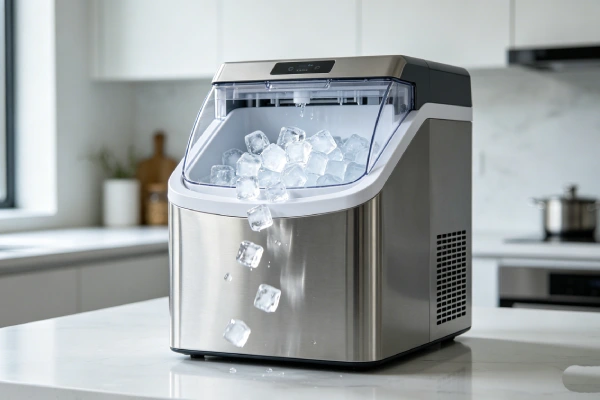
Red Flag #7: Inaccessible Condenser Coils (Design Flaw)
What to search for in reviews: “dust”, “overheating”, “can’t clean”, “coils caked with dust”
Real user warning: *”After 18 months, it started to heat up and not produce as much ice. I saw that the coils was caked with dust – and it’s not easily serviceable. I damaged one of the fan blades in the process. Now it’s non functional.”*
What this means: Design flaw – coils cannot be cleaned without disassembly. Unit will overheat and fail.
How to spot in reviews: Multiple complaints about dust buildup and overheating = avoid.
Red Flag #8: Wet Ice / Rapid Melting (Design Limitation)
What to search for in reviews: “wet ice”, “melts fast”, “clumps”, “concretes”
Real user warning: “The Ice Cube comes out very very wet and not very frozen like a normal Ice Cube! Using the ice cubes will result in any drink being diluted because it melts very fast!”
What this means: This is normal for countertop ice makers – not a defect. But if you want hard ice, this isn’t for you.
How to spot in reviews: This is a design limitation. If you see many “wet ice” complaints, it’s likely normal for that model.
Red Flag #9: Mold/Biofilm Growth
What to search for in reviews: “mold”, “black”, “gunk”, “film”, “slime”
Real user warning: “If I leave any trace of water in this unit overnight, when I fill the reservoir with water I get black floating gunk/film emerge from the tube that sucks the water up into the unit.”
What this means: Design flaw – water pools in tubing, promoting mold growth. Deep cleaning may help temporarily.
How to spot in reviews: Multiple “mold” complaints that cleaning doesn’t fix = avoid.
Red Flag #10: Poor Accessory Quality (Minor)
What to search for in reviews: “scoop broke”, “cheap scoop”, “tray warped”
Real user warning: “The ice scoop sucks. I bought a metal one… The scoop that comes with the machine barely gets any ice.”
What this means: Cost-cutting on accessories. Not a deal breaker – you can buy a metal scoop for $5-10.
How to spot in reviews: Minor issue. Don’t avoid a unit just for this.
How to Read Review Dates – Critical Skill
Check when negative reviews were written:
- All negative reviews from 2022 but positive from 2024? Maybe fixed
- Negative reviews from last month? Still broken
Real example: A brand may have had quality issues in 2022, fixed them in 2023. Recent positive reviews mean more than old negative ones.
How to check: On Amazon, sort reviews by “Most recent” – not “Top reviews.”
Real Review Analysis Examples
Example 1: Compressor failure pattern
Searching for “died” in 1-star reviews shows 15 people saying their unit died within 6 months. This is a pattern. Avoid.
Example 2: Metal in ice pattern
Searching for “metal” shows 8 people finding metal fragments. DANGER. Avoid immediately.
Example 3: Isolated leak
Only 2 people mention leaks out of 1,000 reviews. Could be bad luck. Might still be safe to buy.
What to Look For Instead – Summary
Good signs in reviews:
- Consistent 4+ star rating over multiple years
- Few 1-star reviews (less than 5% of total)
- Recent positive reviews
- Complaints are about minor issues (scoop, not performance)
- Brand responds to negative reviews professionally
Bad signs in reviews:
- Multiple “died in 3-6 months” reports
- Any “metal in ice” reports (DANGER)
- Pattern of same failure over time (not fixed)
- Recent negative reviews (still broken)
- Brand doesn’t respond or blames customer
Prevention – How to Avoid Buying a Bad Ice Maker
- Read 1-star and 2-star reviews first – This is where real problems surface
- Search for keywords – “died”, “leak”, “sensor”, “metal”, “plastic”, “rust”, “mold”
- Check review dates – Recent negative reviews mean still broken
- Look for patterns – One bad review is luck; ten is a design flaw
- Test within return window – Don’t store it in the box
- Use distilled water – Reduces mineral deposits on sensors
- Buy from retailer with easy returns – Costco, Amazon, Best Buy
FAQ
What is the most common problem in countertop ice maker reviews?
Compressor failure (dies in 3-6 months). Search 1-star reviews for “died” or “stopped working.” If you see this pattern, avoid that brand.
Are metal fragments in ice a common complaint?
Less common (5% of failures) but extremely serious. Any mention of metal or plastic in ice is a health hazard. Avoid that brand immediately.
How can I tell if a countertop ice maker is reliable from reviews?
Look for patterns. One 1-star review is bad luck. Ten 1-star reviews saying the same thing is a design flaw. Also check review dates – recent negative reviews mean still broken.
What should I search for in ice maker reviews?
Search for: “died”, “leak”, “sensor”, “metal”, “plastic”, “rust”, “mold”, “noise”, “add water light”. These keywords reveal the most common failures.
Should I trust 5-star reviews?
Read them, but be skeptical. Many 5-star reviews are written within days of purchase. The real problems show up in 1-star reviews from people who owned the unit for months.
How long should a countertop ice maker last?
Field data shows 6-12 months is typical. If you see reviews saying units last 2-3 years, that’s actually good for this product category.
What’s the best way to test an ice maker during return window?
Run it for 24 hours. Check if freezing rods get cold. Make multiple batches. Listen for unusual noises. Check for leaks. If anything fails, return it.
Final Verdict
Should You Buy a Countertop Ice Maker?
Buy if: You understand the limitations (short lifespan, wet ice, potential failures). You read 1-star reviews first. You test during return window. You buy from a retailer with easy returns.
Avoid if: You see patterns of compressor failure in 1-star reviews. You see ANY reports of metal or plastic in ice. You need a reliable appliance that lasts years.
Bottom line: Read 1-star reviews first. Search for “died,” “leak,” “sensor,” “metal,” “plastic.” If you see a pattern of compressor failure, avoid. If you see ANY metal or plastic in ice, avoid immediately – health hazard. Test your unit within the return window. Use distilled water. Don’t leave water overnight. Accept that countertop ice makers are disposable appliances – most fail within 6-12 months.
Related Appliance Failure Reports
- Portable Ice Maker Problems – Complete Failure Modes
- Ice Maker Not Making Ice – Quick Diagnosis Guide
- Dehumidifier Not Collecting Water – Causes & Fix
- Dehumidifier Leaking Water – Causes & Fix
- Dehumidifier Making Loud Noise – Causes & Fix