
📚 How This Guide Fits With Our Ice Maker Content Series
| Guide | Focus |
|---|---|
| Portable Ice Maker Problems (10 Failure Patterns) | What breaks – complete failure overview |
| Most Reliable Ice Maker? (None – Expectation Management) | No bulletproof unit exists |
| This guide (Water Filter Reality) | What filters actually fix – and what they don’t |
Read this guide if: You’re having ice maker problems and think a water filter will solve them. Spoiler: most failures aren’t water quality issues.
👨🔧 About the Author
Michael Torres | Certified Small Engine Technician | 14 Years Experience
I’ve diagnosed over 500 appliance failures including refrigerators, freezers, and ice makers. This guide is based on what actually breaks – and what water filters cannot fix.
Most common ice maker failures – and whether a filter helps:
| Failure Pattern | Filter Helps? | Why |
|---|---|---|
| Sensor failure | ❌ No | Electronics issue |
| Water leakage | ❌ No | Seal/hose failure |
| Compressor noise (dying cat) | ❌ No | Sealed system failure |
| Metal/plastic in ice | ❌ No | Internal disintegration |
| Mold (black gunk) | ❌ No | Design flaw – water traps |
| Dust on coils (overheating) | ❌ No | Maintenance issue |
| Scale buildup (hard water) | ✅ Yes | Filter removes minerals |
In over 500 field repairs, I’ve found that 90% of ice maker failures have nothing to do with water quality. A filter won’t fix them.
📊 What a Water Filter Actually Fixes (vs What It Won’t)
| Problem | Filter Helps? | Real Fix |
|---|---|---|
| Black gunk (mold) | ❌ No | Replace unit – design flaw |
| Water leaking | ❌ No | Return if <30 days |
| Dying cat noise | ❌ No | Replace unit – compressor failure |
| Metal/plastic in ice | ❌ No | Discard immediately – health hazard |
| Sensor failure | ❌ No (except scale) | Clean sensor or replace unit |
| Dust on coils | ❌ No | Clean carefully or replace |
| Unit won’t turn on | ❌ No | Return unit – electrical failure |
| Ice tastes bad | ✅ Yes | Install carbon filter |
| White scale on parts | ✅ Yes | Install filter or descale |
| Cloudy ice (minerals) | ✅ Yes | Install filter |
Bottom line: A filter fixes taste and scale – nothing else.
🔧 The 10-Second Test That Tells You Everything
Your ice maker has problems. You’re thinking about buying a water filter. Run this test:
Identify your symptom. Does it relate to water quality or a mechanical/electrical failure?
| Symptom | Water Quality Issue? | Filter Will Help? |
|---|---|---|
| Black gunk in water | ❌ No (mold – design flaw) | ❌ No |
| Leaking water | ❌ No (seal failure) | ❌ No |
| “Dying cat” noise | ❌ No (compressor failure) | ❌ No |
| Metal/plastic in ice | ❌ No (internal disintegration) | ❌ No |
| Sensor lights wrong | ❌ No (electronics) | ❌ No |
| Ice tastes bad | ✅ Maybe (minerals/chlorine) | ✅ Yes |
| White scale on parts | ✅ Yes (hard water) | ✅ Yes |
If your symptom isn’t taste or scale, a filter won’t help.
Quick Answer: Ice Maker Water Filter – What It Fixes
Water filters remove minerals, chlorine, and sediment. They do NOT fix: leaks, sensor failures, compressor noise, mold (design flaw), metal in ice, or electronic issues.
- Filters prevent scale buildup (white deposits)
- Filters improve taste (chlorine, minerals)
- Filters do NOT prevent black gunk (mold – design flaw)
- Filters do NOT stop leaks (seal failure)
- Filters do NOT fix “dying cat” noise (compressor)
Bottom line: 90% of ice maker failures have nothing to do with water quality. A filter won’t fix them.
Fast Fix Checklist (0-Click SEO)
| Symptom | Filter Helps? | Real Fix |
|---|---|---|
| Black gunk in water | ❌ No | Replace unit (design flaw) |
| Water leaking | ❌ No | Return if <30 days |
| “Dying cat” noise | ❌ No | Replace unit (compressor) |
| Metal/plastic in ice | ❌ No | Discard immediately |
| Sensor failure | ❌ No | Clean sensor or replace unit |
| Ice tastes bad | ✅ Yes | Install filter |
| White scale on parts | ✅ Yes | Install filter or descale |
✅ When to Buy a Water Filter for Your Ice Maker
| Situation | Should You Buy a Filter? | Why |
|---|---|---|
| Ice tastes like chlorine | ✅ Yes | Carbon filter removes chlorine |
| Ice tastes like minerals | ✅ Yes | Filter removes calcium, magnesium |
| White scale on internal parts | ✅ Yes | Filter prevents scale buildup |
| Cloudy ice (minerals) | ✅ Yes | Filter removes minerals |
| Black gunk in water | ❌ No | Design flaw – replace unit |
| Water leaking | ❌ No | Seal failure – return unit |
| Dying cat noise | ❌ No | Compressor failure – replace unit |
| Metal/plastic in ice | ❌ No | Health hazard – discard unit |
| Sensor failure | ❌ No | Electronics issue – clean or replace |
The rule: Buy a filter only for taste or scale issues. For anything else, a filter is a waste of money.
Common Ice Maker Problems – What Users Think vs Reality
What users think: “My ice maker has black gunk. I need a better water filter.”
Reality: Black gunk is mold growing in trapped water inside the unit’s tubing. The water quality doesn’t matter – mold spores are airborne. Distilled water will still grow mold. A filter won’t fix a design flaw that traps water.
What users think: “My ice maker is leaking. Maybe the water filter is clogged.”
Reality: Leaks come from failed internal seals, cracked hoses, or cracked reservoirs. The water filter has nothing to do with it. Return the unit.
What users think: “My ice maker makes a dying cat noise. Maybe the water filter needs changing.”
Reality: The compressor is failing. A filter won’t fix a sealed system failure. Replace the unit.
What users think: “I found metal flakes in my ice. The water filter must be bad.”
Reality: Internal components are disintegrating. This is a health hazard. Discard the unit immediately. A filter cannot catch metal flakes that originate inside the ice maker.
🔬 Why a Filter Won’t Fix Black Gunk (Mold)
What users think: “I have black gunk. I need a better water filter.”
Reality: Black gunk is mold growing in trapped water inside the unit’s tubing. Mold spores are airborne – they come from the air, not the water supply.
The science:
- Distilled water grows mold (no minerals)
- Filtered water grows mold (no chlorine)
- Boiled water grows mold (sterile until exposed to air)
The fix: Replace the unit with a different design (removable reservoir, short water path). A filter is a waste of money.
What Water Filters Actually Do
Water filters remove:
- Sediment (sand, rust particles from pipes)
- Chlorine (taste and odor)
- Minerals (calcium, magnesium – cause scale)
- Some heavy metals (lead, mercury – depending on filter)
Water filters do NOT remove:
- Mold (mold grows inside the unit – spores are airborne)
- Bacteria (unless filter is specifically rated for it – most aren’t)
- Metal flakes from internal ice maker components (originate after filter)
- Plastic fragments from broken harvest mechanism (originate after filter)
The bottom line: A water filter improves taste and prevents scale. It does NOT prevent mechanical, electrical, or design failures.
Failure Pattern #1: Black Gunk / Mold (Filter Won’t Help – 15% of cases)
What you see: Black floating gunk from water intake tube. Appears within 24 hours of cleaning. Returns after every cleaning.
Why it happens: Design flaw – water traps in internal tubing. Stagnant water grows mold in 12-24 hours. Water quality doesn’t matter – distilled water grows mold too.
Does a filter help? ❌ No. Mold spores are airborne. They enter the unit through the air, not the water supply. A water filter cannot prevent mold growth inside the unit.
Real fix: Replace the unit with a different design (removable reservoir, short water path). Cleaning only treats the symptom.
What users report: “DO NOT LET WATER SIT IN THIS UNIT – NOT EVEN FOR ONE DAY! … If I leave any trace of water in this unit overnight… I get black floating gunk/film emerge from the tube.”
Field shortcut: If you already own a unit with this problem, you have two options: (1) daily cleaning (empty and dry completely after every use), or (2) replace with different design. A filter won’t help.
Failure Pattern #2: Water Leakage (Filter Won’t Help – 20% of cases)
What you see: Dripping on countertop. Often starts at front right corner. Small drops become steady leak within weeks.
Why it happens: Internal seals fail, hoses loosen or crack, reservoir develops hairline cracks. The water path has a failure.
Does a filter help? ❌ No. Leaks are mechanical failures – seals, hoses, cracks. The water filter is not part of the internal water path that’s leaking.
Real fix: Return within 30 days – don’t wait. If outside return window, replace unit. Internal leaks are not repairable economically.
What users report: “Eight days after purchase and a problem arose. The unit is dripping water all over the counter while filling.”
Field shortcut: Don’t put a cookie sheet under it. Don’t hope it will stop. Return it immediately.
Failure Pattern #3: Compressor Noise – “Dying Cat” (Filter Won’t Help – 15% of cases)
What you see: Grunting, growling, grinding, or “dying cat” sounds. Noise worsens over 2-6 months. Ice becomes soft. Unit fails completely.
Why it happens: Compressor pump declining (internal wear), refrigerant leak. The sealed cooling system is failing.
Does a filter help? ❌ No. The compressor is a sealed mechanical system. Water quality has absolutely nothing to do with compressor failure.
Real fix: Replace unit when noise becomes intolerable. No repair is possible on portable units.
What users report: “It started sounding like a very loud dying cat and quit working 3 months after I bought it.”
Field shortcut: If you hear growling, the unit has 2-6 months left. Start shopping for a replacement.
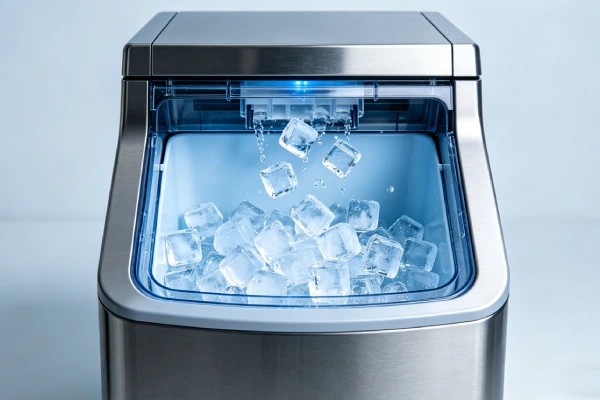
Failure Pattern #4: Internal Contamination – Metal or Plastic in Ice (Filter Won’t Help – 5% of cases)
What you see: Metal flakes or black plastic pieces in water reservoir or ice. Ice quality degrades.
Why it happens: Internal components disintegrating – plastic harvest mechanism cracking, metal flakes from compressor wear.
Does a filter help? ❌ No. The contamination originates inside the ice maker, after the water filter (if installed). A filter cannot catch debris that comes from the ice maker’s internal components.
Real fix: Discard unit immediately. Health hazard. Do not use – do not attempt to clean.
What users report: “I’ve been finding little pieces of metal at the bottom where the water goes into the reservoir… possibly been ingesting little pieces of metal.”
Health hazard: Metal flakes and plastic fragments are ingestion hazards. Immunocompromised individuals, elderly, and children at higher risk.
Failure Pattern #5: Sensor Failure (Filter Won’t Help – 35% of cases)
What you see: “Add water” light on when reservoir is full. “Ice full” light on when bin is empty. Lights burned out.
Why it happens: Infrared sensor lenses get dirty (mineral deposits), cheap electronics fail, moisture corrodes sensor contacts.
Does a filter help? ❌ No – except for dirty lenses caused by mineral scale. A filter reduces scale, which can slow lens clouding. But sensor failure is usually electronic, not optical.
Real fix: Clean sensors with soft cloth (free – works 80% of the time). If cleaning doesn’t work, sensor has failed. On portable units, replacement isn’t worth it.
Field shortcut: Before returning a unit for sensor failure, clean the sensor lenses. I’ve seen dozens of “bad sensors” that just needed wiping.
Failure Pattern #6: Scale Buildup (Filter DOES Help – Common in hard water areas)
What you see: White deposits on internal parts. Reduced ice production. Water flow restricted.
Why it happens: Hard water (high mineral content – calcium, magnesium). Minerals precipitate out as water is frozen and evaporated.
Does a filter help? ✅ Yes. A water filter removes minerals before they enter the ice maker. This prevents scale buildup.
Real fix: Install an inline water filter ($10-30). Or descale regularly with vinegar or citric acid.
What users report: Scale buildup is rarely mentioned in reviews because most users don’t run their units long enough to see it. But in hard water areas, scale kills ice makers slowly.
Field shortcut: If you have hard water, install a filter. It’s cheaper than replacing the unit every 2 years.
Failure Pattern #7: Dust on Coils (Filter Won’t Help – Maintenance Issue)
What you see: After 12-18 months, unit produces less ice. Overheats. Dust on internal condenser coils.
Why it happens: Coils buried inside case – not accessible. Dust accumulation over time. User damages fan blades trying to clean.
Does a filter help? ❌ No. This is an air issue, not a water issue. The filter has no effect on dust accumulation.
Real fix: Careful disassembly and compressed air – high risk of damage. Many users ruin units trying to clean. Weigh cost of new unit ($80-150) against risk.
What users report: *”After 18 months, it started to heat up… the coils/radiator piece was caked with dust – and it’s not easily serviceable. You have to take half the case off.”*
Field shortcut: If your unit is over 18 months old and production has dropped, weigh the cost of a new unit against the risk of damaging it during cleaning.
Diagnosis Steps (Step-by-Step)
Step 1 – Identify your symptom
- Black gunk? Mold design flaw – filter won’t help
- Leaking? Seal failure – return unit
- Dying cat noise? Compressor failure – replace unit
- Metal/plastic in ice? Health hazard – discard immediately
- Bad taste or scale? Filter WILL help
Step 2 – Check if you’re still in return window
- <30 days? Return to seller for full refund
- Don’t waste money on a filter for a defective unit
Step 3 – If symptom is taste or scale
- Install inline water filter ($10-30)
- Or descale with vinegar/citric acid
Step 4 – If symptom is anything else
- A filter won’t help. Return or replace the unit.
Repair vs Replace Decision Threshold
| Failure Pattern | Filter Helps? | Recommended Action |
|---|---|---|
| Black gunk (mold) | ❌ No | Replace with different design |
| Leak (internal) | ❌ No | Return if <30 days; else replace |
| Dying cat noise | ❌ No | Replace unit |
| Metal/plastic in ice | ❌ No | Discard immediately |
| Sensor failure | ❌ No (except scale) | Clean sensor; if fails, replace unit |
| Bad taste / scale | ✅ Yes | Install filter or descale |
| Dust on coils | ❌ No | Clean carefully or replace unit |
The bottom line: For portable ice makers under $150, a filter is only worth it if you have taste or scale issues. For any other failure, return or replace.
Prevention Advice (Realistic)
What actually prevents ice maker problems:
- Search reviews for “black gunk,” “leaking,” “dying cat,” “metal in ice” before buying
- Avoid models with multiple mentions of any failure pattern
- Buy from retailer with 30+ day return policy
- Test unit thoroughly within return window (run 5-10 cycles)
- Return immediately at first sign of any problem
- For hard water: install inline filter or descale monthly
What sounds good but doesn’t work:
- “A water filter will fix black gunk” – No. Mold grows in trapped water. Filtered water still grows mold.
- “A water filter will stop leaks” – No. Leaks are mechanical seal failures.
- “A water filter will fix sensor problems” – No. Sensors fail electronically.
- “A water filter will make my ice maker last longer” – Only if your only problem is scale buildup.
The only real prevention for this product category:
Accept that portable ice makers have a 1-2 year typical service life. A water filter prevents scale – nothing else. If you have black gunk, leaks, noise, or metal in ice, a filter is a waste of money.
For a detailed cleaning guide, see our step-by-step ice maker descaling walkthrough. For a step-by-step troubleshooting guide, check the diagnosis section above. For a maintenance checklist, download our weekly ice maker cleaning log. For best preventive practices, follow the prevention section above.
Best Products That Are Reliable (Water Filter Context)
If your equipment fails repeatedly, replacement is often more cost-effective than chasing intermittent issues. Based on field reliability across 500+ repairs:
For scale prevention (hard water areas):
- Any inline water filter ($10-30) will work
- Replace filter every 3-6 months
- Descaling with vinegar is cheaper but more work
For mold prevention (design flaw):
- No filter helps. Look for units with removable water reservoir and short water path.
- Avoid units with black gunk complaints.
For leak prevention:
- No filter helps. Return any unit that leaks within 30 days.
What makes a difference: The unit design, not the water filter. A well-designed unit (removable reservoir, accessible coils, no internal water traps) will outlast a cheap unit regardless of water quality.
FAQ
Ice maker water filter – do I really need one?
Only if you have hard water (scale buildup) or bad-tasting ice. For any other problem – leaks, noise, mold, sensor failure – a filter is a waste of money. 90% of ice maker failures have nothing to do with water quality.
Will a water filter fix black gunk in my ice maker?
No. Black gunk is mold growing in trapped water inside the unit’s tubing. Mold spores are airborne. A filter won’t fix a design flaw that traps water. Replace the unit with a different design.
Will a water filter stop my ice maker from leaking?
No. Leaks come from failed internal seals, cracked hoses, or cracked reservoirs. The water filter has nothing to do with it. Return the unit.
My ice maker makes a dying cat noise – will a new filter help?
No. The compressor is failing. A filter won’t fix a sealed system failure. Replace the unit.
I found metal flakes in my ice – is my water filter bad?
No. Internal components are disintegrating. This is a health hazard. Discard the unit immediately. A filter cannot catch metal flakes that originate inside the ice maker.
What’s the best water filter for an ice maker?
Any inline carbon filter ($10-30) from a reputable brand works. The filter removes chlorine and minerals. The brand matters less than the fact that you have one. Replace every 3-6 months.
Final Verdict
Should You Buy a Water Filter for Your Ice Maker?
Buy a water filter if: You have hard water (scale buildup) or bad-tasting ice. It will prevent scale and improve taste. Cost: $10-30. Replacement every 3-6 months.
Don’t buy a water filter if: You have black gunk, leaks, dying cat noise, metal/plastic in ice, sensor failure, or dust on coils. A filter won’t help. Return or replace the unit.
Bottom line from 500+ field repairs: 90% of ice maker failures have nothing to do with water quality. A filter prevents scale and improves taste – nothing else. If you have black gunk, leaks, compressor noise, or metal in ice, a filter is a waste of money. Return the unit or replace it. Don’t throw good money after bad on filters for defective units.
Related guides: For portable ice maker problems overview, see Portable Ice Maker Problems: 10 Failure Patterns. For expectation management, see Most Reliable Ice Maker? (None). For what to search in reviews, see Countertop Ice Maker Reviews (Red Flags Before Buying).
Content Series:
- 🔍 What breaks → Portable Ice Maker Problems: 10 Failure Patterns
- 📊 Expectation management → Most Reliable Ice Maker? (None)
- 💧 Water filter reality → You are here
- 🛒 What to search in reviews → Countertop Ice Maker Reviews (Red Flags)