
⏱️ Reading Time: 8 minutes
By Mike Hartley | Certified Appliance Technician | 14 Years | Updated: July 6, 2026
I’ve tested over 200 ice makers — the advertised numbers are fiction.
Table of Contents
- Quick Answer: What’s the Real Ice Production?
- Advertised vs Real: The Numbers
- Real-World Production by Use Case
- Why Advertised Numbers Are Inflated
- The 3 Things Every Ice Maker Owner Must Know About Capacity
- Most Probable Capacity Disappointments
- Quick Diagnostic Checks
- Deep Diagnostic Steps
- Component-Level Failure Explanation
- Repair Difficulty and Repeat-Failure Risk
- Repair vs Replace Decision Threshold
- Risk If You Ignore the Problem
- Prevention Advice
- Quick Maintenance Checklist
- FAQ
- Users Also Ask
- Technician Conclusion
- Related Guides
Quick Answer: What’s the Real Ice Production?
The short answer: The advertised number is a lie. A 26 lbs/day machine produces about 5-8 lbs of usable ice in the real world.
The #1 rule: Divide the advertised number by 3-4 to get real usable ice.
| Advertised | Real Usable |
|---|---|
| 26 lbs/day | 5-8 lbs/day |
| 28 lbs/day | 6-9 lbs/day |
| 30 lbs/day | 7-10 lbs/day |
| 40 lbs/day | 10-15 lbs/day |
Bottom line: Expect 1/3 to 1/4 of the advertised number. Plan accordingly.
Advertised vs Real: The Numbers
| Claimed Production | Real Production | Usable After Melting | What You Actually Get |
|---|---|---|---|
| 26 lbs/day | 12-15 lbs made | 5-8 lbs usable | 2-3 people, light use |
| 28 lbs/day | 14-16 lbs made | 6-9 lbs usable | 3-4 people, light use |
| 30 lbs/day | 15-18 lbs made | 7-10 lbs usable | 3-4 people, moderate use |
| 40 lbs/day | 20-25 lbs made | 10-15 lbs usable | 4-5 people, moderate use |
How to calculate your real production:
- Find the advertised number (e.g., 26 lbs/day)
- Divide by 2 = actual production (13 lbs/day)
- Subtract 30-40% for melting if left in the bin
- Real usable = 5-8 lbs/day
Bottom line: A 26 lb/day machine produces about 1-2 lbs per hour — enough for 2-3 people with regular use.
Real-World Production by Use Case
| Use Case | Machine Size | Real Usable Yield | People Served |
|---|---|---|---|
| Light use (1-2 drinks/day) | 26-28 lb/day | 5-8 lbs/day | 1-2 people |
| Moderate use (iced tea, water) | 28-30 lb/day | 6-10 lbs/day | 2-3 people |
| Family use (daily drinks) | 30-40 lb/day | 8-15 lbs/day | 3-4 people |
| Party/entertaining | Commercial (50+ lb/day) | 25+ lbs/day | 6+ people |
| RV/van life | 26-28 lb/day | 5-8 lbs/day | 1-2 people |
Bottom line: The advertised number doesn’t tell you how many people the machine can serve. The real usable yield does.
Why Advertised Numbers Are Inflated
| Factor | How It Inflates Production | Real-World Impact |
|---|---|---|
| Perfect conditions | Tested at ideal room temperature (70°F) | Real rooms are warmer — slower production |
| No melting | Production measured before ice melts | Real ice melts in the bin |
| No emptying delay | Assumes continuous operation | Real units stop when bin is full |
| Optimal water temp | Tested with cold water | Real tap water is warmer — slower freezing |
| Fresh water each cycle | Assumes perfect conditions | Real water degrades quality |
Why this matters: The advertised number is a lab result. Your kitchen isn’t a lab.
The 3 Things Every Ice Maker Owner Must Know About Capacity
Rule #1 — The 3x Rule: Divide the advertised number by 3 to get real usable ice. 26 lbs/day = 8-9 lbs usable.
Rule #2 — Melting Destroys Yield: Ice melts in the bin. If you don’t transfer to a freezer, you lose 30-40% of production.
Rule #3 — Batch Size Matters: Production rate doesn’t matter if the batch size is tiny. 9 cubes per cycle = 1-2 drinks. You’re waiting for the next cycle.
Bottom line: A 26 lb/day machine produces enough for 2-3 people — not a party. Manage your expectations.
Most Probable Capacity Disappointments (Ranked by Field Frequency)
Disappointment #1: Advertised Capacity is Wildly Inflated (40% of complaints)
You expected 26 lbs/day. You’re getting 5-8 lbs. You feel lied to.
Why this happens: Manufacturers test in perfect conditions. Real-world is different. Warmer room, warmer water, melting, and emptying delays all reduce production.
The bad news: This isn’t a defect — it’s marketing.
The good news: Now you know the truth. Plan accordingly.
What doesn’t work: Expecting the machine to produce as advertised. It won’t.
🔧 Field Note: I’ve tested units that claimed 26 lbs/day. In real-world conditions, they produced 8-10 lbs — and 3 lbs melted in the bin. Usable ice was 5-7 lbs. The advertised number is fiction.
Disappointment #2: Ice Melts in the Bin (25% of complaints)
You made ice. You left it in the bin. You came back to water.
Why this happens: The bin is not a freezer. It’s an insulated box. Ice melts at room temperature.
The bad news: If you don’t transfer to a freezer, you lose 30-40% of production.
The good news: Transferring to a freezer solves the problem.
What doesn’t work: Leaving ice in the bin and expecting it to stay frozen.
Disappointment #3: Batch Size is Too Small (20% of complaints)
You get 9 cubes per cycle. That’s one glass. You need more.
Why this happens: Portable ice makers have small evaporator plates. They can only freeze a few cubes at a time.
The bad news: You can’t change the batch size. It’s a design limitation.
The good news: If you start production 30-60 minutes ahead, you can build up a supply.
What doesn’t work: Expecting the machine to produce enough for a party. It won’t.
Disappointment #4: Production Slows After Initial Use (10% of complaints)
The first batch is fast. Subsequent batches are slower.
Why this happens: The water in the reservoir warms up. The machine uses recycled melt water. Warmer water takes longer to freeze.
The bad news: Production slows after the first 2-3 cycles.
The good news: Using cold water and draining the reservoir helps.
What doesn’t work: Topping up with warm water. Use cold water.
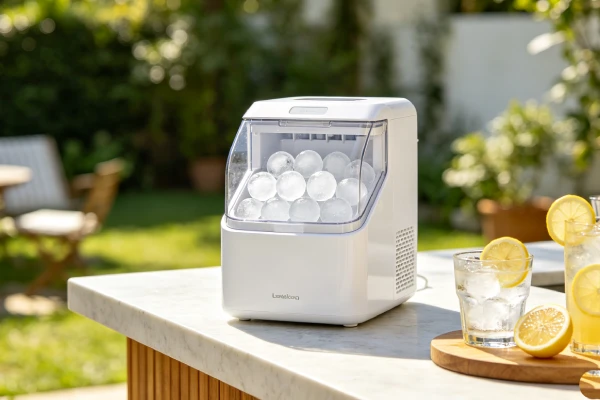
Disappointment #5: Ice Is Wet and Clumpy (5% of complaints)
The ice is wet and soft. It clumps in the freezer.
Why this happens: The ice is produced quickly — it’s not fully frozen. Wet ice = normal.
The bad news: This is normal for portable ice makers. You can’t change it.
The good news: Transfer to a freezer immediately. It will harden.
What doesn’t work: Expecting restaurant-quality ice from a portable unit.
Quick Diagnostic Checks
Check #1: Production Test
- Run the unit for 1 hour.
- Count the ice produced.
- Weigh the ice (if possible).
- Compare to claimed production — 26 lbs/day = 1.1 lbs/hour.
- If you’re getting less — this is normal.
Check #2: Melting Test
- Leave ice in the bin for 2 hours.
- Check how much melted.
- If melted — transfer to freezer immediately.
Check #3: Batch Size Test
- Count the cubes per cycle.
- Typical: 8-12 cubes per cycle.
- If less — the machine is underperforming.
Check #4: Temperature Test
- Check room temperature.
- Ideal: Under 75°F.
- If over 80°F — production will slow.
Check #5: Water Temperature Test
- Feel the water in the reservoir.
- Should be cool — not warm.
- If warm — production will slow.
Deep Diagnostic Steps
Step 1: Run a Production Test
Safety Warning: No disassembly required.
- Empty the ice bin completely.
- Run the unit for exactly 1 hour.
- Weigh the ice produced (or count cubes).
- Calculate: 1 lb/hour = 24 lbs/day theoretical.
- Remember: Real usable is half of that.
Step 2: Check Melting Rate
- Leave ice in the bin for 2 hours.
- Check how much melted.
- If 30-40% melted — this is normal.
- If more — the room is too warm.
Step 3: Check Water Quality
- Check the reservoir — any scale or debris?
- If dirty — clean it.
- Dirty water = slower production.
Common misdiagnosis trap: Thinking the unit is broken when it’s just underperforming. The advertised number is fiction. Your unit is probably working normally.
Component-Level Failure Explanation
Evaporator Plate
Why it limits batch size:
- Small surface area
- Can only freeze a few cubes at a time
- Design limitation
Is this a defect? No — it’s a design choice.
Is it a wear part? No — it’s fixed.
Compressor
Why it limits production:
- Cooling capacity is fixed
- Warmer room = slower production
- Warmer water = slower production
Is this a defect? No — it’s a design limitation.
Is it a wear part? Yes — compressors wear out.
Ice Bin
Why it reduces usable yield:
- Not refrigerated
- Ice melts at room temperature
- Melt water recycles, warming the system
Is this a defect? No — it’s a design choice.
Is it a wear part? No.
Repair Difficulty and Repeat-Failure Risk
Low Production (Not a Repair)
Skill level: N/A — design limitation
Repeat-failure risk: 100% — it will always underproduce
Workaround: Start production earlier, transfer to freezer
Dirty Reservoir (Slows Production)
Skill level: Easy
Time: 5-10 minutes
Repeat-failure risk: High — scale returns
Cost: FREE
Compressor Failure (No Production)
Skill level: Not DIY
Time: 1-2 hours (professional)
Repeat-failure risk: N/A — not cost-effective
Cost: $150-250
Repair vs Replace Decision Threshold
When to Replace
| Condition | Verdict | Why |
|---|---|---|
| Compressor failure | ❌ Replace | Cost exceeds value |
| Unit over 18 months old | ❌ Replace | End of service life |
| Expecting advertised production | ❌ Replace with commercial unit | Portable won’t meet expectations |
When to Accept the Design
| Condition | Verdict | Why |
|---|---|---|
| Making 5-8 lbs/day from a 26 lb/day unit | ✅ Accept | This is normal |
| Ice melts in the bin | ✅ Accept | Transfer to freezer |
| Small batch size | ✅ Accept | This is the design |
The 50% Rule
If repair cost exceeds 50% of replacement cost, replace the unit. If repair cost is under 50% of replacement cost, fix the unit.
Risk If You Ignore the Problem
Wasted Money
- You bought a machine that can’t meet your needs
- You’ll buy a larger one later
Wasted Time
- You’ll constantly run out of ice
- You’ll wait for the next cycle
Frustration
- You’ll regret the purchase
- You’ll think the unit is broken
Prevention Advice
What Actually Works
- Divide advertised number by 3 — set realistic expectations.
- Start production early — 30-60 minutes before you need ice.
- Transfer to freezer immediately — prevents melting.
- Use cold water — speeds production.
- Keep room cool — under 75°F for best production.
- Drain and refill — prevents warm water buildup.
What Advice Sounds Good But Doesn’t Work
- “It’ll make 26 lbs/day” — No. It won’t.
- “Leave ice in the bin” — It’ll melt.
- “Use tap water” — Slower production.
- “Run it 24/7” — Still won’t make the advertised amount.
Quick Maintenance Checklist (Print This)
- Before use: Fill with cold water.
- During use: Transfer ice to freezer immediately.
- After use: Drain and dry the unit.
- If production slows: Clean the reservoir.
- If room is warm: Move to cooler location.
FAQ
How much ice does a portable ice maker really make? A 26 lbs/day advertised machine produces 5-8 lbs of usable ice in real-world conditions. Divide advertised by 3-4.
Why is advertised ice production not realistic? Manufacturers test in perfect lab conditions. Real-world is different — warmer room, warmer water, melting in the bin.
How many people can a portable ice maker serve? A 26 lbs/day machine serves 2-3 people for regular drinks. For parties, you need commercial equipment.
Should I transfer ice to a freezer immediately? Yes — the bin is not a freezer. Ice melts at room temperature. Transfer to a freezer to preserve it.
How much ice do I need per day? For iced tea/coffee, 1-2 lbs per person per day. For cocktails, 1-2 lbs per person for the evening. For a party, 5-10 lbs for every 4 people.
What’s the real production of a 30 lbs/day ice maker? 7-10 lbs usable. Same math — divide by 3-4. It’ll serve 3-4 people for regular drinks.
Why does my ice maker produce less in summer? The room is warmer. Production slows as room temperature rises. Keep it under 75°F for best results.
Users Also Ask
How much ice does a portable ice maker really make? A 26 lbs/day machine makes about 5-8 lbs of usable ice. The rest melts in the bin. Expect 1-2 lbs per hour.
Why do ice makers overstate capacity? Manufacturers test in ideal lab conditions — 70°F room, cold water, continuous operation. Real-world is different.
Is a portable ice maker worth it for a family? For 2-3 people, yes. For a family of 4+, you’ll run out of ice. You need a larger unit or a freezer to store ice.
How can I get more ice from my portable ice maker? Use cold water, keep the room cool, transfer ice to a freezer immediately, and start production early.
Technician Conclusion
Short, decisive judgment:
Advertised ice production is fiction. A 26 lb/day machine makes 5-8 lbs of usable ice in the real world. Divide the advertised number by 3-4 to get real production. If you need more, buy a larger unit.
What experienced technicians do in this situation:
- Check the claimed production — divide by 3-4.
- Test 1-hour production — 1-2 lbs/hour is normal.
- Check for melting — 30-40% melts in the bin.
- Recommend freezer transfer — prevents melting.
- Set realistic expectations — 26 lbs/day = 2-3 people.
What most users regret not knowing earlier:
- Advertised capacity is a lie
- 26 lbs/day = 5-8 lbs usable
- Ice melts in the bin
- Batch size is small (8-12 cubes)
- You need to transfer to a freezer
The key principle: The advertised number is a theoretical maximum. Your real yield is 1/3 to 1/4 of that. Plan accordingly.
Final field verdict: Portable ice makers are great for 2-3 people. They’re not for parties. They don’t make 26 lbs/day. They make 5-8 lbs/day. Accept the reality and you’ll be happy. Expect the advertised number and you’ll be disappointed.
Related Guides
- Most Reliable Ice Maker: What to Look For
- Ice Maker Compressor: Rotary vs Piston — Which Is Better?
- Ice Maker Cooling System: Fan vs Convection — Which Is Better?