
Why Is My Electric Blanket Only Heating One Side? Quick Answer
If your electric blanket only heats one side, the most common causes are incomplete heating coverage by design, dual control malfunction, or heating element failure. Many blankets, especially larger sizes, are designed with heating elements only in the center portion, leaving the sides unheated. This is often intentional but poorly disclosed. If one side of a dual-control blanket works while the other doesn’t, the controller may be faulty, or the heating element on that side may have failed.
Electric Blanket Only Heating One Side: 7 Common Causes
1. Incomplete Heating Coverage by Design
Many electric blankets are designed with heating elements only in the center portion, leaving the sides unheated. This is often not clearly disclosed in product descriptions.
- Component: Heating wire layout design
- Mechanism: Manufacturer places heating elements only in the middle section to reduce cost or simplify construction
- Trigger: From first use
- Result: Sides of the blanket remain cold while center heats
What users report: “The Full size blanket only has heating wires through roughly the middle half of the blanket. About 18 inches on each side have no heating wires.” “The blanket only heats the middle, which is fine for one person, but when two people are using it, it’s an issue.”
2. Dual Control Malfunction
In dual-zone blankets, one controller may fail while the other continues working.
- Component: Individual controllers for each side
- Mechanism: Electronics failure in one controller prevents that side from heating
- Trigger: Normal use, age (1-3 years), power surges
- Result: One side heats normally, the other side stays cold
What users report: “I love the dual controls, but they seem to malfunction. One side gets really hot, and the other doesn’t heat up at all.” “Even with dual controls, one side of the blanket is always cold.”
3. Heating Element Failure on One Side
The heating wires in one zone may break while the other zone continues to work.
- Component: Resistive heating wires in one section of the blanket
- Mechanism: Wires can break due to repeated flexing, folding, or age
- Trigger: Frequent folding, body weight, washing, age (2-4 years)
- Result: One side of blanket stops heating entirely
What users report: “I expected both sides to have consistent heating with the dual controllers, but one side of the blanket stays cool while the other gets way too hot.”
4. Insufficient Heating for Larger Sizes
King and queen-size blankets often have heating elements that don’t extend across the full width, leaving large cold areas.
- Component: Heating wire layout in larger blankets
- Mechanism: Manufacturers often use the same heating element pattern scaled up, leaving proportionally larger unheated areas
- Trigger: Design choice
- Result: Large cold spots on sides, unsuitable for two people
What users report: “The king-size blanket only heats the middle part, leaving the sides cold. It works fine for one person, but not for two.” “The size is great, but it only heats the center. The side near the edges doesn’t get warm enough for my partner.”
5. Connection Issues at the Controller Interface
Loose or damaged connections where the controller plugs into the blanket can cause one side to fail.
- Component: Connector pins, socket contacts
- Mechanism: Poor contact on one side’s connection interrupts power to that zone
- Trigger: Movement, tugging on cords, partial disconnection
- Result: One side doesn’t heat; other side works
6. Wire Movement Within the Blanket
In some blankets, heating wires are not sewn in place and can shift during use or washing.
- Component: Unsecured heating wires
- Mechanism: Wires move within the fabric, creating areas with no wires
- Trigger: Normal use, washing, movement
- Result: One side may have fewer wires, causing uneven heating
7. Fabric Issues Causing Discomfort (Not Heating Related)
While not a heating failure, fabric pilling and snagging can affect user experience.
- Component: Fabric material
- Mechanism: Low-quality fibers break and ball up on surface
- Trigger: Normal use, washing
- Result: Blanket becomes rough and uncomfortable despite heating function
What users report: “The black side of the blanket picked up fabric fuzz and became rough within a few days. The heating was good, but the fabric disappointed me.”
Electric Blanket Uneven Heat Distribution: How to Fix
Step 1: Identify the Pattern
- Is one side completely cold, or just cooler?
- Are the edges cold while center heats?
- Does the cold side ever warm up?
Step 2: Swap Controllers (Dual-Zone Only)
- Swap the controllers between sides
- If the cold side becomes warm and the warm side becomes cold → controller issue
- If the cold side stays cold → heating element issue
Step 3: Check for Design Limitations
- If only the edges are cold, it may be intentional design
- Measure the heated area—manufacturers often only heat the center
- Check product specifications or reviews for complaints
Step 4: Inspect Connections
- Unplug and reconnect both sides firmly
- Check for damaged pins or loose connections
Step 5: Feel for Heat Distribution
- Run on high for 30 minutes
- Map out which areas heat and which remain cold
Electric Blanket Cold Side Solution
If the issue is a design limitation:
- Return the blanket if still within return window
- Look for blankets advertised as “full-surface heating”
- Consider two twin-size blankets instead of one larger size
- Accept that the sides will remain cold and position yourself in the heated zone
If the issue is controller failure:
- Swap controllers to confirm
- Purchase a replacement controller if available ($20-40)
- Contact manufacturer for warranty replacement
If the issue is heating element failure:
- Confirm by swapping controllers
- Replace the blanket—heating elements cannot be repaired
Electric Blanket Dual Control Not Working: Troubleshooting
Symptoms of dual control failure:
- One side heats, other doesn’t
- One side overheats, other is cold
- Settings don’t match between sides
Diagnosis steps:
- Swap controllers between sides
- If problem moves → controller issue
- If problem stays → heating element issue
Replacement options:
- Some manufacturers sell replacement controllers ($20-40)
- Check Sunbeam, Beautyrest, and other brands
- Generic brands usually don’t have replacements
Fixing Electric Blanket Heating Issues: Quick Reference
| Symptom | Likely Cause | Solution |
|---|---|---|
| Sides cold, center heats | Intentional design | Check specs before buying |
| One side cold, one side works | Controller failure | Swap controllers to confirm |
| One side cold after controller swap | Heating element failure | Replace blanket |
| Cold spots on one side only | Wire breakage | Replace blanket |
| Intermittent heating on one side | Loose connection | Check and secure connections |
| Large cold areas on king/queen | Design limitation | Choose different model |
Electric Blanket Not Heating Properly: Design or Defect?
How to tell if it’s design or defect:
Design limitation (normal):
- Cold areas are symmetrical on both sides
- Cold area is consistent width (often 12-18 inches)
- Only the edges are cold, center heats well
- Matches online reviews describing same pattern
Defect (needs replacement):
- Cold spots are random, not symmetrical
- One side cold, other works fine
- Cold spots developed over time (wasn’t like this when new)
- Uneven heating within the heated zone
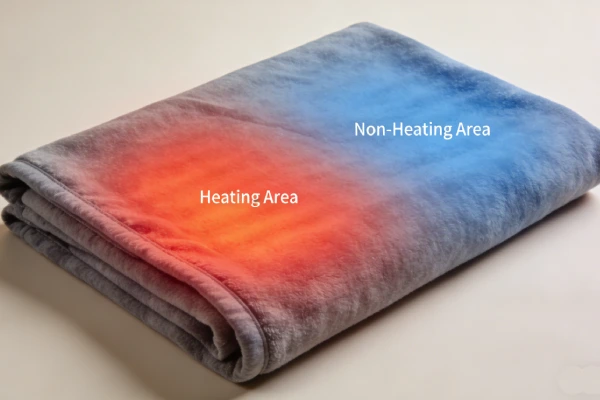
King Size Electric Blanket Only Heating Middle
This is an extremely common complaint for king and queen-size blankets. Manufacturers often use the same heating element pattern scaled up, resulting in proportionally larger unheated areas on the sides.
What users report: “The king-size blanket only heats the middle part, leaving the sides cold. It works fine for one person, but not for two.”
Solutions:
- Look for blankets advertised as “full-surface heating”
- Check reviews specifically from users with larger sizes
- Consider two twin-size blankets instead of one king
Field Verification Tests (No Tools)
Test 1: Controller Swap Test (Dual-Zone Only)
- Swap controllers between sides
- Run on high for 20 minutes
- Pass: Both sides work with either controller
- Fail: Problem moves with controller → controller issue; stays on same side → element issue
Test 2: Heat Distribution Mapping
- Run blanket on high for 30 minutes
- Mark areas that heat and areas that stay cold
- Pass: Heating matches expected pattern
- Fail: Random cold spots or one side completely dead
Test 3: Design Limitation Check
- Measure width of heated area
- Compare to blanket width
- Pass: Heated area covers most of blanket
- Fail: Significant unheated edges (over 12 inches)
Test 4: Connection Test
- Disconnect and reconnect each side firmly
- Listen for click when fully seated
- Pass: Secure connection
- Fail: Loose or no click—connector issue
Test 5: Progressive Heating Test
- Run on low, then medium, then high
- Note if cold side ever warms at higher settings
- Pass: Both sides respond to setting changes
- Fail: One side never warms at any setting
Real-World Usage Failure Scenarios
Scenario 1: The Design Limitation Surprise
- User: Couple bought full-size blanket
- Timeline: First use
- Issue: Sides stay cold, only center heats
- Cause: Intentional design, not disclosed
- Outcome: Returned; bought blanket with full-surface heating
Scenario 2: The Dual Control Failure
- User: Couple with dual-zone blanket
- Timeline: 1 year
- Issue: One side stopped heating; other side works
- Cause: Controller failure on cold side
- Outcome: Swapped controllers; problem moved; replaced controller
Scenario 3: The Progressive One-Side Failure
- User: Single user
- Timeline: 2 years
- Issue: One side gradually lost heat over months
- Cause: Heating element fatigue
- Outcome: Blanket replaced
Scenario 4: The King-Size Disappointment
- User: Couple with king blanket
- Timeline: First use
- Issue: Large cold areas on both sides
- Cause: Design limitation for larger size
- Outcome: Kept blanket; learned to position in center
Scenario 5: The Intermittent One-Side Heating
- User: Moves blanket frequently
- Timeline: 6 months
- Issue: One side works sometimes, cuts out
- Cause: Loose connection at controller
- Outcome: Secured connection; problem solved
Scenario 6: The Fabric Wear Issue
- User: Regular use
- Timeline: 1 month
- Issue: Fabric pilling and snagging, but heating works
- Cause: Low-quality fabric
- Outcome: Acceptable compromise for heat; fabric issue cosmetic
Common Misdiagnosis Patterns
Misdiagnosis 1: “Blanket is broken, one side doesn’t heat” → Design limitation
- Symptom: Sides cold, center heats
- Actual cause: Intentional design, not defect
- Verification: Check reviews; if pattern common, design issue
Misdiagnosis 2: “One side dead, need new blanket” → Controller issue
- Symptom: One side of dual-zone doesn’t heat
- Actual cause: Controller failure on that side
- Verification: Swap controllers; if problem moves, controller issue
Misdiagnosis 3: “Uneven heating means defective” → Wire movement
- Symptom: Some areas hotter than others
- Actual cause: Wires may have shifted
- Verification: Smooth out blanket; if improves, wire movement
Misdiagnosis 4: “Blanket too small for two people” → Design issue
- Symptom: Not enough heated area for two
- Actual cause: Heated zone only in center
- Verification: Check heated area width; if narrow, design issue
Misdiagnosis 5: “Fabric pilling means poor quality” → Correct
- Symptom: Fabric rough after short use
- Actual cause: Low-quality material
- Verification: Compare to price point; expected for budget
Electric Blanket Lifespan and Reliability
| Usage Level | Expected Lifespan | Common Failure Mode |
|---|---|---|
| Light (occasional, seasonal) | 5-8 years | Age-related wire fatigue |
| Moderate (nightly, cold months) | 3-5 years | Heating element failure |
| Heavy (year-round, nightly) | 2-4 years | Controller issues, wire breakage |
What affects one-sided heating specifically:
- Dual-zone blankets have twice the components, twice the failure points
- Larger sizes often have more design limitations
- Controller failures affect one side only
- Heating elements can fail in one zone independently
Repair vs Replace Decision Logic
Consider replacing just the controller if:
- The blanket is less than 3 years old
- Swapping controllers confirms the problem follows the controller
- The manufacturer sells replacement controllers ($20-50)
Consider replacing the entire blanket if:
- Heating elements have failed on one side (confirmed by controller swap)
- The issue is a design limitation (sides never heated)
- The blanket is more than 3-5 years old
- Replacement controllers are unavailable
- Both sides have issues
Warranty Considerations
- Most electric blankets have 1-3 year warranties
- Keep receipts and register your product
- Contact manufacturer first for in-warranty issues
Controller Replacement Options
Some manufacturers sell replacement controllers separately:
- Sunbeam: Available for many models ($20-40)
- Biddeford: Limited availability
- Beautyrest: Some models have replacements
- Generic brands: Usually not available
How to find:
- Locate model number on blanket tag or controller
- Search “[brand] [model] replacement controller”
- Contact manufacturer
What to Look for When Buying (To Avoid One-Sided Heating)
Features that matter for even heating:
- Full-surface heating – Look for blankets that advertise heating across entire surface
- Reviews from owners of same size – Check specifically for king/queen complaints
- Heated area specifications – Some manufacturers list actual heated dimensions
- Dual-zone with independent controllers – Allows each side to set own temperature
- Return policy – In case design doesn’t meet expectations
Questions to ask before buying:
- Does the heating extend to the edges?
- What is the actual heated width?
- Do users with larger sizes report cold sides?
- Are replacement controllers available?
Technician Notes
Based on repair observations:
- Many “one-sided heating” complaints are actually design limitations. The blanket was never designed to heat the sides.
- Dual-zone blankets fail twice as often. Two controllers, twice the failure rate.
- Controller swap is the best diagnostic tool. Takes 2 minutes and tells you exactly where the problem is.
- Heating elements on one side can fail independently. If swapping controllers doesn’t fix it, the element is broken.
- Larger sizes are more likely to have cold sides. Manufacturers rarely extend heating elements to full width.
- Fabric issues are cosmetic but indicate lower quality. Higher-end blankets use better materials.
- If the blanket heated both sides when new and now doesn’t, it’s a failure. Not a design issue.
Frequently Asked Questions
Why is my electric blanket only heating one side?
The most common causes are incomplete heating coverage by design, dual control malfunction, or heating element failure. Check if the cold side ever worked when new.
How do I fix an electric blanket that only heats one side?
First, swap controllers if you have a dual-zone blanket. If the problem moves, replace the controller. If it stays, the heating element has failed and the blanket needs replacement.
Why does my dual-control blanket only heat one side?
One controller may have failed. Swap controllers between sides to confirm. If the problem moves with the controller, replace that controller.
Why are the sides of my electric blanket cold?
Many blankets are designed with heating elements only in the center. This is especially common in larger sizes. Check if the cold areas are symmetrical on both sides.
Why does my king-size blanket only heat the middle?
This is a common design limitation. Manufacturers often use the same heating element pattern scaled up, leaving proportionally larger unheated areas on the sides.
Can I replace just one controller on a dual-zone blanket?
Some manufacturers sell replacement controllers. Check your model number and contact the manufacturer. Generic brands usually don’t offer replacements.
Why did one side of my electric blanket stop working?
If both sides worked when new and one side stopped, it’s likely heating element failure or controller malfunction. Swap controllers to diagnose.
Is it normal for a large electric blanket to have cold sides?
Unfortunately, yes for many models. Always check reviews from owners of the same size before purchasing.
How do I know if my blanket’s one-sided heating is a defect?
If the cold spots are random, asymmetrical, or developed over time, it’s likely a defect. If the sides have always been cold, it’s probably by design.
What should I look for in an electric blanket that heats evenly?
Look for “full-surface heating” in the description, check reviews specifically about edge heating, and consider reading heated area specifications.
Summary
Electric blankets that only heat one side typically have one of these causes:
- Incomplete heating coverage by design → sides never heated → check specs before buying
- Dual control malfunction → one controller failed → replace controller
- Heating element failure → one zone broken → replace blanket
- Design limitation for larger sizes → common in king/queen → choose different model
- Connection issues → loose or damaged connectors → check and secure
Electric blanket not heating properly? Follow these steps:
- For dual-zone blankets, swap controllers to diagnose
- Check if cold areas are symmetrical (design) or random (defect)
- Measure heated width vs blanket width
- Read reviews from owners of same size
- Replace controller if available, otherwise replace blanket
Understanding whether your blanket’s one-sided heating is by design or a defect helps you make the right decision about repair or replacement.