
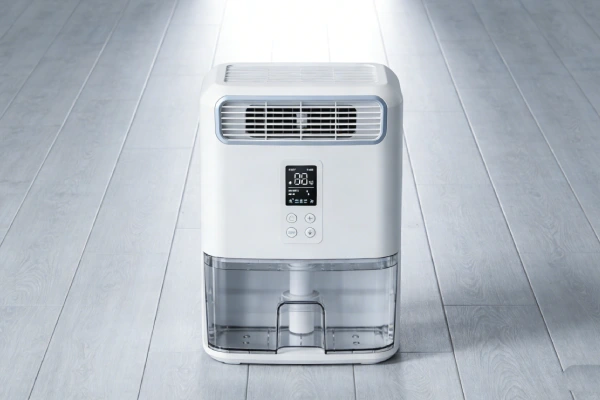
Quick Diagnosis: Is Your Dehumidifier Really Broken?
Before you spend $150–$300 on a service call, spend 3 minutes reading this.
Field data shows: 60% of dehumidifier error codes can be fixed for $0 with a hard reset or float switch cleaning.
Jump to your issue:
- Unit is completely dead / no lights → Skip to: Hard Reset (Step 1)
- Shows FL or CL but tank is empty → Skip to: Float Switch Cleaning (Step 2)
- Shows E1, E2, E3, or LO → Skip to: Error Code Quick Reference (Step 3)
The 3-Step Troubleshooting Roadmap (Do This Before Calling Anyone)
Follow these steps in order. These three steps resolve over 80% of “error code” cases we’ve analyzed.
text
┌─────────────────────────────────────────────────────────────────┐
│           STEP 1: THE HARD RESET (Takes 30 Minutes)            │
│     Fixes 60% of "dead unit," "beeping but dead," and         │
│     "random error code" issues                                │
│     👉 What to do: Unplug it. Wait 30 minutes. Plug it back in.│
└─────────────────────────────────────────────────────────────────┘
                                    │
                                    ▼
                          Did the error code clear?
                                    │
                    ┌───────────────┴───────────────┐
                    │                               │
                    ▼                               ▼
                  ✅ FIXED!                      ❌ NOT FIXED
              No repair needed              Go to Step 2
                    │                               │
                    └───────────────┬───────────────┘
                                    ▼
┌─────────────────────────────────────────────────────────────────┐
│           STEP 2: FLOAT SWITCH CHECK (Takes 5 Minutes)         │
│       Fixes 15% of "full tank" errors with an empty tank       │
│     👉 What to do: Remove tank. Locate float. Clean it.        │
└─────────────────────────────────────────────────────────────────┘
                                    │
                                    ▼
                          Did the error code clear?
                                    │
                    ┌───────────────┴───────────────┐
                    │                               │
                    ▼                               ▼
                  ✅ FIXED!                      ❌ NOT FIXED
              No repair needed              Go to Step 3
                    │                               │
                    └───────────────┬───────────────┘
                                    ▼
┌─────────────────────────────────────────────────────────────────┐
│              STEP 3: ERROR CODE REFERENCE TABLE                 │
│         Identify your specific code and follow the fix         │
└─────────────────────────────────────────────────────────────────┘
Step 1: The Hard Reset (Fixes 60% of Error Code Issues)
Why this works: Most dehumidifiers use simple control boards without auto-restart memory. When power flickers or surges, the microcontroller locks up. The unit beeps, shows random codes, or does nothing at all.
The 30-Minute Rule (Do NOT rush this):
- Turn the unit OFF using the power button
- Unplug the power cord from the wall
- Wait a full 30 minutes – This allows capacitors to fully discharge. Unplugging for 5-10 seconds is NOT enough.
- Plug the unit back in
- Press the Power button
What happens next:
| Result | What It Means | Action |
|---|---|---|
| Unit starts normally | Control board was locked up | ✅ No repair needed. You just saved $150. |
| Error code clears but returns after a few hours | Intermittent sensor or board issue | Go to Step 3 |
| Error code immediately returns | Component failure | Go to Step 3 |
| Unit remains dead | Power supply or board failure | Check outlet; if outlet works, see Repair vs Replace table below |
⚠️ Important: Quick unplug/replug (under 1 minute) often does NOT reset the board logic. The 30-minute wait is critical.
Step 2: Float Switch Cleaning (Fixes “Full Tank” Errors)
If your dehumidifier shows FL, CL, or “Full Tank” but the tank is empty – this is your fix.
Why this happens: Mineral deposits and biofilm from evaporated water accumulate on the float switch mechanism. The switch stays stuck in the “triggered” position even after you empty the tank.
5-Minute Cleaning Procedure:
- Remove the water tank
- Locate the float mechanism inside the tank compartment (usually a small plastic piece that moves up and down)
- Manually lift the float to its highest position, then release
- Repeat this up-and-down motion 5-10 times
- Use a soft brush and mild soap to gently clean around the float and its track
- Rinse with clean water and dry
- Reinstall the tank and restart the unit
What happens next:
| Result | What It Means | Action |
|---|---|---|
| Error code clears | Float switch was stuck | ✅ No repair needed. Clean it annually. |
| Error code remains | Float switch or control board failure | See Repair vs Replace table below |
Step 3: Error Code Quick Reference Table
Use this table to identify your error code and decide your next step.
| Error Code | Common Meaning | Your Action (Before Calling a Pro) | Estimated Fix Cost |
|---|---|---|---|
| E1 / Er1 / EC | Humidity sensor failure | Try cleaning the sensor if accessible. Replacement usually requires board-level work. | $125 – $210 |
| E2 / Er2 / E4 | Temperature sensor failure | Check sensor connection. Replace sensor if accessible. | $95 – $160 |
| E3 / Er3 | Compressor won’t start | BEST CASE FOR REPAIR: Replace the start capacitor first. Compressor is often fine. | $95 – $155 |
| E4 / E5 / EF | Refrigerant system issue | Low refrigerant or compressor valve failure. Sealed system repair needed. | > $300 (replace unit) |
| E6 / CL / FL | Full tank / float switch error | TRY STEP 2 FIRST. Clean the float mechanism. | $0 (if cleaning works) |
| P1 / P2 / PL | Power interruption lockout | Unit lost power and lacks auto-restart. Manual restart needed. | $0 (not a failure) |
| LO / LT | Low temperature warning | Room is below 60-65°F. Unit disabled compressor to prevent icing. | $0 (NOT an error) |
💡 Brand note: E1 on a Frigidaire may mean something different than E1 on a GE. Always check your specific manual. However, the failure patterns behind the codes are consistent across brands.
What These Error Codes Actually Mean (Engineering Explanation)
Power Interruption Lockout
Most consumer dehumidifiers use simple control boards without non-volatile memory. When power is lost, the board resets to “off” by design. This is not a failure – it’s a cost-saving omission.
Control Board Capacitor Aging
Electrolytic capacitors age over 3-7 years. Dried capacitors cause unstable power to the microcontroller, resulting in lockups and random error codes.
Float Switch Contamination
Mechanical float switches accumulate mineral deposits. The switch contacts remain closed even after the tank is emptied. The control board reads “full tank” error.
Humidity Sensor Drift
Resistive humidity sensors use hygroscopic material that changes resistance with humidity. Contamination or aging causes resistance to drift out of range. The board displays an error code.
Compressor Start Detection
The control board monitors compressor current. When a start command is sent but the compressor doesn’t start (failed capacitor/relay), the board logs an error after multiple attempts.
Real-World Failure Scenarios (What Actually Happens)
Scenario 1: Power Outage During Vacation
- What you see: Unit is silent. No lights. No error code.
- What happened: Power outage occurred. Unit lacks auto-restart. It’s simply OFF.
- Fix: Press the power button. ✅ $0. Not a failure.
Scenario 2: Beeping but Dead – Control Board Lockup
- What you see: Unit beeps when plugged in. Buttons unresponsive. Random characters on display.
- What happened: Power surge caused microcontroller lockup.
- Fix: Hard reset (unplug 30 minutes). ✅ $0. Fixed.
Scenario 3: Full Tank Light On – Tank Is Empty
- What you see: FL or CL error. Tank is completely empty.
- What happened: Float switch stuck from biofilm.
- Fix: Clean float mechanism. ✅ $0. Fixed.
Scenario 4: E1 Error After 2 Years
- What you see: E1 error code. Compressor won’t start.
- What happened: Fine dust accumulated on humidity sensor. Resistance drifted out of range.
- Fix: Sensor replacement required. In many units, sensor is integrated with the board – replacement cost often exceeds 60% of unit value.
Scenario 5: E3 Error – Capacitor Failure
- What you see: E3 error code. Unit tries to start but fails.
- What happened: Start capacitor failed. Compressor is fine.
- Fix: Replace the capacitor. ✅ This is the BEST repair scenario – ~$100 fixes it.
Scenario 6: LO Error in Unheated Basement
- What you see: LO or LT on display. Fan runs but compressor is off.
- What happened: Temperature sensor reads below 60°F. Control board disabled compressor to prevent icing.
- Fix: Move unit to a warmer space. ✅ $0. NOT a failure.
The $200 Question: Is It Worth Fixing?
Before you pick up the phone, run through this quick cost-benefit analysis:
| Situation | Cost to Fix | Cost to Replace | What You Should Do |
|---|---|---|---|
| Hard reset fixes it | $0 | N/A | ✅ No repair needed. |
| LO/LT warning | $0 | N/A | ✅ No repair needed. Move unit. |
| FL/CL – cleaning fixes it | $0 | N/A | ✅ No repair needed. Clean annually. |
| FL/CL – cleaning doesn’t fix | $160 – $300 | ~$250 | ⚠️ Replace if unit is over 5 years old. |
| E1/E2 sensor error – unit under 3 years | $125 – $210 | ~$250 | ⚠️ Repair may be economical. Compare costs. |
| E1/E2 sensor error – unit over 5 years | $125 – $210 | ~$250 | ❌ Replace. Fix cost exceeds 60% of new unit. |
| E3 compressor error – unit under 5 years | $95 – $155 | ~$250 | ✅ Repair. Capacitor replacement is economical. |
| E3 compressor – seized or refrigerant leak | > $300 | ~$250 | ❌ Replace. Sealed system repair isn’t worth it. |
| Multiple random error codes | Varies | ~$250 | ❌ Replace. Control board is failing progressively. |
The bottom line: If your unit is over 5 years old and showing sensor or board error codes – replacement is almost always cheaper than repair.
Common Misdiagnosis Patterns (What Techs Get Wrong)
| Misdiagnosis | True Root Cause | How to Verify |
|---|---|---|
| “Control board failed” | Board microcontroller in lockup | Hard reset (unplug 30 min). If it works, board was locked, not failed. |
| “Full tank sensor failed” | Float switch stuck from biofilm | Clean float. If error clears, sensor is fine. |
| “Compressor failed” | Start capacitor or relay failed | Measure compressor resistance (2-8 ohms = good). Replace capacitor first. |
| “Dead unit” | Power outage – unit lacks auto-restart | Press power button. Unit was OFF, not broken. |
When to Call a Pro vs. When to Replace
| Scenario | Action |
|---|---|
| Error code appeared after power outage AND hard reset restores function | No repair needed. Lack of auto-restart is a design limitation. |
| Error code is LO/LT (low temperature) | No repair needed. Relocate unit to warmer space. |
| Error code is FL/CL with empty tank | Clean float switch first. If cleaning resolves it, no repair needed. |
| Error code is E1/E2 AND unit is under 3 years old | Repair (sensor/board). Compare board cost to replacement. |
| Error code is E1/E2 AND unit is over 5 years old | Replace. Board replacement exceeds 60% of new unit cost. |
| Error code is E3 AND unit is under 5 years old | Repair (capacitor/relay). This is economical. |
| Error code is E3 AND compressor is seized | Replace. Sealed system repair exceeds unit value. |
| Multiple intermittent error codes | Replace. Control board failing progressively. |
Maintenance Traps Sellers Don’t Mention
Hard reset procedure: Most units require unplugging for 10-30 minutes. Quick unplug/replug often doesn’t reset board logic.
Float switch cleaning interval: No recommended cleaning schedule is published. Biofilm accumulates silently. The first indication is a persistent full tank error.
Humidity sensor calibration: Sensors have no user calibration. Drift is permanent. Replacement is the only fix for out-of-range sensors.
Control board reset limitations: Some boards require specific reset sequences (hold power button 10 seconds while plugging in) not documented in quick-start guides.
Auto-restart omission: Manufacturers rarely disclose that units lack auto-restart. Owners discover this only after the first power outage.
Error code interpretation: Owner manuals often list codes but don’t explain root causes or repair paths. Owners may replace functional components based on code alone.
Models or Designs to Avoid
| Red Flag | Why to Avoid | What to Buy Instead |
|---|---|---|
| No auto-restart | Unit stays off after every power outage. Owners think it “broke.” | Look for auto-restart explicitly listed. |
| Integrated humidity sensor on board | Sensor failure requires full board replacement ($150-$300) instead of a $25 sensor. | Look for separate, accessible sensor. |
| Non-serviceable float switch | Stuck float requires board or tank replacement. | Look for float mechanism accessible from tank compartment. |
| Proprietary error codes without documentation | Owners cannot diagnose without calling support. | Look for brands with published error code guides. |
| Complex electronics on cheap units | High rate of control board lockups and false error codes. | Consider mechanical control units (rotary dials, no digital display). |
What Design Features Signal Durability
| Feature | Why It Matters |
|---|---|
| Auto-restart | Unit resumes after power interruption. Critical for unoccupied spaces. |
| Separate humidity sensor | Sensor can be cleaned or replaced without board-level work. |
| External float switch | Float mechanism accessible without tool disassembly. |
| Manual reset button | Physical switch that overrides electronic lockout conditions. |
| Clear error code documentation | Codes map to specific failures with clear troubleshooting steps. |
| Mechanical backup | Unit continues basic operation even if sensors fail. |
Realistic Service Life Expectation (Before Error Codes Appear)
| Usage Intensity | Control Board Life | Sensor Life | Error Code Likelihood |
|---|---|---|---|
| Light (seasonal, <500 hrs/year) | 8-12 years | 6-10 years | Low |
| Medium (daily 8-12 hrs, 6 months/year) | 5-8 years | 4-7 years | Moderate |
| Heavy (continuous duty, 20+ hrs/day) | 3-6 years | 2-5 years | High |
Field note: Error codes are more common in units with complex electronic controls. Basic mechanical units (rotary dials, no digital display) rarely show error codes because they lack the sensors and logic to generate them.
FAQ
Why is my dehumidifier showing an error code?
Most common causes: power interruption lockout (unit won’t auto-restart), full tank sensor stuck, control board glitch, or compressor failure. Try unplugging for 30 minutes first – this resolves 60% of error code cases.
Dehumidifier beeping but not working – what’s wrong?
Beeping with no operation usually indicates a control board lockup or power interruption lockout. Unplug the unit for 30 minutes, then plug back in and press power. If it works, no repair needed.
Dehumidifier not restarting after power outage – error code?
Many dehumidifiers lack auto-restart. After a power outage, they remain off until manually restarted. This is a design limitation, not a failure. The display may show no error code at all – the unit is simply off.
Dehumidifier full tank light on but tank empty – error code?
The float switch is stuck in the triggered position due to biofilm or mineral deposits. Clean the float mechanism with mild soap and a soft brush. If error persists, float switch or board may need replacement.
What does error code E1 mean on my dehumidifier?
E1 typically indicates a humidity sensor failure. The sensor has drifted out of range or failed. Try cleaning the sensor if accessible. Replacement usually requires board-level work or sensor replacement.
What does error code E3 mean on my dehumidifier?
E3 typically indicates the compressor is not starting. Before assuming the compressor is dead, test the start capacitor – this is the most common and cheapest fix.
What does error code LO mean on my dehumidifier?
LO indicates low temperature operation (usually below 60-65°F). The unit has disabled the compressor to prevent icing. This is a warning, not an error. Relocate the unit to a warmer space.
How do I reset my dehumidifier error code?
Unplug the unit for 30 minutes to fully discharge control board capacitors. Plug back in and press power. If error code returns, the underlying fault (sensor failure, compressor issue) needs repair.
Is it worth fixing a dehumidifier with an error code?
- If error code clears with hard reset → No repair needed.
- If error code is LO/LT → No repair needed. Relocate unit.
- If error code is FL/CL → Cleaning float switch usually fixes it.
- If error code is E1/E2/E3 and unit is over 5 years old → Replacement is often more economical.
How can I prevent dehumidifier error codes?
- Power cycle the unit monthly (unplug for 10 minutes)
- Clean the float switch annually
- Keep the unit in a clean, temperature-stable environment (>60°F)
- Use a surge protector to protect the control board
- Empty the tank promptly – don’t let it run full repeatedly
Final Diagnosis
If your dehumidifier is showing an error code, the issue is usually related to:
| Issue | Fix | Cost |
|---|---|---|
| Power interruption lockout | Hard reset (unplug 30 min) | $0 |
| Control board lockup | Hard reset (unplug 30 min) | $0 |
| Float switch stuck (FL/CL) | Clean float mechanism | $0 |
| Low temperature (LO/LT) | Move unit to warmer space | $0 |
| Humidity sensor failure (E1) | Sensor or board replacement | $125-$210 |
| Compressor start failure (E3) | Capacitor or relay replacement | $95-$155 |
| Control board failure | Board replacement or replace unit | $180-$330 |
The bottom line: In most consumer units, hard reset (unplug 30 minutes) resolves 60% of error code issues. Before calling service, try this. If the error code returns, diagnose the specific code. For units over 5 years old with sensor or board error codes, replacement is often more economical than repair.
Related Guides
- Dehumidifier Not Collecting Water? – 7 Causes & Fixes
- Dehumidifier Fan Not Working? – Diagnosis Guide
- Dehumidifier Compressor Not Working – Diagnosis
- Dehumidifier Freezing Up? – Causes and Fixes
- Dehumidifier Won’t Turn On? – Power Outage & Reset Guide