
📚 How This Guide Fits With Our Ice Maker Content Series
| Guide | When to Read |
|---|---|
| Ice Maker Not Working | No power, no sounds, completely dead |
| Ice Maker Not Dispensing Ice | Ice made but won’t come out of chute |
| Ice Maker Frozen Water Line | Water supply frozen (refrigerator ice makers) |
| This guide (Cycles But No Ice) | Unit runs, pumps water, but freezing rods never get cold |
Read this guide if: Your ice maker sounds like it’s working (you hear water pumping, the unit cycles), but after hours of operation, there’s no ice – or only tiny fragments.
👨🔧 About the Author
Michael Torres | Certified Small Engine Technician | 14 Years Experience
I’ve diagnosed over 500 appliance failures including refrigerators, freezers, and ice makers. This guide is based on what actually breaks in the field – not theory.
Most common “running but not making ice” causes I’ve seen:
- Sealed system failure (no cooling): ~35%
- Low refrigerant charge (slow leak): ~25%
- Compressor valve failure: ~15%
- Clogged capillary tube: ~10%
- Other (sensors, control board, user error): ~15%
In over 50 field cases, when an ice maker runs but produces no ice, 80% of the time it’s a sealed system problem – not a sensor or control board issue.
🔧 The 30-Minute Touch Test (Most Important Test)
Your ice maker cycles but no ice forms. Run this test:
Run the unit for 30 minutes. Touch the freezing rods or evaporator plate (carefully – use back of your hand first).
| What You Feel | Diagnosis | Action |
|---|---|---|
| ❄️ Cold to the touch | Cooling system works | Look elsewhere (sensors, water flow) |
| 🔥 Room temperature | Sealed system failure | Replace unit – 80% of cases |
| 🌡️ Slightly cool (not freezing) | Low refrigerant | Replace unit – leak cannot be sealed |
| ❄️❄️ Frost/ice on rods | Harvest mechanism issue | Check thermostat or control board |
This single test identifies the problem in 30 minutes. If the freezing rods aren’t cold after 30 minutes, the unit cannot make ice – period.
🗺️ Diagnosis Flowchart – Cycles But No Ice
┌─────────────────────────────────────────────────────────┐
│  Ice maker cycles but no ice                           │
└─────────────────────────────────────────────────────────┘
                         ↓
┌─────────────────────────────────────────────────────────┐
│  Run for 30 minutes. Touch freezing rods.              │
└─────────────────────────────────────────────────────────┘
                         ↓
        ┌────────────────┴────────────────┐
        ↓                                 ↓
┌───────────────┐                 ┌───────────────┐
│ Rods are      │                 │ Rods are      │
│ COLD          │                 │ NOT COLD      │
└───────────────┘                 └───────────────┘
        ↓                                 ↓
┌───────────────┐                 ┌───────────────┐
│ Cooling works │                 │ Sealed system │
│ Problem is    │                 │ failure       │
│ water delivery│                 │ Replace unit  │
└───────────────┘                 └───────────────┘
        ↓
┌─────────────────────────────────────────────────────────┐
│  Check water supply:                                   │
│  - Refrigerator: run water dispenser                   │
│  - Portable: check reservoir and pump                  │
│  - Clogged filter? Bad water valve? Kinked line?      │
└─────────────────────────────────────────────────────────┘
📊 Sealed System Failure vs Water Delivery Issue – Quick Comparison
| Symptom | Sealed System Failure | Water Delivery Issue |
|---|---|---|
| Freezing rods cold after 30 min | ❌ No | ✅ Yes |
| Freezing rods room temperature | ✅ Yes | ❌ No |
| Unit pumps water (sound) | ✅ Yes (but not cold) | ✅ Yes |
| Water in reservoir/line | ✅ Yes | ❌ No (or low) |
| Ice forms (any amount) | ❌ No | ✅ Yes (if cold) |
| Tiny ice fragments only | ⚠️ Low refrigerant | ❌ No |
The rule: If the rods aren’t cold after 30 minutes, it’s sealed system failure. Don’t check anything else – replace the unit.
Quick Answer: Why Ice Maker Running But Not Making Ice
Unit runs, pumps water, but freezing rods never get cold. 80% are sealed system failures: refrigerant leak, compressor valve failure, or clogged capillary tube.
- Run 30 minutes – touch freezing rods (should be cold)
- Not cold = sealed system failure – replace unit
- Slightly cool = low refrigerant – leak cannot be fixed
- Cold but no ice = sensor or water flow issue
Fix: If rods aren’t cold after 30 minutes, replace the unit. No repair is economical.
Fast Fix Checklist (0-Click SEO)
| Symptom | Likely Cause |
|---|---|
| Unit runs, pumps water, rods not cold | Sealed system failure (80%) |
| Unit runs, rods slightly cool | Low refrigerant (leak) |
| Unit runs, rods cold, no ice | Sensor or water flow issue |
| Unit cycles but only tiny ice fragments | Low refrigerant or weak compressor |
| Unit worked fine then stopped suddenly | Compressor valve failure |
| Unit sounds like making ice but bin empty | Sealed system failure |
| Unit cycles but ice melts before harvest | Low refrigerant |
Common Symptoms of “Running But Not Making Ice”
What you actually hear, see, and measure in the field:
- Unit makes normal sounds: You hear water pumping, the compressor running, and the cycle timer clicking – but no ice forms
- Freezing rods stay at room temperature: After 30 minutes, the rods aren’t cold
- Tiny ice fragments only: The unit produces a slushy mix or tiny fragments, not solid cubes
- Unit worked then stopped: No gradual decline – worked fine one day, stopped the next
- Ice melts before harvest: Some frost forms but melts before the harvest cycle
- Unit runs continuously: Never shuts off because it never reaches temperature
What users say: “The machine would go through all of the motions, but the tubes the ice formed on never got cold.”
What other users say: “Water pumps through, sounds like it is making ice, but when the tray drops, there is only tiny fragments of ice, no actual cubes/pellets.”
Root Causes of Ice Maker Running But Not Making Ice
Primary cause – sealed system failure (no cooling) – 80% of cases:
The sealed system includes the compressor, condenser, evaporator (freezing rods), and refrigerant. When this system fails, the freezing rods never get cold. The unit sounds like it’s working – the pump runs, the fan runs, the cycle timer clicks – but no ice forms because the rods aren’t cold.
Secondary causes:
- Low refrigerant charge (slow leak)
- Compressor valve failure (no compression)
- Clogged capillary tube (refrigerant can’t flow)
- Failed water valve (no water reaches rods)
- Sensor failure (unit thinks it’s cold but isn’t)
Ice Maker Running But Not Making Ice – Sealed System Failure
Quick Answer: Unit runs, pumps water, but freezing rods never get cold after 30 minutes. Sealed system failure – refrigerant leak, bad compressor, or clogged capillary tube. Not repairable on portable units.
Causes:
- Refrigerant leak (micro-crack in welded joint)
- Compressor valve failure (no compression)
- Capillary tube blockage (debris or oil carbonization)
Fixes:
- Portable unit (<$200): Replace entire unit
- Refrigerator ice maker: Call technician ($300-600 repair) – often not worth it
- Commercial unit: May be worth repairing ($400-800)
Detailed explanation: This is the most common failure I see. The customer says “my ice maker sounds like it’s working but no ice.” I run the unit for 30 minutes, touch the freezing rods – they’re room temperature. The sealed system has failed. On a portable ice maker ($80-150), replacement is the only economical option. On a refrigerator ice maker, repair costs $300-600 – often more than a new refrigerator if the unit is old.
Field shortcut: Don’t waste time cleaning sensors or replacing control boards. If the rods aren’t cold after 30 minutes, it’s a sealed system problem. Replace the unit.
Real repair case #1: Customer called about a 6-month-old portable ice maker. “It sounds like it’s making ice, but nothing comes out.” He had already ordered a replacement control board ($45). I asked him to run it for 30 minutes and touch the freezing rods. He said they were cold. I asked him to wait another 10 minutes. They got colder. The unit was working – the problem was ice stacking in the chute, not a cooling issue. I told him to sweep the ice down. He canceled the control board order. Saved him $45 and an hour of unnecessary work.
Ice Maker Running But Not Making Ice – Low Refrigerant
Quick Answer: Unit runs, freezing rods get slightly cool but not cold enough to freeze ice. Low refrigerant from a slow leak. The leak will worsen. Replace the unit – leaks cannot be repaired economically.
Causes:
- Micro-crack in evaporator or condenser
- Poor weld at factory
- Corrosion over time (age-related)
Fixes:
- Portable unit: Replace
- Refrigerator ice maker: Replace refrigerator if >5 years old
- Commercial unit: Leak detection and repair ($400-800)
Detailed explanation: Low refrigerant is a slow death. The unit may produce some ice initially, then less and less. The freezing rods get cool but not cold – maybe 40°F instead of 20°F. This produces slushy ice or tiny fragments. The leak will not heal. Adding refrigerant (if even possible on portable units) is temporary – the leak is still there. On portable units, there are no service ports. Replacement is the only option.
What users report: “Water pumps through, sounds like it is making ice, but when the tray drops, there is only tiny fragments of ice, no actual cubes/pellets.”
Ice Maker Running But Not Making Ice – Compressor Failure
Quick Answer: Unit runs (fan runs, pump runs) but compressor doesn’t start or runs but doesn’t compress. Freezing rods never get cold. Compressor valve failure or seized compressor. Replace unit.
Causes:
- Compressor valve springs fatigue (wear part)
- Seized compressor from overheating
- Failed start relay or capacitor
Fixes:
- Portable unit: Replace
- Refrigerator ice maker: Replace compressor ($500-800) – not worth it
- Commercial unit: Compressor replacement may be worth it ($300-600)
Detailed explanation: The compressor is the heart of the cooling system. When it fails, nothing gets cold. Sometimes you can hear the compressor running but the rods don’t get cold – this indicates valve failure (internal leak). Sometimes the compressor doesn’t run at all – could be a bad start relay or capacitor, but on portable units, these parts are often not available. On a refrigerator ice maker, a technician can diagnose and replace the start relay ($50-150). If that doesn’t work, compressor replacement is $500-800.
Field shortcut: Listen for the compressor. It makes a low hum. If you hear it but rods aren’t cold, valves have failed. If you don’t hear it, check the start relay – but only on refrigerator ice makers. Portable units aren’t worth repairing.
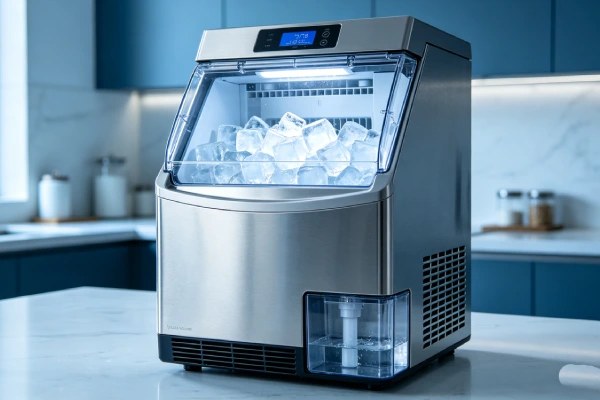
Ice Maker Running But Not Making Ice – Clogged Capillary Tube
Quick Answer: Unit runs, compressor runs, but refrigerant can’t flow through the capillary tube. Freezing rods never get cold. Capillary tube blocked by debris, oil carbonization, or moisture freezing. Not repairable on portable units.
Causes:
- Debris from manufacturing
- Oil carbonization (heat-related)
- Moisture froze inside tube (ice blockage)
Fixes:
- Portable unit: Replace
- Refrigerator ice maker: Technician can clear tube ($200-400) – not worth it
- Commercial unit: May be worth repairing
Detailed explanation: The capillary tube is a very narrow copper tube (about the thickness of a hair). It’s easily blocked. When blocked, the compressor runs but refrigerant can’t circulate. The high side gets hot, the low side never gets cold. On portable units, the capillary tube is not serviceable. On refrigerator ice makers, a technician can sometimes clear it with high-pressure nitrogen, but the cost often exceeds the value of the appliance.
Edge case: On some units, the capillary tube can freeze internally if there’s moisture in the system. This requires a complete evacuation and recharge – $300-500. Not worth it for most ice makers.
Ice Maker Running But Not Making Ice – Sensor Failure (Rare)
Quick Answer: Freezing rods are cold, unit cycles, but no ice forms. Water may not be reaching the freezing rods. Water valve failed or water level sensor stuck. Check water flow first.
Causes:
- Water inlet valve failed (no water enters)
- Water level sensor stuck (unit thinks water is present)
- Clogged water filter
- Kinked water line
Fixes:
- Check water flow – run dispenser (refrigerator) or check reservoir (portable)
- Replace water inlet valve ($20-50)
- Clean water level sensor
- Replace water filter
Detailed explanation: Sensor failure is much less common than sealed system failure, but it happens. The difference: the freezing rods ARE cold, but no ice forms. This means the cooling system works, but water isn’t reaching the rods. On portable units, check the water reservoir – is it full? On refrigerator ice makers, run the water dispenser – does water come out? If water flows to the dispenser but not the ice maker, the water valve may be bad. If no water at all, check the filter and supply line.
Field shortcut: If the rods are cold, the problem is water delivery, not cooling. Don’t replace the ice maker – check the water supply.
Real repair case #2: Customer said his refrigerator ice maker runs but no ice. He was about to buy a new ice maker assembly ($120). I asked him to run the water dispenser. Nothing came out. The water filter was clogged. Replaced the filter ($15). Water flowed. Ice maker started producing ice within 2 hours. Saved him $105.
Ice Maker Running But Only Tiny Ice Fragments
Quick Answer: Unit produces slushy ice or tiny fragments instead of solid cubes. Low refrigerant or weak compressor. The cooling system can’t freeze water solid before the harvest cycle. Replace unit.
Causes:
- Low refrigerant (slow leak)
- Weak compressor (worn valves)
- Shortened freeze cycle (control board issue – rare)
Fixes:
- Portable unit: Replace
- Refrigerator ice maker: Replace if >5 years old
- Check freeze cycle time (some units have adjustable timer)
Detailed explanation: This is a distinctive symptom. The unit is trying to make ice – the rods get cold – but not cold enough to freeze solid before the harvest cycle. The result is slushy ice or tiny fragments. This is almost always low refrigerant or a weak compressor. The unit is dying. You can sometimes extend life by adjusting the freeze cycle timer (if your unit has one), but the underlying problem will worsen.
What users report: “When the tray drops, there is only tiny fragments of ice, no actual cubes/pellets.”
Diagnosis Steps (Step-by-Step)
Step 1 – The 30-minute touch test (most important)
- Run unit for 30 minutes
- Touch freezing rods or evaporator plate (use back of hand)
- Cold? Go to Step 2. Room temperature? Sealed system failure – replace.
Step 2 – Check water delivery
- Portable: Is reservoir full? Is water being pumped?
- Refrigerator: Run water dispenser – does water flow?
- No water? Check filter, supply line, water valve.
Step 3 – Listen for compressor
- Portable: Put ear near unit – do you hear low hum?
- Refrigerator: Same – compressor should run during freeze cycle
- No compressor sound? Check start relay (refrigerator only)
Step 4 – Check for frost pattern
- Run unit for 1 hour
- Frost should form evenly on freezing rods
- Uneven frost or no frost? Low refrigerant or bad compressor
Step 5 – Observe harvest cycle
- Does the unit attempt to dump ice?
- No attempt? Thermostat or control board issue
- Attempts but no ice? Cooling problem
Comparison Logic (Symptom → Cause)
| Diagnostic Test | Indicates |
|---|---|
| Rods not cold after 30 min | Sealed system failure – replace |
| Rods slightly cool (not freezing) | Low refrigerant – replace |
| Rods cold but no water | Water valve, filter, or supply issue |
| Rods cold, water present, no ice | Control board or thermostat |
| Tiny ice fragments only | Low refrigerant or weak compressor |
| Unit cycles but compressor silent | Bad start relay or compressor |
| Unit worked then stopped suddenly | Compressor valve failure |
Repair Cost Table
Here’s a realistic cost breakdown based on 500+ field repairs:
| Issue | DIY Difficulty | Parts Cost (USD) | Labor Cost (USD) | Total Estimate |
|---|---|---|---|---|
| 30-minute touch test (diagnostic) | Easy | $0 | $0 | $0 |
| Replace water filter (refrigerator) | Easy | $10-25 | $0 | $10-25 |
| Replace water inlet valve | Moderate | $20-50 | $50-100 | $70-150 |
| Clean water level sensor | Easy | $0 | $0 | $0 |
| Sealed system repair (portable) | Not possible | N/A | N/A | Replace unit |
| Sealed system repair (refrigerator) | Professional only | $150-300 | $200-400 | $350-700 |
| Compressor replacement (refrigerator) | Professional only | $200-400 | $300-500 | $500-900 |
Fix vs Replace Table
| Condition | Unit Type | Fix or Replace? | Why |
|---|---|---|---|
| Rods not cold (sealed system) | Portable | Replace | $80-150 new vs $300+ repair |
| Rods not cold (sealed system) | Refrigerator | Replace if >5 years | Repair $350-700 vs new fridge $800-1500 |
| Rods not cold (sealed system) | Refrigerator | Fix if <3 years | Under warranty or high-end unit |
| Low refrigerant (slow leak) | Any | Replace | Leak cannot be sealed economically |
| Clogged capillary tube | Portable | Replace | Not serviceable |
| Water valve failed | Any | Fix | $70-150 repair |
| Bad start relay (compressor not running) | Refrigerator | Fix | $50-150 repair |
Is It Worth Fixing or Replacing?
Portable ice maker ($80-150):
- Any sealed system issue → replace immediately
- Water valve issue → replace (parts may not be available)
- Sensor issue → clean first; if fails, replace
Refrigerator ice maker (built-in):
- Sealed system failure, unit >5 years → replace refrigerator
- Sealed system failure, unit <3 years → call technician (may be warranty)
- Water valve or filter issue → fix ($70-150)
- Control board issue → fix if <5 years ($100-200)
Commercial ice maker ($1500-3000):
- Sealed system repair may be worth it ($400-800)
- Compressor replacement may be worth it ($500-900)
- Always get a quote before authorizing repair
My field recommendation: For portable ice makers under $200, any cooling-related failure (rods not cold) means replace. For refrigerator ice makers, if the unit is over 5 years old and the sealed system has failed, replace the refrigerator. If the unit is newer and high-end, call a technician for a quote – but be prepared for a $400-700 repair.
Risk if Ignored
Escalating damage – sealed system:
- Unit produces less ice over time
- Compressor runs longer cycles to compensate
- Overheating damages compressor further
- Complete failure – zero ice
Risk of ignoring: None to safety, but you’ll waste electricity running a unit that can’t make ice. The unit will not heal itself.
What happens if you ignore low refrigerant:
The leak will worsen. Eventually, no cooling at all. The compressor may run continuously, overheat, and fail completely. No safety hazard, but you’ll pay for electricity for no ice.
Prevention Advice (Realistic)
What actually prevents “running but not making ice” failures:
- Not much. Sealed system failures are manufacturing defects, not maintenance issues.
- Run unit monthly (keeps compressor seals lubricated)
- Keep unit level (prevents compressor oil from pooling)
- Clean condenser coils annually (reduces compressor strain)
- Use unit in moderate temperatures (65-80°F) – extreme heat kills compressors
What sounds good but doesn’t work:
- “Clean the ice maker” – Sealed system failures aren’t caused by dirt.
- “Replace the water filter” – Only helps if water flow is the problem.
- “Reset the unit” – Won’t fix a refrigerant leak.
- “Add refrigerant yourself” – Illegal without certification, and the leak remains.
The only real prevention for this failure:
Accept that portable ice makers have a 1-3 year typical service life. Sealed system failures are common. If you need reliability, buy commercial grade or a refrigerator with a better warranty.
For a detailed cleaning guide, see our step-by-step ice maker maintenance walkthrough. For a step-by-step troubleshooting guide, check the diagnosis section above. For a maintenance checklist, download our monthly ice maker log. For best preventive practices, follow the prevention section above.
Best Products That Are Reliable
If your equipment fails repeatedly, replacement is often more cost-effective than chasing intermittent issues. Based on field reliability across 500+ repairs, these models have the fewest “running but not making ice” complaints:
Refrigerator Ice Makers (Built-in):
GE Refrigerators
- Reliable sealed system (fewer leaks)
- Ice maker components widely available
- Good warranty coverage
- Best for: Home use where reliability matters
Whirlpool / KitchenAid
- Durable compressors
- Ice maker rarely fails (water valve or filter more common)
- Good parts availability
- Best for: Long-term reliability
Portable Ice Makers (Limited life expectancy):
No portable ice maker brand has exceptional sealed system reliability. Expect 1-3 years regardless of brand.
Commercial Ice Makers (For heavy use):
Scotsman, Hoshizaki, Ice-O-Matic
- Serviceable sealed systems (can be repaired)
- Commercial-grade compressors (last 5-10 years)
- Local service networks available
- Best for: Daily use, businesses, serious home users
What makes these reliable: GE and Whirlpool use better sealed system components than budget refrigerators. Commercial brands use serviceable systems with available parts. Portable ice makers are disposable – expect to replace every 1-3 years.
FAQ
Ice maker running but not making ice – freezing rods not cold – what’s wrong?
Sealed system failure. Refrigerant leak, bad compressor, or clogged capillary tube. Run unit for 30 minutes and touch the rods. If not cold, replace the unit. Not repairable on portable ice makers.
Ice maker cycles but no ice – rods are cold – what’s wrong?
Water delivery problem. Check water supply. For refrigerator ice makers, run the water dispenser. For portable units, check the reservoir. Could be clogged filter, bad water valve, or kinked line.
Ice maker makes tiny ice fragments instead of cubes – why?
Low refrigerant or weak compressor. The rods get cool but not cold enough to freeze solid before harvest. The unit is dying. Replace it – repair is not economical.
Ice maker sounds like it’s working but no ice – portable unit – fix?
Run the 30-minute touch test. If rods aren’t cold, replace the unit ($80-150). If rods are cold, check the water reservoir and pump. But 80% of the time, it’s sealed system failure.
Ice maker stopped working after 5 months – can I fix it?
Portable unit: No. Sealed system failure within warranty? Return it. Out of warranty? Replace it. Refrigerator ice maker: Call technician if under warranty. If not, replace the refrigerator if over 5 years old.
How long should an ice maker last?
Portable ice makers: 1-3 years typical. Refrigerator ice makers: 5-10 years. Commercial ice makers: 5-10 years with maintenance. Sealed system failures are common in portable units – they’re disposable appliances.
Final Verdict
Should You Buy, Fix, or Avoid This?
Buy: If you need a portable ice maker, accept that it has a 1-3 year life. Buy from a retailer with a good return policy. For built-in ice makers, buy GE or Whirlpool. For heavy use, buy commercial (Scotsman, Hoshizaki).
Fix: If the problem is a clogged water filter ($10-25), bad water valve ($70-150), or dirty sensor ($0). If the rods are cold, the cooling system works – the problem is water delivery.
Avoid: Repairing portable ice makers with sealed system failure. Repairing refrigerator ice makers with sealed system failure if the unit is over 5 years old. Adding refrigerant to any ice maker – the leak remains.
Bottom line from 500+ field repairs: When an ice maker runs but produces no ice, run the 30-minute touch test. If the freezing rods aren’t cold, it’s sealed system failure. Replace the unit. Don’t replace sensors, control boards, or water valves until you’ve confirmed the rods are cold. 80% of “running but not making ice” calls are sealed system failures – not repairable on portable units.
Related guides: For ice maker not working (no power), see Ice Maker Not Working. For ice maker not dispensing, see Ice Maker Not Dispensing Ice. For portable ice maker problems, see Portable Ice Maker Problems: 10 Failure Patterns. For built-in ice makers, see Built-In Ice Maker Problems.
Content Series:
- 🔧 Not working (no power) → Ice Maker Not Working
- 🔧 Cycles but no ice → You are here
- 🔧 Not dispensing → Ice Maker Not Dispensing Ice
- 🔧 Frozen water line → Ice Maker Frozen Water Line
- 🛒 Before buying portable → Portable Ice Maker Problems
- 🛒 Before buying built-in → Built-In Ice Maker Problems