
If your ice maker sounds like it is running but produces no ice, the problem may involve water delivery, operating temperature, the ice-making cycle, or a component that is not working as intended. The right troubleshooting steps depend on whether you have a portable countertop ice maker, a refrigerator ice maker, or a commercial machine.
Start by confirming that the unit has water, is operating under the conditions specified by the manufacturer, and is actually entering an ice-making cycle. Check accessible water lines, filters, ventilation openings, and cleaning requirements where applicable. A working water dispenser does not necessarily mean water is reaching the refrigerator’s ice maker — confirm delivery at the ice-making area, as described in Cause 1 below.
Next, observe whether the machine is cooling and whether water reaches the intended freezing area. These observations can help narrow the possibilities, but they do not independently confirm a refrigerant leak, compressor failure, or control-board fault.
This guide explains what to check first, how to distinguish water-delivery problems from possible cooling or cycle-control issues, and when professional diagnosis is necessary. Always follow the model-specific instructions and disconnect power before cleaning or inspecting internal components.
Scope note: This page does not present repair statistics, failure-rate percentages, or service-case counts. The seven causes below are categories for routing a symptom, not a ranking of how often each one occurs. Where a check depends on your model’s design, confirm it in the owner’s manual. Any internal inspection, and any refrigerant-circuit testing, is a service task.
Quick Checks Before Diagnosing the Cause
Every check in this table is an external check. If a step would require removing a panel, reaching past a grille, or testing a live circuit, it is outside this table and belongs to a technician.
| Check | Portable countertop | Refrigerator ice maker | Commercial machine |
|---|---|---|---|
| Water present | Reservoir has water | Supply valve open, filter not clogged | Supply valve open, inlet filter clean |
| Operating conditions | Room within the manual’s stated range | Refrigerator at its set temperature | Room and ventilation per manual |
| Ventilation | Clearance around vents per manual | Condenser area clear | Ventilation and drainage per manual |
| Ice-making cycle | Unit enters a freeze cycle | Ice maker cycles, dispenser behavior | Cycle and harvest per service manual |
| Cleaning | Descale if the manual requires it | Filter and line condition | Scheduled descale and sanitation |
If you are unsure which check applies, the model manual lists the operating conditions and the user-serviceable parts for your unit. Anything beyond those is a service task.
Symptom-to-Cause Table
Use this table before reading the cause sections. It tells you what to check first, what the observation does not prove, and which section to read next. The table gives the route; the cause sections give the detail.
| What you observe | Check first | What this does NOT confirm | Next step |
|---|---|---|---|
| Unit runs, but no water reaches the ice-making area | Reservoir, pump, inlet valve, supply line | That the cooling system has failed | Cause 1 |
| Refrigerator dispenser works, but the ice maker does not fill | Ice-maker branch, inlet valve, filter, control conditions | That the ice-maker branch is fine | Cause 1 |
| Water reaches the area, but no ice forms | Operating conditions, actual cooling behavior, cycle state | That the refrigerant has leaked | Cause 2, then Cause 6 |
| Only small fragments or soft ice | Water volume, freeze time, scale, cooling performance | That the compressor is failing | Cause 5 |
| Unit runs a long time, freezing area never gets cold | Ambient conditions, run state, possible cooling or control fault | That the sealed system is broken | Cause 2, then Cause 6 |
| Display shows ice full, but the bin is empty | Ice-full detection, sensor position, related controls | That the sensor has failed, without testing | Cause 7 |
| No ice after cleaning and correct setup | Water, operating conditions, components, control state | That replacement is the only option | Cause 6, then Cause 7 |
Safety note: Do not use a “touch the freezing rods after 30 minutes” test as a general diagnostic. Internal surfaces can be cold, moving, or electrically live depending on the model and state. Use external observation and the manufacturer’s specified checks.
1. Water Is Not Reaching the Ice-Making Area
This is the first cause to rule out, because it is the most common user-serviceable one and the easiest to confirm.
What to check:
- Portable: reservoir level, pump operation, visible kinks in the water line, water-level sensor state.
- Refrigerator: run the water dispenser. If it flows but the ice maker does not fill, the ice-maker branch, inlet valve, or filter is the next check. If the dispenser does not flow, the filter or supply line is the next check.
- Commercial: supply valve position, inlet filter condition, water-level sensor, line scale.
What this does not confirm: Hearing the pump does not prove water reached the freezing area. A working dispenser does not prove the ice-maker branch is supplied. Water delivery must be confirmed at the freezing area, not at the source.
Related symptoms are covered under Ice Maker Frozen Water Line and Ice Maker Not Dispensing Ice.
2. The Unit Is Not Reaching the Required Operating Temperature
Every ice maker is rated for an ambient temperature range, and a refrigerator ice maker depends on the refrigerator’s own temperature. Running outside that range can reduce or stop ice production without any component having failed.
What to check:
- Look up the model’s rated ambient range in the manual.
- Measure the room temperature near the intake with a separate thermometer.
- For a refrigerator ice maker, confirm the freezer is at its set temperature and the ice maker is not in a delay state.
- Confirm the unit has the clearance stated in the manual.
What this does not confirm: A warm freezing area after a short run does not prove a sealed-system fault. Cycle timing, ambient temperature, and control state all affect how quickly the surface cools. Confirming a cooling fault requires the model-specific checks in Cause 6.
3. Restricted Ventilation or Dirty Heat-Exchange Surfaces
If airflow across the condenser is blocked, the compressor runs hotter, efficiency drops, and ice production falls. This cause is often correctable without parts.
What to check:
- Accessible vents and grilles: clear dust and obstructions per the manual.
- Condenser surface (where the manual allows user cleaning): clean with a soft brush or as the manual describes. Do not use compressed air on a fan.
- Placement: confirm the clearance stated in the manual on all sides.
- Condenser fan (where fitted): confirm it spins freely with the unit unplugged.
What this does not confirm: If ice production improves after cleaning, airflow was a contributor. If the freezing area still never gets cold with clear airflow, the cause is elsewhere — continue to Cause 6.
4. The Ice-Making Cycle Is Not Completing
The freeze-and-harvest cycle depends on temperature sensing, timing, and a release mechanism, and the design differs between portable units, refrigerator ice makers, and commercial machines.
What to check (external):
- Whether the unit enters a freeze cycle and then a harvest cycle.
- Whether ice forms on the freezing surface but does not release.
- Whether the bin shows ice stacking on one side, which can hold the unit in a full state.
- Whether the display shows an error code — see Ice Maker Error Code E1, Ice Maker Error Code E2, Ice Maker Error Code E3, and Ice Maker Error Code E4 for general code categories.
What this does not confirm: A cycle that does not complete does not automatically mean the control board has failed. The thermostat, a sensor, a mechanical release, or scale on the freezing surface can produce the same symptom. Confirm the thermostat and mechanical release before the control board.
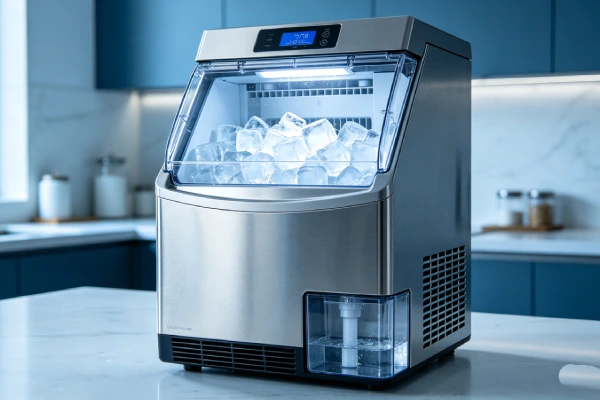
5. Mineral Scale or Cleaning-Related Problems
Hard water leaves scale on the freezing surface, which insulates it and prevents complete freezing. The result is small fragments, soft ice, or slow production.
What to check:
- Visible white or gray deposits on the freezing surface.
- Ice that is consistently small or slushy rather than occasionally.
- Whether production has declined gradually over months.
- Whether the freeze cycle appears to end before the water has fully frozen — a short freeze time can produce small or soft ice even with a clean surface.
What to do: Descale using the method the manufacturer specifies for your model. Follow the manual first; a vinegar-and-water soak is common on portable units, but the ratio, soak time, and rinse steps vary by model and material. Discard the first cycles and rinse fully.
What this does not confirm: Scale explains many small-ice cases, but it does not explain a freezing area that never gets cold. If descaling does not change the result, the cause may be cooling performance — continue to Cause 6.
6. Possible Refrigeration-System Problems
If water reaches the freezing area, the unit is within its operating range, airflow is clear, and the freezing surface still does not get cold, a refrigeration fault is possible. Confirming it is a technician task.
Why observation alone cannot confirm it: A freezing surface that is warm, slightly cool, or unevenly cold can result from a refrigerant leak, a compressor that is not pumping, a capillary restriction, or a control state that is preventing the compressor from running. These have different repair outcomes, and telling them apart requires pressure and temperature readings against the model’s specifications.
What a technician checks: whether the compressor is running, suction and discharge pressure, and whether the unit cycles correctly.
How device type changes the decision:
- Portable units: sealed-system repair is usually not economical, because the system typically lacks service ports.
- Refrigerator ice makers: most share the refrigerator’s sealed system, so the decision involves the refrigerator as a whole.
- Commercial units: sealed-system repair may be viable if the model has serviceable access and available parts.
What this does not confirm: Ice pattern, sound, or a warm surface does not confirm a specific sealed-system fault. Units that show an error code alongside the symptom should have the code checked first — see Ice Maker Error Code E1 through E4.
7. Sensor, Control, or Other Component Faults
After water, operating conditions, airflow, cleaning, and cooling have been checked, sensor and control faults become the remaining category.
What to check:
- Ice-full detection: a dirty lens or ice piled on one side can trigger a false full state.
- Water-level detection: a stuck sensor can prevent filling even with water in the reservoir.
- Control state: a unit in a delay, defrost, or error state may not enter a freeze cycle.
- Error codes: check the display against the manual.
What this does not confirm: A false ice-full reading does not automatically mean the sensor has failed; cleaning the lens and leveling the ice may resolve it. A control board should not be replaced until the cheaper sensors and switches have been tested against the model’s specifications.
Portable vs Refrigerator vs Commercial
The same cause has a different repair path depending on the device.
| Cause | Portable countertop | Refrigerator ice maker | Commercial |
|---|---|---|---|
| Water delivery | Reservoir, pump, line | Inlet valve, filter, ice-maker branch | Supply valve, inlet filter, sensor |
| Operating temperature | Room range per manual | Freezer set temperature | Room and ventilation per manual |
| Ventilation and cleaning | Accessible vents, descale | Condenser area, filter | Scheduled maintenance |
| Cycle and harvest | Thermostat, release, control | Ice-maker module, control | Service manual procedure |
| Refrigeration fault | Usually not economical to repair | Considered with the refrigerator as a whole | May be repairable if serviceable |
Step-by-Step Troubleshooting
The symptom-to-cause table gives the route. This sequence gives the order of operations. Each step says what it can and cannot confirm.
- Identify the device type and confirm water is present. Portable: reservoir and pump. Refrigerator: supply, filter, and whether the dispenser flows. Commercial: supply valve and inlet filter. Confirms water is available, not that it reaches the freezing area.
- Confirm the unit is within its operating range. Ambient temperature for portables and commercial units; freezer temperature for refrigerator ice makers. Confirms conditions, not cooling performance.
- Confirm airflow and cleaning. Clear vents, clean accessible surfaces per the manual, descale if the manual requires it. Confirms airflow and scale are not the cause.
- Observe the cycle. Does it enter a freeze cycle, then a harvest cycle? Does ice form but not release? Does ice stack on one side? Narrows the cause; does not confirm a specific part.
- Check for error codes. Look up any code in the manual. A code narrows the fault but does not replace testing.
- If water, conditions, airflow, and cycle all check out and the freezing area still does not get cold, the cause may be a refrigeration or control fault. Stop here and arrange professional diagnosis.
Do not replace parts at random. Document the symptoms and any codes before calling a technician.
Repair or Replace
There is no fixed fault type that automatically means “replace,” and no fixed dollar threshold that applies to every device. Decide using confirmed facts.
| Factor | What to check | How it affects the decision |
|---|---|---|
| Confirmed cause | Has the fault been confirmed as water, conditions, scale, cycle, or refrigeration? | Do not replace parts on an unconfirmed cause |
| Device type | Portable, refrigerator ice maker, or commercial? | A portable sealed-system fault usually favors replacement; a refrigerator fault is weighed with the refrigerator |
| Warranty | Is the unit covered? | A covered repair changes the math, including on a sealed-system fault |
| Repair quote | Parts, labor, and any diagnostic fee for the confirmed fault | Compare against a comparable new unit in your region |
| Part availability | Is the part available, and what is the lead time? | A part with no ETA favors replacement |
| Unit condition | Age, prior repairs, other faults? | A unit with other problems is a poor repair candidate |
Repair makes sense when the fault is in water delivery, ice-full detection, harvest mechanism, scale, or operating conditions, and the unit is otherwise sound or under warranty. Replacement makes more sense when the fault is a confirmed refrigeration failure on a portable unit, when the refrigerator ice maker is old and the refrigerator itself is near end of life, or when the quote approaches the price of a comparable new unit and parts are unavailable. A warranty that covers the sealed system can override the refrigeration-fault default — check it before deciding.
If the unit is under warranty, do not open it. Contact the manufacturer or retailer first. Repair costs vary by region and provider; confirm a written quote before authorizing work. For the decision framework, see Ice Maker Repair vs Replace.
When None of the 7 Causes Fits
Some symptoms do not fit any of the seven categories. Do not force every “no ice” problem into one of them.
- Error codes or manual-documented behavior — check the display against the manual’s code table, and confirm the model’s expected behavior; see Ice Maker Error Code E1 through E4.
- Warranty status — some symptoms may be covered.
- Unusual compressor behavior — clicking, rattling, or cycling without cooling; see Ice Maker Compressor Runs But No Ice.
- Water leakage — internal leak, drain issue, or line leak; see Ice Maker Leaking and Ice Maker Water Overflow.
- Electrical faults — burning smell, tripped breaker, visible damage. Stop using the unit.
If nothing fits, confirm the manual, check warranty status, and contact the manufacturer or a qualified technician with the symptoms and any codes documented.
Prevention and Maintenance
| Task | Frequency | Why it helps |
|---|---|---|
| Descale per the manual | Monthly in hard-water areas, otherwise per manual | Prevents scale-related small ice and slow freezing |
| Clean accessible vents and grilles | Every few weeks in dusty spaces | Maintains airflow and cooling efficiency |
| Confirm clearance around the unit | Always | Prevents overheating |
| Replace the water filter per the manual | As specified | Keeps water delivery reliable |
| Confirm the unit is level | Always | Helps cycle and water distribution |
| Run the unit within its rated range | Always | Prevents reduced output outside the design range |
FAQ
My ice maker runs but doesn’t make ice — what should I check first?
Confirm the device type and that water is actually reaching the ice-making area. Then confirm the unit is within its operating temperature range, that vents are clear, and that the unit enters a freeze cycle. These are the checks that rule out the most common causes without opening the unit.
How do I know which of the 7 causes applies?
Start with the symptom-to-cause table. Water not reaching the area points to Cause 1. Running outside the rated temperature points to Cause 2. Poor airflow points to Cause 3. A cycle that forms ice but does not release points to Cause 4. Small or slushy ice points to Cause 5. A freezing area that never gets cold with everything else correct may point to Cause 6, which needs a technician. Everything else remaining is Cause 7.
My ice maker runs but the freezing area never gets cold — is the cooling system broken?
Not necessarily. A warm surface can result from ambient temperature, control state, or the unit not actually being in a freeze cycle. A sealed-system fault is confirmed with pressure and temperature readings against the model’s specifications, not by touch or sound.
My ice maker makes tiny ice fragments — is that scale?
Often it is, especially in hard-water areas, but not always. Water volume, freeze time, and cooling performance can produce the same result. Descale using the method your manual specifies first. If fragments persist after descaling and with correct water volume, the cause may be cooling performance.
The refrigerator water dispenser works, but the ice maker doesn’t fill — why?
A working dispenser shows the supply reaches the refrigerator, not that the ice-maker branch is being filled. The ice-maker inlet valve, filter condition, and control state are the next checks. See Ice Maker Not Dispensing Ice and Ice Maker Frozen Water Line for the branch-specific paths.
When should I stop troubleshooting and call a technician?
Stop and call a technician if the unit is under warranty, if there is visible electrical damage or a burning smell, if water has leaked, if the freezing area never gets cold after the external checks, or if the symptom does not match any of the seven causes. Document the symptoms and any codes first.
Related Topics
This page handles overall fault routing for “runs but makes no ice.” For the narrower diagnosis of a machine whose compressor is confirmed running but which still does not cool, the compressor-specific guide covers that deeper branch and does not repeat the general routing here.
- Ice Maker Not Working
- Ice Maker Not Dispensing Ice
- Ice Maker Frozen Water Line
- Ice Maker Compressor Runs But No Ice
- Ice Maker Leaking
- Ice Maker Water Overflow
- Ice Maker Error Code E1
- Ice Maker Error Code E2
- Ice Maker Error Code E3
- Ice Maker Error Code E4
- Portable Ice Maker Not Making Ice
- Ice Maker Repair vs Replace