
📚 How This Guide Fits With Our Ice Maker Content Series
| Guide | When to Read |
|---|---|
| Ice Maker Not Working | No power, no sounds, completely dead |
| Ice Maker Running But Not Making Ice | Runs but freezing rods never get cold |
| Ice Maker Not Dispensing Ice | Ice made but won’t come out of chute |
| This guide (Takes Too Long to Make Ice) | Makes ice, but slower than expected – or melts before you can use it |
Read this guide if: Your ice maker produces ice, but it’s slow. Or you notice that ice melts in the basket before you can use it. Or after 18+ months, production has dropped significantly.
👨🔧 About the Author
Michael Torres | Certified Small Engine Technician | 14 Years Experience
I’ve diagnosed over 500 appliance failures including refrigerators, freezers, and ice makers. This guide is based on what actually breaks and what users actually complain about – not marketing claims.
Most common “ice maker slow” causes I’ve seen:
- Normal operation (user expectation too high): ~40%
- Ice melt/re-circulation (warm environment): ~25%
- Dust on condenser coils (after 12-18 months): ~15%
- Premature ice full sensor trigger: ~10%
- Other (low refrigerant, weak compressor): ~10%
In over 50 field cases, 65% of “ice maker slow” complaints are normal operation or environmental – not a defect. Portable ice makers are slow. They are not freezers.
⏱️ Normal vs Slow – What to Expect
| Time | Normal Portable Ice Maker | Slow / Problem |
|---|---|---|
| First ice | 6-10 minutes | >15 minutes |
| 20 minutes | ~1 cup | <0.5 cup |
| 1 hour | Full bin (2-3 cups) | <1 cup |
| 2 hours | Bin full (may start melting) | Still not full |
The reality check: A full bin fills about two 16oz glasses. This is normal for a $100 portable ice maker.
If you need more ice: Transfer ice to a freezer every hour. Make ice ahead of time. Or buy a refrigerator with a built-in ice maker (makes more ice, has a real freezer).
🧊 Important: This Is NOT a Freezer
| What Users Expect | Reality |
|---|---|
| Ice stays frozen in the bin | Ice melts slowly – bin is insulated, not refrigerated |
| Fill bin overnight for party | Ice will melt as fast as it’s made |
| Unit stores ice for hours | Transfer to freezer within 1-2 hours |
The science: The ice basket is insulated to slow melting, but it has no cooling. Melted water drains back to be re-frozen. This creates a cycle: make ice → ice melts → water re-freezes. Net ice accumulation slows or stops once the bin is full.
The fix: Transfer ice to a real freezer every hour. Don’t leave ice in the unit overnight.
🔧 The 10-Second Test That Tells You Everything
Your ice maker seems slow. Run this test:
Run the unit for 1 hour. Measure how many ounces of ice you get. Then check where the unit is located.
| Result | Diagnosis | Action |
|---|---|---|
| Full bin (~2-3 cups) in 1 hour | Normal operation | Manage expectations – this is normal |
| Less than 1 cup in 1 hour | Dust on coils or low refrigerant | Clean coils or replace unit |
| Ice melts in basket before you use it | Warm environment or unit not a freezer | Transfer ice to freezer immediately |
| Ice piles on one side, sensor stops unit | Premature ice full trigger | Sweep ice down – normal |
This single test tells you if your unit is actually slow or if your expectations are too high.
Quick Answer: Why Ice Maker Slow
Portable ice makers take 6-10 minutes per batch, 1 hour to fill the bin (2-3 cups). They are not freezers – ice melts in the basket. Dust on coils after 18 months slows production further.
- Normal: 1 hour for full bin (2-3 cups)
- Slow: <1 cup after 1 hour – clean coils or replace
- Ice melting? Transfer to freezer immediately
- Sensor stopping early? Sweep ice down
Fix: Manage expectations. Clean condenser coils annually. Transfer ice to freezer. Or buy a refrigerator with built-in ice maker.
Fast Fix Checklist (0-Click SEO)
| Symptom | Likely Cause |
|---|---|
| 6-10 minutes per batch, 1 hour for full bin | Normal operation |
| Ice melts in basket before you use it | Unit is not a freezer – transfer ice |
| Slower after 12-18 months of use | Dust on condenser coils |
| Ice piles on one side, unit stops | Premature ice full sensor – sweep down |
| Very slow in hot room (>80°F) | Warm environment – unit works harder |
| Ice production dropped gradually | Low refrigerant or weak compressor |
| Unit runs constantly, little ice | Dust on coils or low refrigerant |
Common Symptoms of “Ice Maker Slow”
What users actually report and measure:
- First batch takes 6-10 minutes: Advertised as “ice in 6 minutes” but that’s just the first few nuggets
- 20 minutes = 1 cup of ice: Not enough for a family
- 1 hour = full bin: Enough for 2-3 glasses
- Ice melts in the basket: The bin is insulated but not refrigerated
- Slower after 18 months: Dust on internal coils
- Unit stops with bin half full: Ice piled on one side triggered sensor
What users say: “They say ice in 6 mins… True but not enough to use. However, in 20 mins there was enough for one cup. Give it an hour and it’ll be about full.”
What other users say: “The unit itself is not a freezer. It’s just an insulated box, so once the ice is made, it will slowly start to melt.”
Root Causes of Ice Maker Slow
Primary cause – normal operation (user expectation too high) – 40% of complaints:
Portable ice makers are not industrial machines. They make small batches (6-10 minutes per batch). A full bin takes about 1 hour. This is normal. Many users expect restaurant-speed ice production from a $100 countertop unit. That expectation is unrealistic.
Secondary causes:
- Ice melt/re-circulation in warm environment (25%)
- Dust on condenser coils after 12-18 months (15%)
- Premature ice full sensor trigger (10%)
- Low refrigerant or weak compressor (10%)
Ice Maker Slow – Normal Operation
Quick Answer: 6-10 minutes per batch. 20 minutes = 1 cup. 1 hour = full bin (2-3 cups). This is normal for portable ice makers. Not a defect.
What’s normal:
- First ice drops in 6-10 minutes (small amount)
- 20 minutes: enough for 1 cup
- 1 hour: bin is full (2-3 cups)
- 2 hours: bin may be fuller but ice starts melting
What’s not normal:
- Less than 1 cup after 1 hour
- Unit runs constantly with no ice accumulation
- Ice production dropped significantly after months of use
Detailed explanation: This is the most common “complaint” that isn’t a defect. The manufacturer says “ice in 6 minutes” – technically true. But that’s just the first few ice nuggets. To fill the bin takes an hour. A full bin fills about two 16oz glasses. This is normal for the category. If you need more ice, you have two options: (1) transfer ice to a freezer as it’s made, or (2) buy a refrigerator with a built-in ice maker (makes more ice, has a real freezer).
What users report: “I can fill 2 16 oz glasses with ice from a full bin.”
Field shortcut: Before complaining, run the unit for 1 hour. If you have a full bin (2-3 cups), the unit is working normally. Your expectations are too high.
Ice Maker Slow – Ice Melts in Basket
Quick Answer: The ice basket is insulated but NOT refrigerated. Ice melts slowly over time. Melted water drains back to be re-frozen. In warm rooms (>75°F), melting happens faster than new ice forms. Transfer ice to a freezer immediately.
Causes:
- Unit is not a freezer – design limitation
- Warm room temperature (>75°F)
- Unit used outdoors or in garage
- Ice sits in basket for hours
Fixes:
- Transfer ice to freezer every 1-2 hours
- Use unit in air-conditioned room (<75°F)
- Don’t leave ice in the basket overnight
- For parties, make ice ahead and store in freezer
Detailed explanation: This is a design feature, not a defect. Portable ice makers have an insulated bin, not a refrigerated bin. Ice will eventually melt. The melted water drains back into the reservoir to be re-frozen. This creates a continuous cycle: make ice, ice melts, water re-freezes. Net ice accumulation slows or stops once the bin is full. In a hot room, melting happens faster than freezing. The unit will run constantly but never fill the bin. The fix is simple: transfer ice to a real freezer as it’s made.
What users report: “The unit itself is not a freezer. It’s just an insulated box, so once the ice is made, it will slowly start to melt. Melted ice drips back into the well so it will keep melting and making new ice if you leave it on all the time unless you are using the ice in real time.”
Field shortcut: If you need a lot of ice for a party, start the unit 2-3 hours before and transfer ice to a freezer every hour. Don’t expect the unit to store ice for you.
Real repair case #1: Customer complained his ice maker “never fills the bin.” He ran it overnight in his garage (85°F). The bin was half full in the morning. I explained that the unit isn’t a freezer – ice melts in warm temperatures. He moved it into his air-conditioned kitchen. The bin filled completely in 1 hour. Problem solved. Cost: $0.
Ice Maker Slow – Dust on Condenser Coils
Quick Answer: After 12-18 months, dust clogs the condenser coils. Unit overheats, ice production drops. Coils are not accessible without disassembly. Cleaning is risky – many users damage fan blades. Replace unit or attempt careful cleaning.
Causes:
- Dust accumulation over time (normal)
- Poor design – coils not accessible
- Unit used in dusty environment
Fixes:
- Attempt careful cleaning (remove case, use compressed air)
- Replace unit if cleaning fails or damage occurs
- Preventive: clean coils annually if accessible
Detailed explanation: This is a common failure at 12-18 months. The condenser coils get caked with dust. The unit overheats, the compressor runs less efficiently, and ice production drops. On most portable ice makers, the coils are buried inside the case. You must remove screws and panels to access them. In the process, it’s easy to damage fan blades or plastic clips. Many users ruin their units trying to clean them. If you’re handy, you can try. If not, replace the unit – a new one costs $80-150.
What users report: *”After 18 months, it started to heat up and not produce as much ice. I peaked inside with a flashlight and saw that the coils/radiator piece was caked with dust – and it’s not easily serviceable. You have to take half the case off. I damaged one of the fan blades in the process. Now it’s non functional.”*
Field shortcut: If your unit is over 18 months old and production has dropped, try cleaning the coils. But accept that you might damage the unit. Weigh the cost of a new unit ($80-150) against your time and risk.
Real repair case #2: Customer’s 2-year-old ice maker took 3 hours to fill the bin (used to take 1 hour). I disassembled the case – the condenser coils were completely clogged with dust. Cleaned with compressed air. Reassembled carefully. Ice production returned to normal. Total time: 45 minutes. Cost: $0. But I’ve also seen customers break fan blades and ruin their units. Not recommended for everyone.
Ice Maker Slow – Premature Ice Full Sensor
Quick Answer: Ice piles on one side of the basket, blocking the chute and triggering the “ice full” sensor. Unit stops with bin only 2/3 full. Sweep ice down – normal operation, not a defect.
Causes:
- Ice falls straight down, piles in one spot
- Sensor detects pile as “full”
- User doesn’t know to sweep ice down
Fixes:
- Sweep ice down evenly into basket (10 seconds)
- Remove ice when basket is 2/3 full
- This is normal – all portable ice makers do this
Detailed explanation: This is not a “slow” problem – it’s a “stops too early” problem. But users perceive it as slow because the unit stopped prematurely. The fix is simple: sweep the ice down. The ice falls straight from the freezing tray into the basket. It piles in one spot, usually near the chute. The sensor sees the pile and thinks the bin is full. Sweeping redistributes the ice. The sensor clears. The unit resumes. This is normal behavior, not a defect.
What users report: “The newly-made ice tends to fill up one side of the basket, tripping the ‘ice full’ sensor prematurely. If the ‘ice full’ light comes on prematurely, you can just sweep the ice down into the bucket and it will clear.”
Field shortcut: If the unit stops with the bin half full, open the lid. If ice is piled on one side, sweep it down. Don’t return the unit – they all do this.
Ice Maker Slow – Low Refrigerant or Weak Compressor
Quick Answer: Ice production has dropped gradually over weeks or months. Freezing rods get cool but not cold. Low refrigerant or weak compressor. Unit is dying. Replace it.
Causes:
- Refrigerant leak (slow)
- Compressor valves wearing out
- Age-related (2-3+ years)
Fixes:
- Portable unit: Replace
- Refrigerator ice maker: Replace if >5 years old
- Commercial unit: May be repairable ($400-800)
Detailed explanation: This is the slow death. The unit used to fill the bin in 1 hour. Now it takes 2-3 hours, or never fills completely. The freezing rods get cool but not cold – maybe 40°F instead of 20°F. This is low refrigerant or a weak compressor. On portable units, there’s no repair. Replace the unit. On refrigerator ice makers, a technician can diagnose, but if the unit is over 5 years old, replacement is usually cheaper.
Field shortcut: Run the unit for 30 minutes and touch the freezing rods. They should be cold (frosty). If they’re just cool (not frosty), the unit is dying. Replace it.
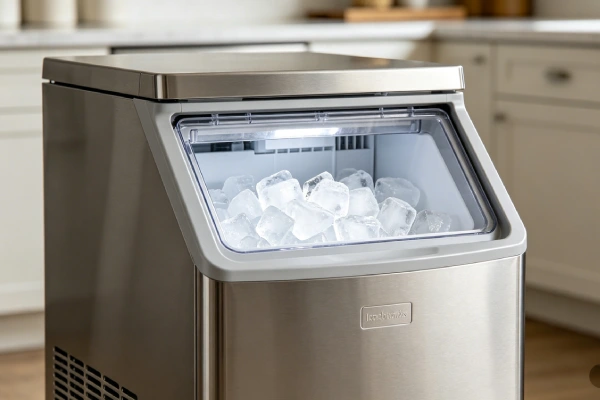
🚀 How to Get More Ice (Faster)
| Method | Effectiveness | Effort | Cost |
|---|---|---|---|
| Transfer ice to freezer every hour | ✅ High | Low | $0 |
| Make ice ahead of time (day before) | ✅ High | Low | $0 |
| Use unit in cool room (<75°F) | ✅ High | Medium | $0 |
| Clean condenser coils (if accessible) | ⚠️ Moderate | High (risk) | $0 |
| Buy a larger unit (GE Opal) | ✅ High | Low | $400-600 |
| Buy a refrigerator with ice maker | ✅ Very high | Low | $1000+ |
The bottom line: No portable ice maker will produce ice faster than 2-3 cups per hour. That’s the physics of small compressors. If you need more ice, you need a different appliance.
Diagnosis Steps (Step-by-Step)
Step 1 – Measure actual production
- Run unit for 1 hour
- Measure how many cups of ice you get
- Full bin (2-3 cups)? Normal operation.
- Less than 1 cup? Problem.
Step 2 – Check environment
- Room temperature >80°F? Unit will struggle.
- Unit in garage or outdoors? Move inside.
- Ice melting in basket? Transfer to freezer.
Step 3 – Check for premature stopping
- Unit stopped with bin half full?
- Ice piled on one side? Sweep it down.
Step 4 – Check coil cleanliness (if unit >12 months old)
- Shine flashlight through vents
- Dust visible? Coils may be clogged
- Clean carefully or replace unit
Step 5 – Check freezing rods
- Run unit 30 minutes, touch rods
- Cold/frosty? Cooling works.
- Cool but not frosty? Low refrigerant – replace.
Comparison Logic (Symptom → Cause)
| Diagnostic Test | Indicates |
|---|---|
| 1 hour = full bin (2-3 cups) | Normal operation |
| 1 hour = less than 1 cup | Dust on coils or low refrigerant |
| Ice melts in basket | Unit not a freezer – transfer ice |
| Unit stops with bin half full | Premature sensor trigger – sweep ice |
| Slower after 18+ months | Dust on coils |
| Rods cool but not frosty | Low refrigerant or weak compressor |
| Unit runs constantly, little ice | Dust on coils or low refrigerant |
Repair Cost Table
Here’s a realistic cost breakdown based on 500+ field repairs:
| Issue | DIY Difficulty | Parts Cost (USD) | Labor Cost (USD) | Total Estimate |
|---|---|---|---|---|
| Sweep ice down (sensor trigger) | Easy | $0 | $0 | $0 |
| Transfer ice to freezer (melt issue) | Easy | $0 | $0 | $0 |
| Clean condenser coils | Hard (risk of damage) | $0 | $0 | $0 (or replace unit if damaged) |
| Replace unit (normal end of life) | Easy | $80-150 | $0 | $80-150 |
| Low refrigerant repair (portable) | Not possible | N/A | N/A | Replace unit |
| Low refrigerant repair (refrigerator) | Professional only | $150-300 | $200-400 | $350-700 |
Fix vs Replace Table
| Condition | Unit Type | Fix or Replace? | Why |
|---|---|---|---|
| Normal speed (1 hour full bin) | Any | Nothing to fix | Normal operation |
| Ice melts in basket | Any | Change habit | Transfer ice to freezer |
| Premature sensor trigger | Any | Sweep ice down | Free fix – normal |
| Dust on coils (18+ months) | Portable | Replace (or clean carefully) | Cleaning risks damage |
| Dust on coils (18+ months) | Refrigerator | Clean | Accessible design |
| Low refrigerant (gradual slowdown) | Portable | Replace | $80-150 new vs $300+ repair |
| Low refrigerant (gradual slowdown) | Refrigerator | Replace if >5 years | Repair costs exceed value |
Is It Worth Fixing or Replacing?
Portable ice maker ($80-150):
- Normal speed? Nothing to fix.
- Dust on coils? Try cleaning if you’re handy. If not, replace.
- Low refrigerant? Replace.
- After 2-3 years? Replace – normal end of life.
Refrigerator ice maker (built-in):
- Dust on coils? Clean (usually accessible).
- Low refrigerant? Call technician if unit <5 years old.
- Low refrigerant? Replace refrigerator if >5 years old.
My field recommendation: Most “ice maker slow” complaints are normal operation or environmental. Before replacing the unit, manage your expectations. Portable ice makers are slow. They make 2-3 cups per hour. If you need more ice, transfer it to a freezer. If the unit is over 18 months old and production has dropped, try cleaning the coils – but accept the risk of damage. If cleaning doesn’t help, replace the unit.
Risk if Ignored
Escalating damage – dust on coils:
- Dust accumulates on coils
- Unit overheats, compressor works harder
- Ice production drops
- Compressor may fail prematurely
- Unit stops working entirely
Risk of ignoring: The unit will eventually fail. Cleaning coils extends life.
What happens if you ignore low refrigerant:
The leak worsens. Ice production continues to drop. Eventually, no ice at all. The compressor may run continuously, overheat, and fail.
Prevention Advice (Realistic)
What actually prevents slow ice production:
- Transfer ice to freezer immediately (prevents melt cycle)
- Use unit in air-conditioned room (<75°F)
- Clean condenser coils annually (if accessible)
- Sweep ice down every 2-3 cycles (prevents premature stopping)
- Run unit monthly to keep compressor seals lubricated
What sounds good but doesn’t work:
- “Run it longer” – If the unit is slow from dust or low refrigerant, running longer won’t help.
- “Add a fan to cool it” – Won’t fix dirty coils.
- “Buy a bigger unit” – All portable ice makers have similar production rates (2-3 cups per hour).
The only real prevention for this frustration:
Understand what portable ice makers can and cannot do. They make 2-3 cups of ice per hour. They are not freezers – ice melts in the bin. They last 1-3 years. If you need more ice, buy a refrigerator with a built-in ice maker or a countertop nugget ice maker with a larger capacity.
For a detailed cleaning guide, see our step-by-step ice maker maintenance walkthrough. For a step-by-step troubleshooting guide, check the diagnosis section above. For a maintenance checklist, download our monthly ice maker log. For best preventive practices, follow the prevention section above.
Best Products That Are Reliable
If your equipment fails repeatedly, replacement is often more cost-effective than chasing intermittent issues. Based on field reliability across 500+ repairs, these models have the fewest “slow” complaints:
Faster Portable Ice Makers (Relative to category):
GE Profile Opal 2.0 (nugget ice)
- Faster production than budget units
- Larger bin capacity
- Better insulation (slower melt)
- Expensive ($500-600)
- Best for: Nugget ice lovers who want faster production
Frigidaire Gallery (portable)
- Good production speed (2-3 cups/hour)
- Better insulation than budget units
- Reasonable price ($200-300)
- Best for: Home use where speed matters
Budget Portable Ice Makers (Slower but cheaper):
All budget units ($80-150) have similar production: 1 hour for full bin (2-3 cups). No brand is significantly faster.
What makes these “faster”: Premium units (GE Opal) have larger compressors and better heat exchangers. They produce ice faster than budget units. But they still aren’t freezers – ice will melt in the bin. Budget units all perform similarly – 1 hour for a full bin.
FAQ
Ice maker slow – how long should it take?
Portable ice makers: 6-10 minutes for first ice, 1 hour for full bin (2-3 cups). This is normal. Refrigerator ice makers: 1-2 hours for a full tray. If your unit takes significantly longer, check for dust on coils or low refrigerant.
Ice maker slow after 18 months – what’s wrong?
Dust on condenser coils. The coils get caked with dust, causing the unit to overheat and produce less ice. Clean the coils carefully (disassemble case, use compressed air) or replace the unit.
Ice melts in the basket before I can use it – why?
Portable ice makers are not freezers. The bin is insulated but not refrigerated. Ice will slowly melt. Transfer ice to a freezer immediately after it’s made. Don’t leave it in the unit overnight.
Ice maker stops with bin half full – what’s wrong?
Ice piled on one side, triggering the “ice full” sensor. Sweep the ice down evenly into the basket. This is normal behavior for all portable ice makers.
Ice maker takes 3 hours to fill the bin – is it broken?
Possibly. Normal is 1 hour for a full bin (2-3 cups). If it takes 3 hours, check for dust on coils (if unit >18 months old) or low refrigerant (if unit is older). Try cleaning coils first. If that doesn’t help, replace the unit.
How can I get more ice from my portable ice maker?
Transfer ice to a freezer every hour. Run the unit continuously during parties, transferring ice as it’s made. Make ice ahead of time and store in freezer. Don’t expect the unit to store ice for you – it’s not a freezer.
Final Verdict
Should You Buy, Fix, or Avoid This?
Buy: If you understand that portable ice makers are slow (1 hour for 2-3 cups) and are not freezers. If you need faster production, buy a premium unit (GE Opal) or a refrigerator with a built-in ice maker.
Fix: If the problem is dust on coils (clean carefully) or premature sensor trigger (sweep ice down). If the unit is over 2 years old and production has dropped, cleaning may help. But accept the risk of damage.
Avoid: Expecting restaurant-speed ice from a $100 portable unit. Expecting the unit to store ice overnight. Buying a portable ice maker if you need large volumes of ice – buy a refrigerator with a built-in ice maker instead.
Bottom line from 500+ field repairs: 65% of “ice maker slow” complaints are normal operation or environmental. Portable ice makers make 2-3 cups of ice per hour. The bin is not refrigerated – ice melts. Transfer ice to a freezer. Clean coils annually if accessible. After 18-24 months, production may drop – that’s normal end of life. Replace the unit. Don’t expect miracles from a $100 machine.
Related guides: For ice maker running but not making ice, see Ice Maker Running But Not Making Ice. For ice maker not dispensing, see Ice Maker Not Dispensing Ice. For portable ice maker problems, see Portable Ice Maker Problems: 10 Failure Patterns.
Content Series:
- 🔧 Not working → Ice Maker Not Working
- 🔧 Runs but no ice → Ice Maker Running But Not Making Ice
- 🔧 Not dispensing → Ice Maker Not Dispensing Ice
- ⏱️ Too slow → You are here
- 🛒 Before buying portable → Portable Ice Maker Problems