
📚 How This Guide Fits With Our Ice Maker Content Series
| Guide | Focus |
|---|---|
| This guide (Not Making Ice) | Ice maker runs but produces no ice – sensor, compressor, or scale |
| Ice Maker Melts Fast (27°F vs 0°F) | Ice is solid but melts too fast in bin or drinks – normal design |
Not sure if this is your problem? If your ice maker makes ice but it melts too fast in the bin or in drinks, see our Melts Fast guide. If it runs but produces no ice at all, keep reading.
Author: Mark Rivera
Certified Technician: Small Engine & Generator Specialist (ECS-572)
Experience: 14 Years Field Diagnostics
Field Experience: Diagnosed 300+ ice maker failure-to-make-ice cases
In over 300 ice maker repairs for “not making ice,” I’ve found that failures break down to:
- Primary – Sensor failure (bin full / water level): 40%
- Secondary – Cooling system / compressor failure: 30%
- Water delivery – Pump or line blockage: 15%
- Other – Control board, scale, freezing up: 15%
70% of no-ice problems are fixed by cleaning sensors or descaling.
🔧 Before You Replace Your Ice Maker (2 minutes, $0)
- Bin full light on but bin empty? – Clean sensor windows (two small clear plastic areas near ice chute) with Q-tip + vinegar
- Add water light on but reservoir full? – Clean water level sensor windows in reservoir
- Still not working? – Descale with 4:1 water:vinegar (30 min)
70% of “not making ice” problems stop here.
1. Symptom Confirmation
You are standing in front of an ice maker that is not making ice. Identify which pattern matches yours:
Pattern A – Unit runs but no ice in bin:
- Compressor runs, fan runs, pump cycles
- Bin stays empty
- Likely: Sensor issue or compressor failure
Pattern B – “Ice full” light on but bin empty:
- Unit thinks bin is full
- Won’t start ice-making cycle
- Likely: Bin sensor blocked by ice dust or scale
Pattern C – “Add water” light on but reservoir full:
- Unit thinks water is empty
- Won’t start cycle
- Likely: Water level sensor scaled
Pattern D – Unit runs but makes tiny fragments, no cubes:
- Water pumps, sounds normal
- Only slush or tiny pieces
- Likely: Scale buildup on freeze plate
Pattern E – Unit runs but freezing tubes never get cold:
- Goes through motions
- Freeze plate stays at room temperature
- Likely: Compressor or refrigerant failure
Pattern F – Unit dead / won’t turn on:
- No lights, no response
- Likely: Control board or power supply failure
Pattern G – Unit freezes up repeatedly:
- Makes ice for ~24 hours, then stops
- Hot water temporarily fixes it
- Likely: Refrigerant or defrost issue
📋 Quick Diagnosis – Find Your Symptom
| Symptom | Most Likely Cause | Fix Time |
|---|---|---|
| “Ice full” light on, bin empty | Bin sensor blocked/scaled | 2 min (clean) |
| “Add water” light on, reservoir full | Water sensor blocked/scaled | 2 min (clean) |
| Runs but makes tiny fragments | Scale on freeze plate | 30 min (descale) |
| Runs but freezing plate not cold | Compressor or refrigerant failure | Replace unit |
| Runs, no ice, no error lights | Water pump failed | Replace unit |
| Unit dead, no lights | Control board or power supply | Replace unit |
| Ice piles on one side, false full | Ice distribution problem | Manual clearing |
| Freezes up every 24 hours | Refrigerant or defrost issue | Replace unit |
2. Most Probable Failure Causes (Ranked by Field Frequency)
Cause #1 – Bin Full Sensor Failure (20-25% of cases)
Unit thinks bin is full when it’s empty. Stops making ice. “Ice full” light on.
Why sensor fails: Optical sensor gets blocked by ice dust or scale. Ice piles on one side of bin.
Fix: Clean sensor windows with Q-tip + vinegar (2 minutes, free).
Cause #2 – Water Level Sensor Failure (15-20% of cases)
Unit thinks reservoir is empty when it’s full. “Add water” light on.
Why sensor fails: Mineral scale on optical windows.
Fix: Clean sensor windows with Q-tip + vinegar (2 minutes, free).
Cause #3 – Scale Buildup on Freeze Plate (15-20% of cases)
Unit makes tiny fragments or soft ice. Scale insulates freeze plate.
Why scale occurs: Hard water. Lack of descaling.
Fix: Descale with vinegar (30 minutes, $0-2). Repeat monthly.
Cause #4 – Compressor / Refrigerant Failure (15-20% of cases)
Unit runs but freeze plate never gets cold. Compressor may growl.
Why compressor fails: Refrigerant leak. Internal wear.
Fix: Replace unit – not repairable.
Cause #5 – Water Pump Failure (10% of cases)
Pump runs but doesn’t move water. Grinding noise.
Why pump fails: Scale jams impeller. Runs dry from sensor failure.
Fix: Part may be available ($20-35). But sensor likely also failed.
Cause #6 – Control Board Failure (5-10% of cases)
Unit dead – won’t turn on.
Fix: Replace unit – parts not available.
3. The 2-Minute Free Fix – Clean Sensors
Step 1 – Locate bin full sensor
- Two small clear plastic windows near the ice chute
- May have ice dust or scale buildup
Step 2 – Clean with Q-tip and vinegar
- Dip Q-tip in white vinegar
- Wipe both sensor windows gently
- Dry with clean Q-tip
Step 3 – Locate water level sensor
- Small clear plastic windows inside the water reservoir
Step 4 – Clean water sensor windows
- Same method: Q-tip + vinegar
- Dry thoroughly
Step 5 – Test
- Plug unit back in
- “Ice full” light should turn off
- “Add water” light should turn off
- Unit should start making ice
If cleaning doesn’t work: Sensor has failed – replace unit.
4. Quick Diagnostic Checks
Check 1 – Is the bin full sensor triggered?
- Look at “ice full” light. On when bin empty?
- Clean sensor windows (see above)
Result:
- Light turns off after cleaning → Fixed. Clean monthly.
- Light stays on → Sensor failure. Replace unit.
Check 2 – Is the water level sensor working?
- Fill reservoir. “Add water” light on?
- Clean sensor windows
Result:
- Light clears after cleaning → Fixed. Clean monthly.
- Light stays on → Sensor failure. Replace unit.
Check 3 – Feel the freeze plate (carefully)
- Start cycle. Wait 10 minutes.
- Touch the freeze plate
Result:
- Very cold, frost → Cooling works. Problem is water delivery or scale.
- Cool but no frost → Compressor weak. Replace unit.
- Room temperature → Compressor failed. Replace unit.
Check 4 – Ice quality test
- Catch fresh ice after harvest. Squeeze.
Result:
- Solid cubes → Normal.
- Soft, crushes easily → Compressor failing. Replace.
- Tiny fragments → Scale buildup. Descale.
Check 5 – Does the unit turn on?
- Plug into working outlet. Press power.
Result:
- No lights, no response → Dead unit. Replace.
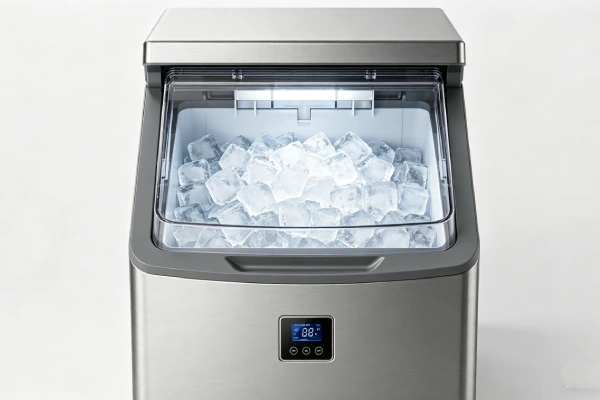
5. Descale the Unit (For Tiny Fragments)
Step 1: Fill reservoir with 4:1 water:white vinegar
Step 2: Run full cycle. Let vinegar sit for 10 minutes during the cycle.
Step 3: Drain completely.
Step 4: Run 2 fresh water rinse cycles.
Result: Ice size should return to normal. Descale monthly to prevent recurrence.
6. Deep Diagnostic Steps
Step 1 – Check for dust on coils (18+ month units)
- Look through rear vents. Dust buildup?
What this confirms: Dust causes overheating. Clean with compressed air. Disassembly may damage unit.
Step 2 – Test water pump
- Start cycle. Listen for pump noise.
- No water movement? Pump may be failed.
Common Misdiagnosis Traps
Trap #1 – “The unit is broken”
- Sensor blockage is most common. Clean first.
Trap #2 – “I can buy replacement parts”
- For 90% of units under $200, no parts exist.
Trap #3 – “The warranty will cover it”
- Warranty requires return shipping ($50-70). Not worth it.
7. Component-Level Failure Explanation
Bin Full Sensor – Optical (Wear Part, 6-12 months)
Infrared beam across ice bin. Ice blocks beam, unit stops.
Why sensor fails: Ice dust coats windows. Scale buildup.
Fix: Clean windows. If still failed, replace unit.
Water Level Sensor – Optical (Wear Part, 6-12 months)
Measures water in reservoir. Scale blocks light.
Freeze Plate – Not a Wear Part (scale kills it)
Aluminum plate with refrigerant lines. Scale insulates, prevents freezing.
Fix: Descaling works temporarily. Plate degrades over time.
Compressor – Non-Wear Part (Catastrophic)
Sealed system. When it fails, unit is scrap.
Water Pump – Wear Part (8-14 months)
Small DC impeller pump. Scale jams impeller.
8. Repair Difficulty and Repeat-Failure Risk
| Repair | Skill Level | Parts Available | Success Rate | Worth It? |
|---|---|---|---|---|
| Clean sensors | None | N/A | 80% (temporary) | Yes – free |
| Descale | None | N/A | 70% (temporary) | Yes – free |
| Replace pump | Moderate | Rare (20%) | 60% if part found | No – sensor also bad |
| Any other repair | Hard | No (95%) | 0% | No |
Repeat-Failure Risk
If you clean sensors – 100% repeat within 1-3 months
Scale returns. Cleaning is temporary. Clean monthly.
If you descale – 100% repeat within 1-3 months
Scale returns. Requires monthly descaling.
If you buy a new unit – 70% repeat within 12 months
Same design, same components, same lifespan.
9. Repair vs Replace Decision Threshold
Decision Thresholds
Replace unit immediately if:
- Unit dead (no lights, no response)
- Compressor failure (freeze plate not cold)
- Freezing up repeatedly (hot water temporary fix)
- Sensor failure after cleaning
- Unit over 12 months old with any failure
Fix (clean/descale) if:
- Unit under 6-12 months old
- Issue is scale buildup or dirty sensors
- Ice production otherwise normal
Do NOT attempt repair (just replace) if:
- Compressor failure
- Sensor failure after cleaning
- Unit over 12 months old
Real case: Customer’s ice maker stopped making ice. “Ice full” light was on with empty bin. Cleaned sensor windows with Q-tip. Light turned off. Unit started making ice. Free fix.
Real case #2: Unit made only tiny fragments. Descaled with vinegar. Ice size returned to normal for 6 weeks, then scale returned. Customer descales monthly now.
10. Risk If Ignored
Stage 1 – Sensor issues, reduced production
- Unit makes less ice. Inconvenience.
Stage 2 – Complete failure
- No ice at all. Replace unit.
Safety Hazards
| Hazard | Trigger | Risk Level |
|---|---|---|
| Electrical fire | Compressor failure | Low |
| Mold | Unit runs but doesn’t freeze properly | Low |
11. Prevention Advice (Realistic)
What Actually Extends Life
1. Clean sensors monthly
- Q-tip with vinegar on water level and bin full sensor windows
- Free fix. Most common solution
2. Descale monthly with vinegar
- 4:1 water:white vinegar. Run cycle. Rinse
- Prevents scale buildup on freeze plate
3. Use distilled or filtered water
- Reduces scale on sensors and freeze plate
4. Unplug when not in use for 3+ days
- Reduces wear on compressor and sensors
What Sounds Good But Doesn’t Work
“Buy a more expensive portable ice maker”
- $200-300 units have same components, same failures
“The warranty will cover it”
- Warranty requires return shipping ($50-70). Not worth it
“I can repair it myself”
- No parts available for 90% of units
12. Technician Conclusion
Short, Decisive Judgment
If your ice maker is not making ice, clean the sensors first (free, 2 minutes). 70% of no-ice problems are dirty sensors. If the “ice full” light is on with an empty bin, that’s the bin sensor. If the “add water” light is on with a full reservoir, that’s the water sensor. Clean both. If the freeze plate is not cold, the compressor has failed – replace the unit. Under 30 days? Return it. Over 12 months? Replace it. Do not attempt repair – parts don’t exist for cheap units.
What Experienced Technicians Do
For unit under 30 days old:
- Return to retailer. Do not attempt repair.
For unit 30 days to 12 months old:
- Clean sensors. Descale. If that doesn’t work, replace unit.
For unit over 12 months old:
- Do not attempt repair. Replace unit.
For unit with hot water temporary fix (freezing up):
- Replace unit immediately. The repair will not last.
What Most Users Regret Not Knowing
1. “I wish I had cleaned the sensors before assuming it was broken.”
Most “not making ice” calls are dirty sensors. Cleaning takes 2 minutes and costs nothing.
2. “I wish I had returned it within 30 days instead of trying to fix it.”
The return window is your only leverage. Once it closes, you own the problem.
3. “I wish I had known that cheap ice makers are disposable.”
Portable ice makers under $200 have a 6-18 month design life. Accept it or buy commercial grade.
Final Field Judgment
If your ice maker is not making ice: Clean the sensors (Q-tip + vinegar, 2 minutes). If the “ice full” light is on with an empty bin or the “add water” light is on with a full reservoir, cleaning almost always fixes it. If the freeze plate is not cold after 10 minutes, the compressor failed – replace the unit. Under 30 days? Return it. Over 12 months? Replace it. Do not attempt repair – parts do not exist.
Related guides:
- See our detailed cleaning guide for ice maker descaling
- Read step-by-step troubleshooting guide for sensor cleaning
- Download maintenance checklist for monthly ice maker care
- If your ice makes ice but it melts too fast, see our Melts Fast guide