
A countertop ice maker that feels hot is not automatically broken. The compressor and condenser move heat out of the water and into the room, so warm exhaust air and a warm cabinet around the rear grille are part of normal operation. The problem starts when the machine cannot get rid of that heat, and that is when ice production slows and cycles get longer.
This page separates normal heat from overheating, explains the five things that cause it, sets out how to find the clearance your model actually needs, and gives the order to fix it in. It covers portable ice maker and countertop ice maker units; faults that are not about heat have their own pages.
A note on the clearance figure: no single number applies to every machine. Published requirements differ by brand and model, and some models state different figures for freestanding and cabinet installation. Where a number appears here, it is a range to check against your manual, not a rule.
Note on model differences: clearance, vent positions and fan layout vary by brand and model. Where a step involves a part, the manual shows where it is.
Is It Normal for a Countertop Ice Maker to Get Hot?
Normal Heat During Ice Making
Two kinds of heat come off the machine and they are not the same thing.
- Exhaust heat. Air leaving the rear or side vents is warmer than the room. That is the heat removed from the water, and it is the machine working.
- Cabinet heat. The plastic around the compressor and the rear grille feels warm. This is conducted heat from the components inside, and a warm cabinet with normal production is a machine within its limits.
What is not normal is a rear grille that is uncomfortable to hold a hand near, or a machine that has become noticeably hotter than it was when new under the same conditions.
Signs Your Ice Maker May Be Overheating
Overheating shows in behaviour, not in how hot the plastic feels:
- Cycles that have got longer compared with the machine’s own earlier performance.
- Production that has fallen, or ice that comes out soft, wet or partly formed.
- Shutdowns mid-cycle that restart after a pause, with no water or bin fault.
- A sound that is new — a growl, grind or rattle from the rear.
- A rear grille that is uncomfortable to be near, with less clearance than the manual asks for.
Two of those together — longer cycles plus a hot rear grille with tight clearance — is the pattern this page is about.
Why Is My Countertop Ice Maker Overheating?
Insufficient Ventilation or Clearance
The rear grille and side vents need to move air, and a unit against a wall or in a closed cabinet cannot. Heat builds around the condenser, the compressor runs hotter, and the cycle lengthens. This is the most common cause and the easiest to fix.
Dusty Condenser or Blocked Air Vents
Dust, pet hair and kitchen grease build on the grille and, where it is reachable, on the condenser fins, and that layer insulates the coil. On models where the condenser sits behind a service panel, cleaning it may not be a user task — check the manual before removing anything. The external vents are always a user task, and they are what to clean first.
High Room Temperature or Nearby Heat Sources
An ice maker next to an oven, beside a dishwasher that exhausts warm air, or in direct sun works with pre-warmed intake air. The manual states an operating temperature range; a room outside it is a cause, not a fault. The same clearance that works in a cool kitchen may not be enough in a hot one.
Cooling Fan Not Working Properly
The fan moves air across the condenser. If it has stopped, is obstructed, or runs slowly and noisily, the machine overheats whatever the clearance.
How to check it from outside, safely: with the machine running, listen at the rear for the fan and feel for air movement at the exhaust grille. A fan that is silent, or that has a new rattle, is the finding. Do not reach into the housing; clear only obstruction you can see from outside with the machine unplugged. An ice maker fan not spinning is a fault in its own right, and it is one of the few causes here that a user can confirm from outside.
Compressor or Internal Cooling Problems
If clearance, vents, room temperature and fan are addressed and the machine still overheats, the fault is inside the sealed system. A machine that runs but never cools is the ice maker compressor runs but no ice pattern, and that belongs to a technician.
How Much Clearance Does a Countertop Ice Maker Need?
There is no single number. What the manuals actually do is state a figure per face, and sometimes a different figure for cabinet installation.
Rear Clearance
The rear is where the condenser and exhaust usually sit, so this is the first figure to check. Measure from the wall to the back of the machine, including any rear bulge and the plug.
Side and Top Clearance
Side vents need side clearance; a machine under a wall cabinet needs room above for exhaust to escape. Both figures are in the manual, and neither is safe to guess from another model.
Clearance Requirements by Brand and Model
Published requirements cluster into three patterns, and knowing which pattern your manual uses tells you what to measure:
| Pattern in the manual | What it usually looks like | What to check |
|---|---|---|
| One figure for all faces | A single number, “on all sides” | Measure all four faces against it |
| Separate rear and side figures | A larger rear figure, a smaller side figure | Measure rear and sides separately, not the average |
| Separate freestanding and built-in figures | Two sets of numbers | Use the set that matches how you are installing it |
The actual numbers differ between brands — some state a small figure, others a larger one — which is why the number on any listing, or in any article including this one, is a starting point rather than a specification.
What to do: find the clearance section of your manual. If the manual is missing, the model number on the plate will locate it through the manufacturer’s support.
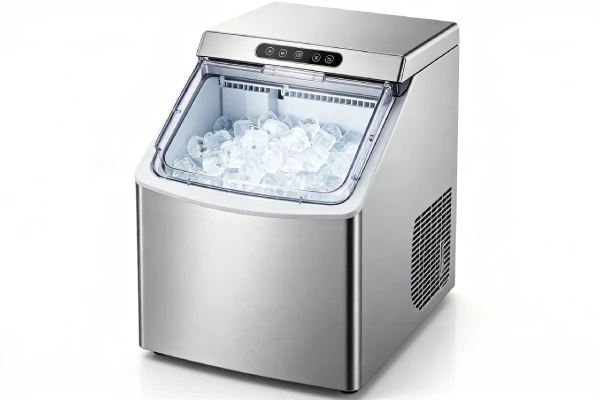
Can You Put a Countertop Ice Maker in a Cabinet?
Only if the manual permits built-in installation and states the clearance for it. A closed cabinet has less air movement than an open counter, and where the manual gives separate figures for built-in use, those are the ones that apply.
If the cabinet has a door, the machine needs air in and air out while the door is closed; check whether the manual addresses that, and if it does not, treat the machine as freestanding rather than assuming the cabinet is fine because the machine fits.
How to Fix an Overheating Countertop Ice Maker
Work in this order and stop when the behaviour returns to normal.
Move the Ice Maker Away from Walls and Heat Sources
Switch off and unplug first. Give the rear and sides at least the clearance the manual states, move it clear of the oven, the dishwasher and direct sun, and check the room is within the operating range. This is free and it is the most common fix.
Clean the Air Vents and Condenser Area
Unplug, then clear the external grille and vents of dust and pet hair with a vacuum brush or a dry cloth. Do not spray water into the housing and do not remove panels unless the manual lists that as a user task. How often depends on the kitchen: a home with pets or a kitchen that fries often needs the grille checked more often than a quiet one.
Check the Cooling Fan
With the machine unplugged, clear obstruction you can see at the fan. Then run the machine and listen: a fan that does not run, or runs slowly and noisily, needs a technician.
Let the Ice Maker Cool Down and Restart It
If the machine shut down mid-cycle, let it cool before restarting, then watch whether it completes a cycle at normal speed. A machine that completes cycles after cooling and clearance correction was overheating from its conditions, not failing.
When to Contact a Technician
Contact service if the machine still overheats after clearance, vents, room temperature and fan are addressed; if it runs but never cools; or if any of the safety signals below appear.
Countertop Ice Maker Overheating but Still Making Ice
If the machine is warm but producing at its usual rate, it is working within its limits and there is nothing to fix. The finding to act on is a change: output down and cycles longer than the machine’s own earlier performance.
If the output has fallen and the rear grille is hot with tight clearance, correct the clearance and clean the vents first, then reassess. A machine that recovers was constrained; one that does not is a candidate for service. If the basket is not filling at all, the ice maker not making ice checks run in parallel, and a countertop ice maker not making ice after the clearance correction is a fault rather than an installation problem.
When Is an Overheating Ice Maker Dangerous?
Stop using the machine and unplug it if you notice a burning smell, smoke, a plug or cord that is hot to the touch, or repeated breaker trips. These are not overheating symptoms to be managed with more clearance; they are reasons to stop.
Stop and arrange service or replacement if the machine is discoloured around the rear grille, if the cord or plug shows heat damage, or if it shuts down repeatedly even after cooling. A machine that leaks while overheating is the ice maker leaking case and should be stopped as well, because water near a hot cabinet is a second risk on top of the first.
How to Prevent a Countertop Ice Maker from Overheating
- Give it the clearance its manual states, on the rear, the sides and above, and keep it there. This is the one measure that prevents the whole problem.
- Keep the vents clear and vacuum the external grille on a regular interval, more often in a kitchen with pets or heavy cooking.
- Keep it out of heat: away from the oven, the dishwasher exhaust and direct sun, and inside the operating temperature range.
- Follow the maintenance schedule in the manual, including the ice maker descale interval, since scale in the water path and dust on the condenser both make the machine work harder. Portable ice maker maintenance and countertop ice maker cleaning intervals are stated per model, so the manual is the reference.
- Watch for the early signals — longer cycles, softer ice, a new noise — and correct the clearance before the machine is asked to run hot for weeks.
Frequently Asked Questions
Why does my countertop ice maker get hot on the sides?
The compressor and condenser reject heat into the cabinet and the room. A warm side is normal; a rear grille that is uncomfortable to be near, with falling output, is not.
Should an ice maker blow out hot air?
Yes. Warm exhaust air is the machine moving heat out of the water. What matters is that the air can leave.
Can poor ventilation stop an ice maker from making ice?
It can slow production and cause shutdowns, and over time it puts continuous extra load on the compressor. Correcting clearance and cleaning the vents is the first test.
Can I run a countertop ice maker inside a cabinet?
Only if the manual permits built-in installation and states the clearance for it, including how air gets in and out with the door closed.
How much clearance does my model need?
Whatever its manual states. Check whether it gives one figure for all faces, separate rear and side figures, or separate freestanding and built-in figures.
How do I check the fan without opening the machine?
With it running, listen at the rear and feel for air movement at the exhaust grille. A silent fan, or a new rattle, is the finding. Clear only visible obstruction, and only with the machine unplugged.
How long should I let an overheating ice maker cool down?
Until it restarts normally, then watch a full cycle. If it overheats again with correct clearance and clear vents, stop using it and arrange service.
Is a hot cabinet a sign the compressor is failing?
Not on its own. Heat is the machine working; the signal is a change in behaviour with the conditions checked first.