
If your ice maker is too slow, the first question is not “what is broken” but “is this the machine’s normal pace, or has something changed.” A unit that has always run at its own pace, a unit that has slowed recently, and a unit that cycles quickly but never fills the basket are three different cases. This guide covers all three, plus the soft ice, slushy ice and fast-melting ice that owners usually report alongside a slow machine.
This page is about a slow portable ice maker and countertop ice maker. It is not about ice maker filter replacement or the water filter inside some models; if your question is about a cartridge, that is a different topic. It is also not the same question as ice maker quick ice, where the machine is fast but the total output is small.
Note on model differences: Cycle time, first-ice time, daily output and basket capacity are stated per model. Use your manual or specification sheet for the rated figures; do not compare your unit against a number from another model or from advertising.
Normal vs. a Problem: A Quick Judgment Table
These are the portable ice maker problems that most often get confused with a genuine slowdown:
| What you observe | What to check first |
|---|---|
| New machine has always been slow | The manual’s rated cycle, plus room temperature and vent clearance; if no rated figure exists, build a baseline as described below |
| Slowed down suddenly | Vent clearance, room temperature, water level, recent changes |
| Getting slower over weeks | Record cycle time weekly; two consecutive weeks of increase is a trend, not a one-off |
| Ice has always been soft | Model design, as described in the manual |
| Ice used to be firm and now is soft | Freezing performance; measure cycle time at the same time |
| Slow and soft appear together | Freezing performance rather than storage or handling; confirm with the two-step check below |
| Ice melts in the basket | Whether the basket is refrigerated; this is storage, not speed |
| Basket never fills, but cycles are quick | Basket capacity and daily output, not cycle time |
Work from the top of the table down. Speed comes before firmness, because a longer cycle can explain softer ice, while softer ice alone cannot explain a longer cycle.
How Long Should an Ice Maker Take to Make Ice?
Four different numbers are often mixed together. Keep them separate:
- First-ice time: how long after startup the first ice drops.
- Cycle time: how long one freeze-and-harvest round takes.
- Daily output: the rated ice production over a day, under stated conditions.
- Basket capacity: how much ice the basket holds, which is not the same as daily output.
First Ice vs. a Full Basket
The first batch can arrive sooner or later than later batches, depending on how the unit starts. A full basket is not one cycle; it is many cycles. “It made ice in X minutes” and “the basket is full” are different claims, and a slow full basket does not automatically mean a slow first batch.
Why Ice-Making Time Varies by Model
Compressor size, evaporator design, ambient rating and whether the model has a refrigerated bin all change the cycle time. A model rated for a longer cycle is not faulty; it is built to a different specification. The manual’s figure for your model is the only fair absolute comparison.
When the Manual Gives No Rated Cycle Time
Build your own baseline instead of borrowing a number:
- Write down the date, room temperature, vent clearance and the time for three consecutive cycles.
- Repeat the same record once a week, under the same conditions.
- Two consecutive weekly records that are both slower than the first is a trend; a single slow session is not.
- A same-model user’s measured time is a weak reference at best, because their room, water and usage differ from yours. Use it to sanity-check an order of magnitude, never as your benchmark.
When Slow Ice Production May Indicate a Problem
A slow machine is worth investigating when any of these is true:
- It used to keep pace and now does not.
- Cycle time has gradually increased over weeks, confirmed by the weekly record above.
- The unit is slower than its own manual’s rated figure under the manual’s stated conditions.
- Slow production comes with unusual noise, a warning, or the unit stopping mid-cycle.
Why Is My Portable Ice Maker Making Ice So Slowly?
The causes below are listed in the order you can check them. Room and ventilation come first because they are the most common and the easiest to fix.
Room Temperature Is Too High
A hot room slows any ice maker. Check the manual’s stated operating temperature range, and compare your room against it.
If the unit can be moved, move it to a cooler spot and retest. If it is built into a counter and cannot be moved, do three things: lower the room temperature with the room’s own cooling, clear at least the manual’s stated clearance on all open sides, and add a small fan to move air past the vents without blowing dust into them. Retest after each change, one at a time, so you can tell which one helped.
Poor Ventilation Around the Ice Maker
The manual states a required clearance around the unit. Blocked vents or a unit pushed against a wall trap heat and slow production. Clear the space and retest.
Dust or Dirt Restricting Heat Dissipation
Exterior dust on vents and the surrounding area can reduce airflow. Clean what the manual says you can reach from outside. Dust on internal condenser coils is different: that is service work, so ask the manufacturer or a technician rather than removing panels yourself. The same applies if you suspect the unit is freezing over internally; that is not a cleaning task.
Water Temperature or Water Supply Issues
Warm water takes longer to freeze, though some models control inlet temperature.
Water level depends on the model. Units with a water-level window or float indicator should be checked against the minimum line before each session. Units with an “add water” light should be checked when the light comes on, not only when ice stops. Units with no indicator at all should be filled to the marked level in the manual and checked before each session.
If the manual specifies a water type, follow it; if it does not, ask the manufacturer rather than assuming distilled or tap.
Mineral Scale or Maintenance Problems
Scale on the water path and parts due for cleaning can slow production. Use the ice maker descale solution or the cleaning tablets your manual approves, at the concentration it states. If the manual gives no schedule, ask the manufacturer for the interval, the approved cleaning agent and the list of user-accessible parts.
Cleaning is not always easy on these units, and owners often describe them as hard to clean. Work within what the manual lists as user-accessible, and if black gunk or mold is visible in a part you cannot reach, treat that as a service question rather than scrubbing harder.
The Machine’s Performance Has Declined
If the conditions above are fine and the unit is still slower than its own rating, the cause may be inside the sealed system. That is not a user repair. Contact the manufacturer or a qualified technician with your measurements.
Why Is My Ice Maker Making Soft or Slushy Ice?
Normal Ice Characteristics of Some Portable Models
Some portable models are designed with a short cycle, and the ice they produce is softer and wetter than freezer ice. If your unit has always produced soft ice or slushy ice, and the manual describes it, that is the model’s normal output, not a fault.
When Soft Ice May Indicate Poor Freezing Performance
Soft ice is worth investigating when it is a change: the unit used to produce firmer ice and now does not, or the ice is soft alongside a longer cycle time.
How to Check Whether Ice Is Freezing Properly
Use a two-step check rather than a single squeeze:
- Record the cycle time for three consecutive batches and note the room temperature.
- Compare the ice from those batches with ice from when the unit was new, under similar room conditions.
If both numbers have moved toward slower and softer, treat it as a performance change and contact the manufacturer. If only the firmness changed and the cycle time did not, check storage and handling first, because ice that sits in the basket will soften without anything being wrong with the machine.
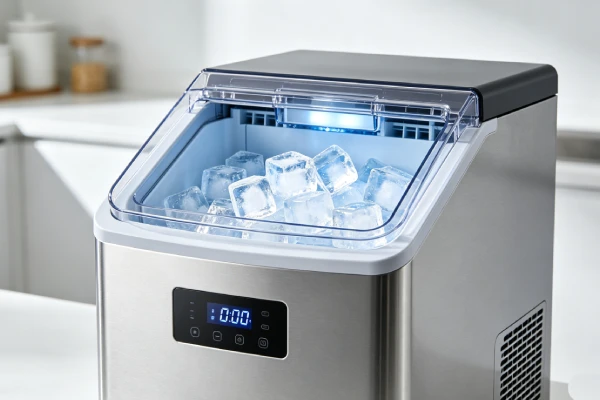
Why Does Ice From an Ice Maker Melt So Fast?
The Ice Basket Is Not a Freezer
Most portable ice makers use an insulated basket, not a refrigerated bin. Ice in that basket melts over time, which is why owners describe ice that melts overnight or ice that melts before the basket fills. That is a storage limitation, not a production fault. “The ice melts too fast” and “the machine is too slow” are often reported together when only one of them is actually happening.
Small or Wet Ice Cubes Melt More Quickly
Smaller and wetter cubes have more surface area and more surface water, so they melt faster in a drink. This is a property of the ice, not a sign of a failing compressor.
How to Store Ice After It Is Made
Transfer the ice within a few minutes of harvest, rather than letting it sit in the basket. Keep it in a sealed, wide container and break up clumps before they set. If you need slow-melting ice for spirits, a portable unit’s output may not suit that use; that is a buying decision, not a repair.
Why Is My Ice Maker Producing Wet or Clumped Ice?
Surface Water on Newly Made Ice
Ice harvested before it fully drains carries surface water. That is normal for many portable units and is why the ice feels wet when it comes out.
Ice Melting and Refreezing in Storage
If wet ice goes into a freezer in a single container, the surface water freezes and bonds the cubes. Transferring in smaller amounts and shaking the container as it freezes reduces the block.
How to Reduce Ice Clumping
Move the ice from basket to freezer within a few minutes of harvest, use a wider container, and break clumps early. If clumping continues even when you transfer within that window into a wide container, treat it as a harvest or drainage question and mention it when you contact the manufacturer.
A Short Note on Small Cubes, Cloudy Ice and Early “Ice Full”
These three come up often alongside slow production, but they are not speed problems:
- Small cubes: cube size is set by the model’s evaporator. A smaller cube than you expected is a specification issue, not a fault.
- Cloudy ice: clear ice requires directional freezing, which most portable units do not do. Cloudiness is a design characteristic.
- Early “ice full”: if ice piles on one side and trips the sensor, or the ice full sensor is stuck, sweep the ice across the basket every few cycles and check that the sensor moves freely. If the unit still stops early, that is a sensor or basket issue and belongs with service, not with the speed question.
How to Improve Ice Maker Performance
- Keep the clearance the manual requires around the unit.
- Use the water type the manual specifies.
- Follow the manual’s cleaning and descaling schedule, using the approved descaler or cleaning tablets.
- Do not overfill the basket or block the ice drop area.
- Record cycle time and firmness before and after any change, so you can tell whether the change helped.
How to Check Whether Your Ice Maker Is Actually Slow
- Time several consecutive cycles, not just one, and note the room temperature and vent clearance at the same time.
- Compare the result with your manual’s rated cycle time for your model, under the conditions the manual states.
- Check water level, water source and vent clearance.
- Clean the parts the manual lists as user-accessible, then retest.
- If the unit is still clearly slower than its own rating, contact the manufacturer with the measurements.
If your manual does not state a rated cycle time, use the baseline method above and treat a clear change from the unit’s own history as the signal.
If your machine is quick per cycle but the basket never fills, that is a capacity and daily-output question rather than a speed fault, and it is handled separately from this page.
When Should You Repair or Replace an Ice Maker?
Contact the manufacturer or a qualified service technician if:
- Cycle time is clearly longer than the manual’s rating after the checks above.
- Soft ice appears alongside a longer cycle, not on its own.
- The unit produces no ice at all, which is an ice maker not making ice situation rather than a speed issue, or it stops mid-cycle.
- The unit has ice in the basket but will not dispense it, which is a dispensing fault, not a speed fault.
- You see water leaking, or ice maker leaking water around the base.
- You hear buzzing, grinding or loud noise that continues after cleaning.
- There is a burning smell or damage to the cord or plug.
- The compressor runs but no ice forms.
- The problem involves the water pump, a fan that is not spinning, or a frozen water line.
The last three points cover different symptoms and different limits, so they are worth separating:
- Water pump: you hear the unit running but no water moves, or water flow stops partway through a cycle. Stop using it and contact the manufacturer; do not open the pump housing.
- Fan: you hear the compressor but the fan does not spin, or the unit gets unusually hot. Stop using it and contact the manufacturer.
- Frozen water line: water flow stops after a cold night or after storage, and normal cleaning does not restore it. Do not force water through or apply heat to internal parts; contact the manufacturer.
If you suspect a mold problem or see black gunk in a part the manual does not let you reach, that is also a service question rather than a cleaning task.
Consider a different machine only if the unit meets its own rating but the rating does not meet your need. That is a capacity question, not a repair.
Frequently Asked Questions
My manual does not give a rated cycle time. How do I know if my unit is slow?
Record cycle time weekly under the same room conditions and compare the unit with its own history. Two consecutive weekly records that are both slower is the signal, even without a rated figure.
Can I use another user’s measured cycle time as a reference?
Only as a rough order-of-magnitude check. Their room, water and usage differ from yours, so it cannot replace your own unit’s manual rating or your own baseline.
My unit is built into a counter and I cannot move it. What then?
Lower the room temperature, keep the manual’s clearance on all open sides, and add a small fan to move air past the vents. Retest after each change, one at a time.
Why is my ice maker taking longer than usual?
A change from the unit’s own past performance is the signal to investigate. Check room temperature, vent clearance, water level and the manual’s cleaning steps first, then compare the new cycle time with your baseline or the manual’s rating.
Why does my portable ice maker make soft ice?
Some models are designed with a short cycle and produce softer ice as normal output. If firmness has changed recently, or changed alongside a longer cycle, treat it as a performance issue and contact the manufacturer.
Does hot water make an ice maker slower?
Warmer water takes longer to freeze on models that do not control inlet temperature. Use the water temperature and water type your manual specifies, and compare cycle times under the same conditions.
Can dirty condenser coils slow down an ice maker?
Dust on internal condenser coils can reduce heat dissipation. That cleaning is service work, not user maintenance, so ask the manufacturer or a technician rather than opening the unit.
Why does my ice maker stop producing ice after a few batches?
A stop mid-cycle or after a few batches is an operational fault, not a speed issue. Check for a warning, a full basket or a water supply problem, and contact the manufacturer if it repeats.
What if my ice maker is quick but I never have enough ice?
That is a capacity question rather than a speed fault: cycle time, batch size and daily output are different measurements. Check your model’s daily output against your own use before treating it as a slow machine.