
Choosing an Ice Maker for Break Room use involves more than comparing purchase prices. The right option depends on how much ice your team uses, whether the machine can keep up during busy periods, how it is supplied with water, and who will handle cleaning and maintenance.
A Portable Ice Maker may work for a small team with modest ice demand, while a higher-volume workplace may need a commercial unit with a larger production capacity and a more suitable water and drainage setup. Before buying, compare actual production and storage specifications, installation requirements, maintenance needs, warranty terms, and total operating costs — not just the advertised daily ice output.
Scope note: This page is a buying and ownership guide for break-room ice makers. It does not present repair statistics, failure-rate rankings, model rankings, a fixed office lifespan, or a fixed replacement interval, and it does not claim or predict search rankings. It also does not claim a personal repair history or product-test experience for the author. Where a step depends on the specific model, the manufacturer’s manual and specification sheet take precedence.
Is a Portable Ice Maker Enough for Your Break Room?
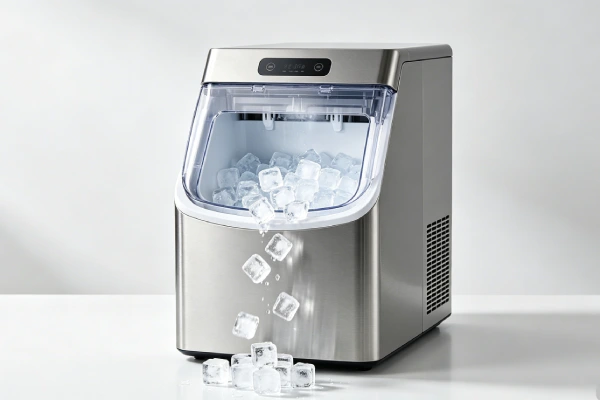
A Countertop Ice Maker is designed for home use. Whether it suits a break room depends on four things you can estimate before buying.
| What to estimate | How to estimate it | What it decides |
|---|---|---|
| Number of people using ice | Count the people who actually take ice daily, not the total headcount | Baseline demand |
| Peak demand | Think about mornings, lunch, and afternoon coffee rounds | Whether the unit can keep up at the busiest hour |
| Water refilling | Who will refill the reservoir, and how often | Whether a manual-fill unit is realistic |
| Cleaning and maintenance | Who will clean the machine, and on what schedule the manual requires | Whether the unit will actually be maintained |
A rough demand estimate: if ten people each take two glasses of ice on a workday, that is twenty servings. A portable unit with a small storage bin may not hold enough ice for a lunchtime rush, even if its daily production figure looks sufficient. The storage bin capacity matters as much as the daily production figure, and the two are separate specifications.
What a portable unit is not designed for: continuous heavy draw throughout the workday. If the machine has to produce ice back-to-back from morning to afternoon, that is closer to a commercial duty cycle than a home one. Countertop Ice Maker Overheating is the typical result when a home-duty unit is pushed past its ventilation and duty limits.
On price: a Countertop Ice Maker Under $300 is often enough for a small team, but check the published production figure and storage capacity rather than the price alone. A cheaper unit with a small bin may cost more in frustration than a slightly larger one.
Portable vs. Commercial Ice Maker
| What to compare | Portable countertop | Commercial (undercounter or freestanding) |
|---|---|---|
| Water supply | Manual reservoir refill | Plumbed supply, or a larger reservoir on some models |
| Drainage | Manual emptying or a small drain | Permanent drain connection |
| Storage bin | Small; refill the bin from the machine | Larger bin, often with a scoop and a bin liner option |
| Daily production | Sized for household use | Sized for business use; check the published production figure |
| Installation | Place on a counter and plug in | Requires plumbing, drainage, clearance, and often a dedicated circuit |
| Maintenance | User-cleaned, with manual instructions | Scheduled cleaning, often with service support |
| Warranty for commercial use | May be void if used commercially — check the terms | Typically written for commercial use |
| Repair support | Limited; parts vary by model | Service network and parts availability are part of the purchase |
What not to assume: the word “commercial” on a portable listing does not change the machine’s duty cycle. Check the published production figure, the storage capacity, and the warranty terms for commercial use rather than the marketing label. If the listing is really a Portable Ice Maker with a commercial-sounding name, the Portable Ice Maker Problems and Built-In Ice Maker Problems guides show what the duty cycle difference means in practice.
5 Things to Check Before Buying
- Published ice production, and the conditions it is measured under. Production figures are measured at stated ambient and water temperatures. A figure quoted for ideal conditions will not match a warm break room, so check the conditions in the specification sheet.
- Storage bin capacity. The bin size decides whether the machine can cover a lunchtime rush. A high daily production figure with a small bin still means waiting for ice.
- Water supply and drainage. Decide between manual refilling and a plumbed supply. A plumbed unit needs a water line and a drain; a manual unit needs someone to refill it and empty it. Ice Maker Not Filling and Ice Maker Not Getting Water cover the fill-side faults that come up most often.
- Installation conditions. Check the manual’s clearance requirements, the ambient temperature range, the electrical requirement, and whether the unit needs a dedicated circuit. An Ice Maker Under Cabinet needs ventilation space that a cabinet may not provide.
- Cleaning requirements, warranty, and parts. Check what the manual says about cleaning the condenser and the ice-making components, whether the warranty covers commercial use, and whether replacement parts and service are available in your region. Ice Maker Warranty Claim covers what to check before you rely on the warranty.
Common Break Room Ice Maker Problems
These are the symptoms most often reported in shared-use settings. They are categories to check, not a ranking.
| What you observe | What it may indicate | What to do |
|---|---|---|
| No ice produced, unit running | Water supply, freeze cycle, or a component fault | Check water level or supply, then the manual’s troubleshooting steps; see Ice Maker Running But Not Making Ice |
| Less ice than usual | Clogged condenser or air filter, warm room, or a developing fault | Check ventilation and clean as the manual describes; see Ice Maker Slow |
| “Add water” light on with a full reservoir | Water-level sensor or fill path | Check the manual’s sensor-cleaning steps; see Ice Maker Keeps Saying Add Water |
| “Ice full” light on with an empty bin | Ice piled on one side, or a sensor blocked by frost or debris | Level the ice and clean the accessible lens; see Ice Maker Ice Full Sensor Stuck |
| Grinding or growling noise | Pump running dry, or a mechanism working against jammed ice | Stop the unit and check the water supply; see Ice Maker Pump Noise |
| Water leaking | Overfilled reservoir, a drain problem, or a seal | Stop the unit, check the drain path; see Ice Maker Leaking and Ice Maker Water Overflow |
| Wet or clumpy ice, or small cubes | Freeze cycle, ambient temperature, or a developing fault | Check the room temperature and the manual’s settings; see Ice Maker Making Small Ice |
| Black specks or gunk in the bin or reservoir | Contamination in the water path | Clean per the manual; see Ice Maker Black Gunk and Ice Maker Black Gunk in 24 Hours |
Important: a symptom does not confirm a specific failed part. “The plate is not cold” and “the ice is soft” narrow the possibilities, but confirming a compressor or refrigerant fault requires a technician with the model’s service documentation.
How Much Does an Office Ice Maker Really Cost?
Compare the total cost over the period you expect to keep the machine, not just the purchase price.
| Cost item | Portable countertop | Commercial unit |
|---|---|---|
| Purchase price | Lower upfront | Higher upfront; varies widely by capacity and features |
| Installation | None beyond a counter and an outlet | Plumbing, drainage, and possibly an electrical circuit |
| Water | Bottled or filtered water if the tap is not suitable | Supply line and possibly a filter |
| Cleaning supplies and filters | Descaler and filter costs per the manual | Descaler, filter, and scheduled service |
| Maintenance and repair | User-cleaned; repair depends on parts availability | Service contract or per-call service; parts are usually available |
| Replacement cycle | Shorter in heavy use; plan for it | Longer service life is typical for commercial equipment |
A simple comparison: Total cost ≈ Purchase price + Installation + (Consumables × years) + Repairs + Replacement cost spread over the years you keep it.
A note on “cost per year”: this page does not give fixed cost-per-year figures, because they depend on local prices, the model, and how the machine is used. Put your own quotes into the formula above.
For the general lifespan discussion, see How Long Do Ice Makers Last and How Long Do Portable Ice Makers Last, which cover the factors that affect service life without assigning a fixed number to every model.
How to Reduce Maintenance Problems
Shared machines fail more often from neglected maintenance than from defects. These steps follow common manufacturer guidance; confirm the schedule in your manual.
- Name one person responsible for refilling water, cleaning, and reporting faults. A shared machine with no owner is the most common reason maintenance slips.
- Follow the manual’s cleaning schedule for the condenser and the ice-making components. Some models require a specific cleaning procedure and power disconnection before maintenance; follow that model’s instructions rather than a generic interval.
- Keep the ventilation clear. Confirm the clearance stated in the manual and keep boxes and supplies away from the vents.
- Check the water supply daily on manual-fill units, and check the filter on plumbed units on the schedule in the manual.
- Check for leaks around the unit and the drain, and address them before they reach flooring or cabinets.
- Post brief instructions on the machine: where to refill, what the indicator lights mean, and who to contact when something is wrong.
- Turn the machine off during long closures if the manual allows it, and follow the manual’s restart procedure when the office reopens.
What does not work: assuming employees will maintain a shared machine without an assigned owner, and buying a “commercial” portable unit expecting commercial duty cycle. Check the specification and the warranty terms instead.
FAQ
Is a portable ice maker enough for a break room?
It depends on how many people take ice daily, how much they take at peak times, and who will refill and clean the machine. A small team with modest demand can use a portable unit with a clear maintenance routine. A workplace with continuous demand through the day is closer to a commercial duty cycle.
How do I estimate how much ice my office needs?
Count the people who actually take ice each day and estimate servings at the busiest hour. Compare that against the machine’s published storage bin capacity and production figure, both measured under the conditions stated in the specification sheet. Storage capacity matters for the lunchtime rush.
What is the difference between a portable and a commercial ice maker?
Portable units use a manual reservoir, a small storage bin, and household-duty components. Commercial units are typically plumbed, drained, have a larger bin and production capacity, and are supported by a service network. The label matters less than the published specifications and the warranty terms.
Why does my break room ice maker keep stopping?
Common causes include a clogged condenser or air filter, a full or misread ice bin, an empty or misread water reservoir, and a fault that needs service. Check ventilation, water, and the bin first, then follow the manual’s troubleshooting steps.
How often should a break room ice maker be cleaned?
Follow the schedule in the manual for your model. Cleaning requirements differ by machine, and some models specify a particular procedure and power disconnection before maintenance. A generic monthly interval does not apply to every unit.
Is it worth repairing a break room ice maker?
Compare the confirmed fault, the written quote, the warranty position, and the cost of a comparable replacement over the period you expect to keep it. A cleaning issue or a minor part is usually straightforward. A major component fault on a heavily used portable unit needs a careful comparison rather than a fixed age rule.
Related Topics
This page covers buying and ownership for break-room ice makers. The guides below cover different symptoms and scenarios, and each keeps to its own job, so the pages do not repeat each other.
- Ice Maker Not Making Ice – Causes and Fixes (general no-ice diagnosis)
- Ice Maker Running But Not Making Ice – Causes and Fixes (unit cycles, no ice)
- Ice Maker Not Filling – Causes and Fixes (no water reaches the mold)
- Ice Maker Not Getting Water – Causes and Fixes (supply-side faults)
- Ice Maker Keeps Saying Add Water – Causes and Fixes (false add-water warning)
- Ice Maker Ice Full Sensor Stuck – Causes and Fixes (false full reading)
- Ice Maker Pump Noise – Causes and Fixes (grinding or growling from the pump)
- Ice Maker Leaking – Causes and Fixes (water under or around the unit)
- Ice Maker Water Overflow – Causes and Fixes (water in the bin or on the floor)
- Ice Maker Making Small Ice – Causes and Fixes (small or malformed cubes)
- Ice Maker Slow – Causes and Fixes (production below expectation)
- Ice Maker Black Gunk – Causes and Fixes (reservoir and line contamination)
- Ice Maker Black Gunk in 24 Hours – Causes and Fixes (fast contamination)
- Ice Maker Warranty Claim – How to Prepare
- How Long Do Ice Makers Last (factors that affect service life)
- How Long Do Portable Ice Makers Last (portable-specific lifespan factors)
- Ice Maker Under Cabinet – Selection Guide (installation and clearance)
- Ice Maker for Daycare – Selection Guide (hygiene and safety requirements)
- Ice Maker Repair vs Replace (cost comparison method)
- Portable Ice Maker Problems – Causes and Fixes
- Built-In Ice Maker Problems – Causes and Fixes
- Countertop Ice Maker Overheating – Causes and Fixes