
📅 Last Updated: July 15, 2026 | Troubleshooting procedures verified for 2026 models.
Your GE ice maker is making hollow ice. The cubes are soft, wet, or incomplete. They melt quickly in your drink. They have a “shaved ice” consistency instead of solid, clear ice. You might even see ice fragments instead of full cubes.
This is not normal. After 14 years in the field and hundreds of GE service calls, we have seen this exact failure on every GE model—from the Opal 2.0 to built-in refrigerator ice makers. The causes are predictable. The fixes are often simple and cheap.
🔴 The Golden Rule of Hollow Ice Troubleshooting
90% of hollow ice problems are fixed by these 2 steps:
- Descale the unit → Scale buildup on the evaporator rods is the #1 cause (60% of cases)
- Clean the condenser coil → Dust buildup causes overheating and poor cooling (20% of cases)
If you have not descaled in the past month, start there. Scale is the #1 cause of hollow ice on GE units. Descale first, then continue troubleshooting.
⚡ 30-Second Hollow Ice Diagnostic Card
| Check This | What to Look For | Verdict |
|---|---|---|
| Evaporator rods | White, chalky scale buildup? | ✅ Descale the unit (60% of cases) |
| Condenser coil | Caked with dust? | ✅ Clean the coil (20% of cases) |
| Unit noise | Grinding or buzzing? | ❌ Compressor or pump is failing → Replace unit |
| Unit age | Over 2 years old? | ❌ Likely compressor wear → Replace unit |
| Ice shape | Small or misshapen? | ✅ Water flow issue → Check filter and fill tube |
Hollow Ice Diagnosis Flowchart
Follow this flowchart to diagnose your GE ice maker:
text
GE ice maker making hollow/soft ice
    │
    ├── Have you descaled in the last month?
    │   ├── NO → ✅ Descale the unit. This fixes 60% of hollow ice cases.
    │   └── YES → Continue ↓
    │
    ├── Is the condenser coil clean (dust-free)?
    │   ├── NO → ✅ Clean the condenser coil. This fixes 20% of cases.
    │   └── YES → Continue ↓
    │
    ├── Does the unit make grinding or buzzing noises?
    │   ├── YES → ❌ Compressor or pump is failing. Replace the unit.
    │   └── NO → Continue ↓
    │
    ├── Is the unit over 2 years old?
    │   ├── YES → ❌ Likely low refrigerant or compressor wear. Replace the unit.
    │   └── NO → Continue ↓
    │
    └── Does it make ice but it's small or misshapen?
        ├── YES → ✅ Water flow issue. Check the water filter and fill tube.
        └── NO → ✅ Reset the unit. If problem persists, contact service.
GE Opal 2.0 vs Opal 1.0 – What’s Different?
If you own a GE Opal, it is important to know which version you have. Here are the key differences:
| Feature | Opal 1.0 | Opal 2.0 |
|---|---|---|
| Descaling method | Manual descaling (requires specific button combination) | One-touch descaling (built-in program) |
| Sensor location | Behind the ice chute | Behind the ice chute (slightly adjusted) |
| Condenser coil | At the rear of the unit | At the rear of the unit (easier to access) |
| Hollow ice causes | Scale + dust + compressor wear | Scale + dust + compressor wear (same) |
| Lifespan | 18–24 months with maintenance | 2–3 years with maintenance |
| Repair parts availability | Limited | More available |
How to identify your model: Check the label on the bottom or rear of the unit. Opal 1.0 was released in 2019. Opal 2.0 was released in 2021. If you are unsure, the descaling method is the easiest way to tell—Opal 2.0 has a one-touch descaling button.
GE Ice Maker Models Covered in This Guide
This guide covers all GE ice maker models that can produce hollow ice:
| Model Type | Examples | Hollow Ice Causes |
|---|---|---|
| GE Opal 2.0 / 1.0 | Nugget ice maker | Scale buildup (60%), condenser dust (20%), compressor wear |
| GE Refrigerator Ice Makers | Built-in units | Scale buildup, low refrigerant, faulty thermostat |
| GE Countertop Units | Standalone bullet ice makers | Scale buildup, water flow issues, pump failure |
7 Causes of Hollow Ice on GE Ice Makers
Cause #1: Scale Buildup on Evaporator Rods (60% of cases)
What is happening: Scale (calcium and magnesium deposits from hard water) builds up on the evaporator rods. This insulates the rods, preventing efficient heat transfer. The water does not freeze completely, resulting in hollow or soft ice.
Why this happens: Hard water. If you do not use filtered water or descale regularly, scale builds up within weeks.
Fix: Descale the unit.
- Unplug the unit.
- Use a commercial descaling solution or a 1:10 vinegar-to-water mix.
- Run a full cycle. Let the solution sit for 20–30 minutes.
- Rinse thoroughly. Run 2 rinse cycles with clean water.
- Plug the unit back in. Make a batch of ice.
Opal 2.0: Use the one-touch descaling program. Follow the on-screen instructions.
Opal 1.0: Manual descaling is required. Press and hold the specific button combination (refer to your manual) to enter descaling mode.
If the problem persists: The scale may be too thick for descaling. You may need to replace the evaporator assembly or the unit.
Prevention: Use filtered water. Descale monthly (Opal) or quarterly (other units).
If you are experiencing other error codes (like E1 or Add Water), see our Ice Maker Error Code E1? $0 Fix vs $300 Repair guide.
Cause #2: Dusty Condenser Coil (20% of cases)
What is happening: The condenser coil is caked with dust. The compressor overheats and cannot cool the evaporator rods properly. The water does not freeze completely.
Why this happens: The condenser coil is difficult to access on many GE units. Owners do not clean it regularly.
Fix: Clean the condenser coil.
- Unplug the unit.
- Locate the condenser coil (usually at the rear or bottom of the unit).
- Use a coil brush or vacuum to remove dust.
- If the coil is heavily caked, use compressed air to blow out the dust.
- Plug the unit back in. Make a batch of ice.
Opal 2.0: The condenser coil is slightly easier to access than on Opal 1.0.
If the problem persists: The compressor may have been damaged by overheating. If the unit is over 2 years old, consider replacing it.
Prevention: Clean the condenser coil quarterly (Opal) or annually (other units).
Cause #3: Low Refrigerant or Compressor Failure (10% of cases)
What is happening: The sealed cooling system is failing. The refrigerant level is low (leak), or the compressor is worn out. The evaporator rods do not get cold enough to freeze the water completely.
Why this happens: Normal wear and tear. Compressors typically last 3–5 years on built-in units and 18–24 months on Opal units. Refrigerant leaks are rare but can happen from vibration.
Fix: This is not a DIY repair. The sealed system requires professional service.
- If the unit is under warranty: Contact GE for service.
- If the unit is over 2 years old: Replace the unit. Repair costs ($250–$400) often exceed the value of the unit.
Signs: The unit runs but the evaporator rods stay warm or barely cold. The ice is consistently hollow or soft.
Cause #4: Dirty or Clogged Water Filter
What is happening: The water filter is clogged with sediment. Water flow to the ice maker is restricted. The unit does not get enough water to make solid ice.
Why this happens: Filters should be replaced every 6 months. Many owners forget.
Fix: Replace the water filter.
- Locate the water filter (inside the refrigerator or on the back of the unit).
- Remove the old filter.
- Install a new filter.
- Run a cycle to purge air from the system.
If the problem persists: The fill tube may be partially frozen or blocked.
Prevention: Replace the water filter every 6 months.
Cause #5: Frozen or Blocked Fill Tube
What is happening: The fill tube that delivers water to the ice tray is partially frozen or blocked. The unit does not get enough water to make solid ice.
Why this happens: The fill tube is too close to the freezer wall, or the water valve is leaking slightly.
Fix: Thaw the fill tube.
- Unplug the unit.
- Locate the fill tube (behind the ice maker assembly).
- Use a hair dryer (low heat) to thaw the tube.
- Plug the unit back in. Make a batch of ice.
If the problem persists: The water valve is leaking. Replace the valve ($20–$50).
Prevention: Ensure the fill tube is properly insulated.
Cause #6: Faulty Thermostat or Temperature Sensor
What is happening: The thermostat or temperature sensor is not reading the temperature correctly. The unit does not freeze long enough, resulting in hollow ice.
Why this happens: Sensor failure (age-related) or calibration drift.
Fix: Test the thermostat with a multimeter.
- Unplug the unit.
- Locate the thermostat or temperature sensor.
- Use a multimeter to test resistance at room temperature and at freezing temperature.
- If the sensor is out of range, replace it ($10–$30).
If the problem persists: The control board may be failing.
Cause #7: Water Quality Issues
What is happening: The water used in the unit has high mineral content or impurities. This affects ice formation and quality.
Why this happens: Hard water or unfiltered tap water.
Fix: Use filtered water. Descale the unit monthly.
Prevention: Use filtered water. This is the single most effective thing you can do to prevent hollow ice.
Detailed Model-Specific Troubleshooting
GE Opal 2.0 / Opal 1.0
Most common hollow ice causes:
- Scale buildup (60% of cases) → Descale monthly
- Condenser coil dust (20% of cases) → Clean quarterly
- Low refrigerant / compressor wear (10% of cases) → Replace unit after 2 years
Lifespan: Opal 2.0: 2–3 years with maintenance. Opal 1.0: 18–24 months with maintenance.
Repair vs replace: If the unit is under 2 years old and the repair costs under $100, repair it. If it is over 2 years old, replace it.
For a complete GE Opal troubleshooting guide, see our GE Opal 2.0 Problems: $0 Fix vs $300 Repair article.
GE Refrigerator Ice Makers (Built-in)
Most common hollow ice causes:
- Scale buildup → Descale quarterly
- Low refrigerant / compressor wear → Replace fridge if over 5 years old
- Faulty thermostat → Replace sensor ($10–$30)
Lifespan: 3–5 years.
Repair vs replace: If the unit is under 5 years old and the repair costs under $200, repair it. If it is over 5 years old, consider replacing the fridge.
For GE refrigerator-specific issues, see our GE Ice Maker Troubleshooting: 7 Common Problems & Fixes guide.
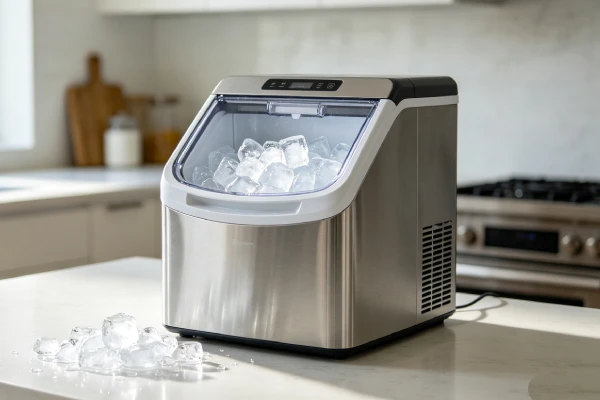
GE Countertop Units (Bullet Ice Makers)
Most common hollow ice causes:
- Scale buildup → Descale monthly
- Water flow issues → Check filter and fill tube
- Pump failure → Replace unit if over 18 months old
Lifespan: 18–24 months with filtered water; 12–18 months without.
Repair vs replace: If the unit is under 18 months old and the repair costs under $50, repair it. If it is over 18 months old, replace it.
If you decide to replace your GE unit, see our Best Budget Ice Maker 2026: 5 Reliable Units Under $200 guide for affordable alternatives.
Quick Diagnostic Checks (Before You Call a Pro)
Step 1: Check the Ice Quality
Take a piece of ice from the unit. Is it solid or hollow/soft? If it is hollow, proceed with troubleshooting. If only some pieces are hollow, the issue may be intermittent (scale or water flow).
Step 2: Check the Evaporator Rods
Run the unit for 10 minutes. Carefully touch the evaporator rods (the metal fingers that freeze the water). Are they cold enough to frost? If they are barely cold, the cooling system is failing. If they are cold but the ice is still hollow, the issue is scale or water flow.
Step 3: Check the Condenser Coil
Look at the condenser coil (rear or bottom of the unit). Is it covered in dust? If yes, clean it. Dust buildup is one of the most overlooked causes of hollow ice.
Step 4: Check for Scale
Look at the evaporator rods. Are they covered in a white, chalky film? If yes, descale the unit. Scale is the #1 cause of hollow ice on GE Opal units.
Step 5: Check the Water Filter
If your unit has a water filter, is it over 6 months old? If yes, replace it. A clogged filter restricts water flow and causes hollow ice.
Step 6: Check the Fill Tube
Is the fill tube partially frozen or blocked? If yes, thaw it with a hair dryer (low heat).
Step 7: Listen for Unusual Noises
Run the unit and listen. Do you hear grinding, growling, or buzzing? If yes, the compressor or pump is failing. Hollow ice is an early warning sign of compressor failure.
If you are repeatedly resetting your unit, see our Ice Maker Reset: When to Use It & When to Replace guide to break the reset cycle.
Component-Level Failure Explanation
Evaporator Rods
Typical lifespan: Indefinite with maintenance. “Fail” due to scale buildup. Scale insulates the rods, preventing efficient heat transfer. The water does not freeze completely. This is maintenance-dependent—not a wear part.
Condenser Coil
Lifespan is indefinite. Does not “fail”—it gets clogged with dust. Dust buildup causes the compressor to overheat and reduces cooling efficiency. This is maintenance-dependent.
Compressor
Typical lifespan: 3–5 years (built-in), 18–24 months (Opal). Fails due to normal wear, overheating from dust buildup, or refrigerant leaks. Compressor failure is irreversible degradation. Once the compressor fails, the unit is effectively totaled.
Water Filter
Typical lifespan: 6 months. Clogs with sediment, restricting water flow. This is a wear part.
Thermostat / Temperature Sensor
Typical lifespan: 5–10 years. Fails due to age or calibration drift. This is a wear part.
Repair Difficulty and Repeat-Failure Risk
| Repair | Skill Level | Time | Repeat Risk |
|---|---|---|---|
| Descale the unit | Easy | 30 min | High (scale returns monthly in hard water) |
| Clean condenser coil | Moderate | 15 min | Moderate (dust returns quarterly) |
| Replace water filter | Easy | 5 min | High (replace every 6 months) |
| Thaw fill tube | Easy | 15 min | High (if valve is leaking) |
| Replace thermostat | Moderate | 20 min | Low |
| Replace water valve | Moderate | 30 min | Moderate (scale returns) |
| Replace compressor | Professional | 2+ hours | N/A (not worth it) |
Hidden Secondary Damage Often Missed:
When scale builds up on the evaporator rods, the compressor runs longer to compensate. This leads to overheating and premature compressor failure. A $0 descaling becomes a $400 compressor replacement.
When the condenser coil is clogged with dust, the compressor overheats. A 15-minute cleaning becomes a $400 compressor replacement.
When to Repair vs Replace Your GE Ice Maker
| Situation | What To Do |
|---|---|
| Hollow ice, scale visible on rods | ✅ Descale the unit. This fixes 60% of cases. |
| Hollow ice, condenser coil dusty | ✅ Clean the coil. This fixes 20% of cases. |
| Hollow ice, unit under 2 years old | ✅ Repair it (replace sensor, thermostat, or valve). |
| Hollow ice, unit over 2 years old (Opal) | ❌ Replace the unit. Opal units are not designed to last beyond 2–3 years. |
| Hollow ice, compressor making noise | ❌ Replace the unit. Compressor repair is not worth it. |
| Hollow ice, unit over 5 years old (built-in) | ❌ Replace the fridge. The repair is not worth it. |
| You have descaled and cleaned the coil, but hollow ice persists | ❌ The cooling system is failing. Replace the unit. |
The rule we use in the field: If you descale, clean the coil, and replace the filter, and the ice is still hollow, the compressor is failing. If the unit is over 2 years old, replace it. If it is under 2 years old, contact GE for warranty service.
The Sunk Cost Trap of Hollow Ice Repairs
We have seen this pattern repeatedly. The owner spends $30 on a descaler. Descale works for 2 weeks. The hollow ice returns. Owner spends $15 on a new filter. Works for 3 weeks. Hollow ice returns. Owner spends $50 on a thermostat. Works for 1 month. Hollow ice returns. At this point, they have spent $95 on a unit that is still making hollow ice. The real issue is the compressor.
The rule we use in the field: If you have tried descaling, cleaning the coil, and replacing the filter, and hollow ice persists, stop. The compressor is failing. If the unit is over 2 years old, replace it.
Prevention Advice (What Actually Works – and What Doesn’t)
What Actually Extends Life:
- Use filtered water. Scale is the #1 cause of hollow ice. This is the single most effective thing you can do.
- Descale monthly (Opal units) or quarterly (other units). The Opal is extremely sensitive to scale.
- Clean the condenser coil quarterly (Opal) or annually (other units). Dust buildup causes compressor overheating.
- Replace the water filter every 6 months. A clogged filter restricts water flow.
- Check the fill tube regularly. Thaw it if frozen.
What Sounds Good But Does NOT Work:
- “Just run a cleaning cycle with vinegar once a year”: The Opal requires monthly descaling, not annual. One cleaning cycle per year is not enough.
- “Use bottled water to avoid scale”: Bottled water still contains minerals. It also lacks chlorine, which encourages mold growth. Use filtered water instead.
- “The hollow ice is normal for this unit”: No. Hollow ice is a symptom of a problem. It is not normal.
- “Just reset it—it will be fine”: A reset will not fix scale buildup, a dirty coil, or a failing compressor. Hollow ice is a hardware issue.
Technician Conclusion
Here is the hard truth from the workbench: Hollow ice is a warning sign. It tells you that something is wrong with the cooling system, the water flow, or the maintenance of the unit.
- If you have not descaled in the past month: Descale the unit. This fixes 60% of hollow ice cases.
- If the condenser coil is dusty: Clean it. This fixes 20% of cases.
- If the unit is making grinding or buzzing noises: The compressor or pump is failing. Replace the unit.
- If you have descaled, cleaned the coil, and replaced the filter, and hollow ice persists: The cooling system is failing. If the unit is over 2 years old, replace it.
- If the unit is under 2 years old and still makes hollow ice: Contact GE for warranty service.
What experienced technicians do in this situation:
We ask: “When was the last time you descaled the unit?” If the answer is “never” or “months ago,” we descale first. Then we check the condenser coil. Then we check the water filter. We tell the customer: “90% of hollow ice issues are caused by scale, dust, or a clogged filter. Let’s try those first. If the problem persists, the compressor is failing.”
What most GE owners regret not knowing earlier:
They regret not knowing that the Opal requires monthly descaling. They regret not knowing that the condenser coil needs quarterly cleaning. They regret not using filtered water from day one. They regret spending $100 on descaler and filters when the real issue was the compressor. And most of all, they regret not replacing the unit sooner.
Our final advice: If your GE ice maker is making hollow ice, descale it first. Clean the condenser coil. Replace the water filter. If the hollow ice persists, the cooling system is failing. If the unit is over 2 years old, replace it. Do not pour money into a unit with a failing compressor.
FAQ
Q1: Why is my GE ice maker making hollow ice?
Hollow ice is caused by incomplete freezing. The most common causes are: 1) Scale buildup on the evaporator rods (60% of cases), 2) Dusty condenser coil (20%), 3) Low refrigerant or compressor wear (10%). Start by descaling the unit.
Q2: How do I fix hollow ice on my GE Opal?
Start by descaling the unit. Scale buildup on the evaporator rods is the #1 cause of hollow ice on GE units (60% of cases). If descaling does not work, clean the condenser coil. If that does not work, the compressor is likely failing.
Q3: Why does my GE ice maker make soft or shaved ice?
Soft ice is a symptom of incomplete freezing. The water is not getting cold enough to freeze solid. This is usually caused by scale buildup, a dusty condenser coil, or a failing compressor.
Q4: How often should I descale my GE Opal?
If you use the unit daily, descale monthly. If you use it weekly, descale every 2 months. The Opal is extremely sensitive to scale. Opal 2.0 has a one-touch descaling program. Opal 1.0 requires manual descaling.
Q5: Why does my GE ice maker make ice that melts quickly?
Ice melts quickly when it is not fully frozen. Hollow or soft ice has more surface area and melts faster. Fix the hollow ice by descaling the unit and cleaning the condenser coil.
Q6: How do I clean the condenser coil on my GE ice maker?
Unplug the unit. Locate the condenser coil (usually at the rear or bottom). Use a coil brush or vacuum to remove dust. If the coil is heavily caked, use compressed air. Opal 2.0 has slightly easier access than Opal 1.0.
Q7: Why does my GE ice maker make small or misshapen ice?
Small or misshapen ice is often caused by restricted water flow. Check the water filter (replace if over 6 months old) and the fill tube (thaw if frozen). Scale buildup can also cause misshapen ice.
Q8: How long should my GE ice maker last before making hollow ice?
With proper maintenance (filtered water, monthly descaling, quarterly coil cleaning), the Opal lasts 2–3 years. Without maintenance, hollow ice appears at 12–18 months. Opal 2.0 generally lasts longer than Opal 1.0.
Q9: Is hollow ice dangerous to consume?
No. Hollow ice is not dangerous—it is just poor quality. It melts faster and dilutes drinks faster. However, it is a sign that your unit needs maintenance or repair.
Q10: Should I repair or replace my GE ice maker if it makes hollow ice?
If the unit is under 2 years old and descaling/cleaning does not fix the problem, contact GE for warranty service. If the unit is over 2 years old and descaling/cleaning does not fix the problem, replace the unit. The compressor is likely failing.
Q11: What is the difference between Opal 1.0 and Opal 2.0 for hollow ice?
The causes of hollow ice are the same (scale, dust, compressor wear). However, Opal 2.0 has a one-touch descaling program and slightly easier condenser coil access. Opal 2.0 also has a longer lifespan (2–3 years vs 18–24 months).
Related Reading
- GE Opal 2.0 Problems: $0 Fix vs $300 Repair
- GE Ice Maker Troubleshooting: 7 Common Problems & Fixes
- Ice Maker Error Code E1? $0 Fix vs $300 Repair
- Ice Maker Reset: When to Use It & When to Replace
- Most Reliable Ice Maker 2026: 5 Brands Ranked by Failure Rates
- Best Budget Ice Maker 2026: 5 Reliable Units Under $200