
When a GE ice maker stops producing ice, replacing the right component may be more practical than replacing the whole appliance. The parts that come up most often are the water inlet valve, the ice maker assembly, the water-level and bin-detection components, the temperature sensor and the control board. The difficult part is identifying which one has failed, because no ice, a full-bin warning and a grinding noise can each come from more than one source.
This page covers what each component does, which symptoms point towards it, how to confirm the part number for your model, and when the cost of a part makes replacement the better decision. It is not a repair manual; the individual procedures live on their own pages.
Note on model differences: a GE Opal countertop ice maker, a GE refrigerator ice maker and a portable ice maker are different machines with different part systems. Use the model number for your unit, and confirm every part against the manufacturer’s diagram before ordering.
How to Identify the Correct GE Ice Maker Replacement Part
Step 1: Find the Complete Model Number
The plate is on the back or underside of a countertop unit, and inside the refrigerator compartment for a built-in ice maker. Note the full model number, not the series name: “Opal” covers more than one generation, and the generations do not share all parts.
Step 2: Identify the Machine Type
A countertop ice maker such as the Opal is self-contained, with its own reservoir, pump and ice mechanism. A refrigerator ice maker is a module inside a freezer compartment, sharing the refrigerator’s water supply and often its control board; a fault that looks like a countertop ice maker not making ice can therefore be a refrigerator fault on a built-in unit. A portable ice maker has its own layout again. A part that fits one does not fit the others, which is where most ordering errors start.
Step 3: Read the Part Number Off the Diagram
The manufacturer’s parts site takes the model number and returns an exploded diagram with a number beside each component. That diagram, not a search result, is the list of parts that fit. Find the component on the diagram and read the number from it.
Step 4: Check Whether the Number Has Been Superseded
Manufacturers replace part numbers over time. Search the number you read; if the result shows a superseded or replacement number, use the newer one and check that it is listed for your model. A listing that carries an old number and no model range may be selling a part that no longer fits current production.
What the Common Mistakes Look Like
- Assuming Opal generations share parts.
- Assuming a refrigerator module and a countertop unit share a valve or a sensor.
- Assuming a WR-prefixed number is universal. It is a GE part number, not a fitment guarantee.
- Assuming a part is faulty because the symptom matches. The symptom narrows the search; the diagram and the checks decide the part.
Is the part really faulty? The strongest test is substitution: a known-good part of the same type, or the suspect part fitted to an identical machine. Where that is not possible, the checks on the symptom pages come next, and a technician’s meter readings come after that. Replacing a part on a symptom alone is a guess.
Common GE Ice Maker Replacement Parts
| Part | What it does | Symptoms that may point to it |
|---|---|---|
| Water inlet valve | Controls water entering the ice maker | No water enters, water volume is wrong, water near the valve |
| Ice maker assembly | Runs the freeze and harvest cycle | No ice, harvest failure, mechanical noise |
| Water level detection components | Detect water in the reservoir, on models that have them | Add Water warning with water present |
| Ice bin detection components | Detect a full bin, on models that have them | Ice Full warning with an empty bin, early stop |
| Temperature sensor | Reads the evaporator temperature | Temperature-related error codes, cycle faults |
| Control board | Runs the sequence and the outputs | Several functions failing together, no response |
| Compressor and sealed system | Cools the evaporator | No cooling at all, warm rods, constant running |
These symptoms are troubleshooting clues, not proof that a specific component has failed. Confirm the part against your model number and the diagram.
Which GE Ice Maker Part Might Be Causing the Problem?
Each section below gives the first check and then points to the page that carries the full diagnosis. The diagnosis is not repeated here, because the symptom pages cover it in detail.
Ice Maker Not Filling with Water
Check the supply first: shut-off valve, supply line, inlet screen, and in cold rooms whether the line has frozen, since an ice maker frozen water line stops flow exactly as a closed valve does. If water reaches the valve and none passes, the valve is the suspect. If the machine has a pump and the pump is not moving water, that is a separate fault. Full checks are on the not-filling and pump pages.
Add Water Light Stays On
Check the level against the manual’s mark, reseat the reservoir, and look at the detection area; on a float model, check the float moves freely. If those are correct, the detection component becomes the suspect. The sensor page carries the rest.
Ice Full Light Stays On
Check basket seating, the detection area, and whether wet ice has piled against it, since wet ice triggers the same reading. A detector stuck in the triggered position is a service question rather than a part to order on the first symptom. The ice-full-sensor page covers the checks.
E1 Error or Temperature Detection Problem
An ice maker error code E1 is model-specific. Check the manual’s code list before ordering a thermistor, because the same code can mean different things across generations, and the resistance figures in a service manual apply only at the temperatures that manual states.
Grinding Noise During Ice Production
Grinding can come from ice stuck in the tray, an obstruction in the chute, a loose panel, or a worn assembly. Check the ice path and the panels before ordering an assembly. The grinding noise page covers the sound diagnosis; this page covers the part.
Ice Maker Runs but Does Not Make Ice
If the machine runs and never cools, that is the compressor runs but no ice pattern, which belongs to the sealed-system section below rather than to a parts order. If it cools and does not harvest, the assembly is the more likely suspect. If the unit has an ice maker frozen condition on the evaporator, the fault page for that covers the thaw before any part is ordered.
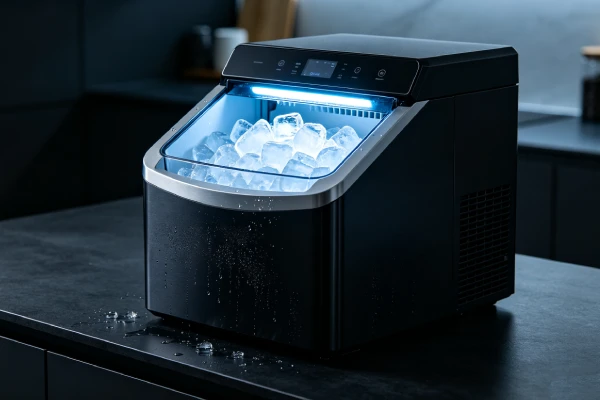
GE Ice Maker Replacement Parts: Cost and Repair Considerations
Part Cost vs Professional Repair Cost
The part price is half the comparison. A professional repair adds labour, often a diagnostic fee, and for sealed-system work the refrigerant handling as well. Put four figures side by side before deciding:
| Item | Example figure |
|---|---|
| Part price | 40 |
| Your time and risk, if DIY | your own |
| Professional labour and diagnostic fee | 150 |
| Comparable new machine | 300 |
Worked example, with invented figures used only to show the method: a 40 part plus a 150 labour-and-diagnostic charge is 190 against a 300 machine, which is worth repairing if the machine is otherwise sound. The same 40 part fitted yourself is 40 against 300, a different decision. The comparison is between what you would actually pay, not between the part price and the machine price.
OEM vs Compatible Parts
An OEM part is the one the manufacturer lists for your model; a compatible part is a third-party equivalent. The difference matters most for sensors and control boards, where calibration and firmware behaviour are part of the part, and least for consumables and simple mechanical items. If you choose compatible, check that the seller states the model range the part fits.
Consumables and Maintenance Parts
Not every purchase is a repair part. An ice maker water filter, a descale solution or cleaning tablets are maintenance items with their own replacement intervals, and an ice maker descale that the manual schedules is cheaper than the pump wear it prevents. Keep them separate from the repair budget: they are recurring costs, not one-off faults.
When Repair Is Worth Considering
A repair is worth considering when the fault is one confirmed part, the part is available for your model, the machine is otherwise sound, and the total cost is well below a replacement. Check the ice maker warranty first: a covered repair changes the arithmetic, and an owner-performed repair during the warranty period may affect the claim. Ask the manufacturer before opening the machine.
When Replacement Makes More Sense
Replacement tends to win when the part is unavailable or superseded with no equivalent, when a second fault appears in the same unit, when the repair is in the sealed system, or when the total cost approaches a comparable new machine. The ice maker repair cost page sets out that comparison, and the ice maker return policy matters if the unit is new enough to return rather than repair.
Where to Buy GE Ice Maker Replacement Parts
- The manufacturer’s parts site, using the model number and the diagram. This is the reference for the part number itself.
- Authorised parts distributors, which list the model range a part fits.
- General marketplaces, where the part number must be checked against the listing and the seller’s compatibility statement read in full.
For consumables such as filters, an ice maker filter replacement is a routine purchase; for sensors and boards, buy the part the diagram names.
Can You Replace GE Ice Maker Parts Yourself?
Simple External Maintenance
Cleaning the bin, the chute and the visible detection areas, reseating the reservoir and the basket, and replacing a filter are owner tasks on most models. None requires opening the housing.
Component Replacement Requiring Technical Skills
Replacing a water inlet valve, an ice maker assembly or a control board means opening the machine, disconnecting water or wiring, and reassembling in order. It suits someone who has done that kind of work before and has the manual in front of them; it is not a first repair.
When to Call a Professional
Call a technician for anything in the sealed system, for a machine still in warranty, and for a fault you cannot confirm to a single part. Sealed-system work needs equipment and refrigerant handling that a household does not have, and opening the housing during a warranty period can affect the claim. A fan that is not spinning sits at the edge of this: it is a replaceable part on some models, but confirming it, and reaching it safely, is work for someone with the manual and the tools.
Frequently Asked Questions
How do I find the correct GE ice maker part number?
Take the full model number from the plate, look it up on the manufacturer’s parts site, read the number from the diagram, and check whether it has been superseded before ordering.
Are GE Opal replacement parts interchangeable between generations?
No. Opal generations do not share all parts, and a part listed for one may not fit another. Confirm against the diagram for your model number rather than the series name.
Can I replace a GE ice maker assembly myself?
It is a moderate repair: the housing comes apart, the assembly is unplugged and unbolted, and the new one goes in the same way. It suits someone who has done similar work; otherwise a technician is the safer route.
How much does a GE ice maker replacement part cost?
It varies by part and model, and the part price is half the comparison. Add labour and any diagnostic fee before comparing with a replacement machine.
Is it worth repairing a GE ice maker?
It depends on the confirmed part, its availability, the machine’s condition, the warranty and the total cost against a replacement. A confirmed cheap part on a sound machine is often worth it; a sealed-system repair usually is not.
Can a faulty sensor stop a GE ice maker from making ice?
Yes, on models where a level or temperature sensor gates the cycle. Check the manual’s code list and the detection area first, because a blocked or dirty detection point produces the same symptom as a failed sensor.
Does replacing a part myself affect the warranty?
It can. Ask the manufacturer before opening the housing; an owner repair during the warranty period may affect the claim, even where the part itself is not covered.
Are the ice maker parts shared with the rest of the refrigerator?
On a built-in module, the ice maker often shares the refrigerator’s water supply and control board, so a fault that looks like an ice maker part can be a refrigerator fault. The refrigerator manual, not the ice maker page, is the reference for those.