
📅 Last Updated: July 18, 2026 | Troubleshooting procedures verified for 2026 models.
Your GE ice maker is making ice that tastes bad. It tastes musty. It tastes like plastic. It tastes like chemicals. Or it just tastes “off.” You have tried throwing out the first batch. You have tried running multiple cycles. The taste is still there.
Here is the hard truth: Bad-tasting ice is almost always a maintenance problem — not a defect.
After 14 years in the field and hundreds of bad-taste service calls, we have seen the same causes repeat. The good news: 90% of bad-taste issues are fixed by cleaning in 30 minutes for $0–$15. The bad news: if you ignore it, the problem will get worse.
👃 What Does Your Ice Smell/Taste Like?
| Taste / Smell | Most Likely Cause | What To Do |
|---|---|---|
| Musty or moldy taste | Mold or biofilm in lines | Clean water lines (#1) |
| Metallic taste | Scale buildup | Descale (#2) |
| Plastic or chemical taste | New unit off-gassing or degrading plastic | Run 3–5 batches. If that fails, check for particles (#4/#7) |
| Stale or “old” taste | Standing water | Drain and refill with fresh water (#6) |
| No bad taste, but black flecks in ice | Plastic or rubber degrading | Replace immediately (#7) |
| No bad taste, but metal flakes in ice | Internal parts rusting | Replace immediately (#3) |
⚠️ HEALTH WARNING: When to Stop Using Your Ice Maker
DO NOT consume ice from your GE ice maker if you see:
| Symptom | What It Means | Action |
|---|---|---|
| Black flecks or particles in the ice or reservoir | Plastic or rubber components are degrading | ❌ Replace the unit immediately. Do not use. |
| Metal flakes in the ice or reservoir | Internal parts are rusting | ❌ Replace the unit immediately. Do not use. |
| Pink slime or black gunk | Biofilm or mold (can cause stomach issues) | ✅ Clean the unit thoroughly. If it returns, replace. |
| Strong chemical smell | Plastic is off-gassing or degrading | ✅ Run 3–5 batches. If it persists, replace. |
If you see black flecks or metal flakes, replace the unit immediately. Do not use it.
If the issue is just musty or metallic taste (no visible particles), cleaning will fix it — continue reading.
🔴 The Golden Rule of Bad-Tasting Ice
Bad-tasting ice comes from three sources:
- Mold and biofilm — grows in water lines and reservoir (40% of cases)
- Scale buildup — mineral deposits affect taste (30% of cases)
- Contaminants — plastic or metal particles in the ice (20% of cases)
If your ice tastes bad, clean your ice maker. 90% of bad-taste issues are fixed by descaling, cleaning the water lines, and cleaning the reservoir.
⚡ 30-Second Bad Taste Diagnostic
| Symptom | What It Means | What To Do |
|---|---|---|
| Musty or moldy taste | Mold or biofilm in lines | Clean with vinegar or commercial cleaner |
| Chemical or plastic taste | New unit off-gassing or degrading plastic | Run 3–5 batches. If persists, replace unit. |
| Metallic taste | Scale buildup or rust | Descale + check for rust |
| Stale or “old” taste | Standing water or biofilm | Clean water lines + drain reservoir |
| Black flecks in ice | Plastic or rubber degrading | Replace unit immediately |
| Metal flakes in ice | Internal components rusting | Replace unit immediately |
| Taste improves after cleaning but returns quickly | Biofilm in lines | Clean more thoroughly. Replace lines if needed. |
Quick Answer: Bad Taste Diagnostic Flowchart
text
GE ice maker — ice tastes bad
    │
    ├── FIRST: Check for particles (black flecks or metal flakes).
    │   ├── YES → ⚠️ DO NOT EAT. Replace the unit immediately.
    │   └── NO → Continue ↓
    │
    ├── Clean the unit ($0–$15, 30 min).
    │   ├── Descale with vinegar or commercial cleaner.
    │   ├── Clean water lines with brush or pipe cleaner.
    │   └── Taste improved? → ✅ Fixed. Clean monthly.
    │
    ├── Is the unit new (less than 1 week old)?
    │   ├── YES → Off-gassing is normal. Run 3–5 batches and discard.
    │   └── NO → Continue ↓
    │
    └── Does the bad taste return within days of cleaning?
        ├── YES → Biofilm in water lines. Clean more thoroughly or replace lines.
        └── NO → The unit is clean. The taste should be gone.
7 Causes of Bad-Tasting Ice (Ranked by Urgency)
| Rank | Cause | Likelihood | Urgency | What To Do |
|---|---|---|---|---|
| #1 | Mold and biofilm in water lines | 40% | 🟡 Medium | Clean water lines (30 min, $0–$15) |
| #2 | Scale buildup | 30% | 🟡 Medium | Descale (30 min, $0–$15) |
| #3 | Plastic or metal particles | 20% | 🔴 Emergency | Replace unit immediately. Do not eat ice. |
| #4 | New unit off-gassing | 5% | 🟢 Low | Run 3–5 batches and discard (24–48 hours) |
| #5 | Dirty water filter | 3% | 🟢 Low | Replace filter ($15–$50, 5 min) |
| #6 | Stale or standing water | 1% | 🟢 Low | Drain + refill with fresh water (2 min) |
| #7 | Degrading plastic components | 1% | 🔴 Emergency | Replace unit immediately. Do not eat ice. |
Diagnose in this order: Check for #3 and #7 first (particles) → If none, do #1 and #2 (clean + descale) → If still bad, check #4, #5, #6.
Detailed Fixes for Each Cause
Cause #1: Mold and Biofilm in Water Lines (40% of cases)
What you taste: Musty, moldy, or “old” taste. The ice smells bad. You may see black gunk in the reservoir.
What causes it: Standing water in the reservoir and water lines. Mold and bacteria grow in the water lines. Biofilm is resistant to simple cleaning.
Fix: Clean the unit thoroughly.
- Unplug the unit.
- Remove the water reservoir.
- Wash with warm soapy water. Scrub away any visible mold.
- Use a 1:10 vinegar-to-water solution or commercial ice machine cleaner.
- Run a full cycle. Let it sit for 20–30 minutes.
- Use a long brush or pipe cleaner to scrub the water lines.
- Rinse thoroughly. Run 2 full cycles with clean water.
If the problem persists: Biofilm may be deeply embedded. Replace the water lines if possible.
Prevention: Drain the reservoir after each use. Clean the unit monthly.
For a complete step-by-step cleaning guide, see our GE Ice Maker Cleaning Guide: Remove Mold, Scale & Slime article.
Cause #2: Scale Buildup (30% of cases)
What you taste: Metallic or mineral taste. The ice is cloudy. The taste gets worse over time.
What causes it: Hard water. Mineral deposits build up on the evaporator rods and in the water lines.
Fix: Descale the unit.
- Unplug the unit.
- Use a commercial descaling solution or a 1:10 vinegar-to-water mix.
- Run a full cycle. Let the solution sit for 20–30 minutes.
- Rinse thoroughly. Run 2 full cycles with clean water.
If the problem persists: The scale may be too thick. You may need to replace the evaporator assembly or the unit.
Prevention: Use filtered water. Descale monthly (Opal) or quarterly (other units).
If scale keeps returning despite descaling, see our GE Ice Maker Making Hollow Ice? 7 Causes & Fixes guide.
Cause #3: Contaminants — Plastic or Metal Particles (20% of cases)
What you see: Black flecks or plastic pieces in the ice. Metal flakes in the reservoir. The ice may taste bad.
What causes it: Internal components are degrading. Plastic parts are breaking down. Metal parts are rusting.
Fix: ⚠️ DO NOT EAT THE ICE. Replace the unit immediately.
Why this happens: Cheap plastic components degrade over time. Heat and moisture accelerate degradation. This is a sign of irreversible degradation.
If the problem persists: The unit is not safe to use. Replace it.
Prevention: Buy units with food-grade plastic components. Avoid the cheapest no-name brands.
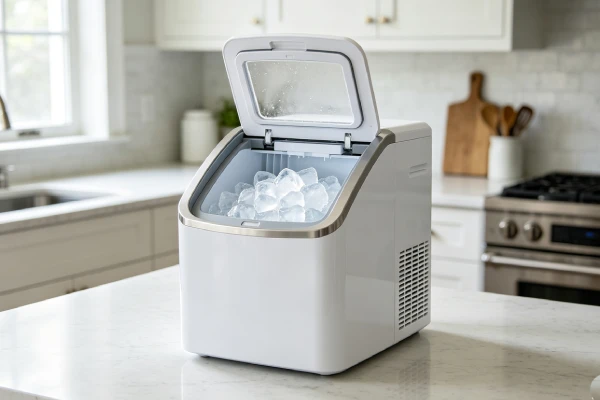
Cause #4: New Unit Off-Gassing (5% of cases)
What you taste: Plastic or chemical taste. The ice smells like new plastic.
What causes it: New plastic components release chemicals (off-gassing). This is normal for new units.
Fix: Run 3–5 batches of ice and discard them. The taste usually disappears within 24–48 hours.
If the problem persists: The plastic may be lower quality. Some units take longer to off-gas. If the taste persists after 5 batches, consider returning the unit.
Prevention: Buy units with BPA-free and food-grade plastic components.
Cause #5: Dirty Water Filter (3% of cases)
What you taste: Stale or chemical taste. The ice tastes like the filter is old.
What causes it: The water filter is saturated. It is releasing contaminants back into the water.
Fix: Replace the water filter.
If the problem persists: The filter may not be compatible with your unit. Use the manufacturer’s recommended filter.
Prevention: Replace the water filter every 6 months.
If your filter is clogged and causing taste issues, see our GE Ice Maker Black Stuff? How to Clean Mold & Fix Filters guide.
Cause #6: Stale or Standing Water (1% of cases)
What you taste: Stale, “flat,” or “old” taste.
What causes it: Water has been sitting in the reservoir too long. Standing water breeds bacteria and affects taste.
Fix: Drain the reservoir. Refill with fresh water. Run a cycle.
If the problem persists: There may be biofilm in the lines. Clean the unit.
Prevention: Drain the reservoir after each use. Do not leave water sitting overnight.
Cause #7: Degrading Plastic Components (1% of cases)
What you taste: Strong chemical or plastic taste. You may see black flecks in the ice.
What causes it: Plastic components are degrading. The unit is releasing chemicals and particles into the ice.
Fix: ⚠️ DO NOT EAT THE ICE. Replace the unit immediately.
If the problem persists: The unit is not safe to use. Replace it.
Prevention: Buy units with food-grade plastic components.
GE Model-Specific Bad Taste Issues
| GE Model | Most Common Bad Taste Cause | What To Do |
|---|---|---|
| GE Opal 2.0 / 1.0 | Scale + biofilm | Descale monthly. Clean lines monthly. |
| GE Refrigerator (built-in) | Scale + dirty filter | Descale quarterly. Replace filter every 6 months. |
| GE Countertop (bullet) | Biofilm (standing water) | Drain after each use. Clean monthly. |
Quick Diagnostic Checks (Before You Call a Pro)
Step 1: Check for Particles
Look at the ice. Do you see black flecks or plastic particles? If yes, do not eat the ice. Replace the unit.
Step 2: Check for Metal Flakes
Look in the water reservoir. Do you see metal flakes? If yes, do not use the unit. Replace it.
Step 3: Taste the Tap Water
Taste the water you are using in the ice maker. Does it taste bad? If yes, the problem is your water supply — not the ice maker.
Step 4: Check for Visible Mold
Look in the water reservoir. Is there visible mold or slime? If yes, clean the unit thoroughly.
Step 5: Check for Scale
Look at the evaporator rods. Are they covered in white scale? If yes, descale the unit.
Step 6: Check the Filter
Is the water filter over 6 months old? If yes, replace it.
Step 7: Smell the Ice
Crush a piece of ice and smell it. Does it smell musty or chemical? If yes, the taste is from the ice itself — not the bin.
Deep Diagnostic Steps (Requiring Partial Disassembly)
Step 1: Inspect the Water Lines
Remove the water reservoir. Inspect the water lines for mold, slime, or biofilm. If you see buildup, clean the lines with a long brush or pipe cleaner.
Safety Warning: Unplug the unit before disconnecting electrical connections.
Step 2: Inspect the Evaporator Rods
Look at the evaporator rods. Are they covered in white scale? If yes, descale the unit.
Step 3: Check for Contaminants
Check the ice bin and reservoir for black flecks or metal particles. If you find them, do not use the unit. Replace it.
If your unit is showing sensor errors along with bad taste, see our GE Ice Maker Sensor Problems: “Bin Full” or “Add Water” Error? guide.
If your unit is showing error codes along with bad taste, see our GE Ice Maker Error Codes: E1, E2, Add Water, Bin Full Fixes guide.
Component-Level Failure Explanation
Water Lines
Lifespan: 2–5 years. Can harbor mold and biofilm. This is maintenance-dependent.
Water Reservoir
Lifespan: Indefinite with maintenance. Can grow mold on surfaces. Requires regular cleaning. This is maintenance-dependent.
Evaporator Rods
Lifespan: Indefinite with maintenance. Scale buildup affects ice quality. This is maintenance-dependent.
Water Filter
Lifespan: 6 months. Saturates and can release contaminants. This is a wear part.
Plastic Components (Reservoir, Tubes, Bin)
Lifespan: 3–5 years. Degrade over time with heat and moisture. Cheap plastics degrade faster and release chemicals. This is a wear part — quality varies by brand.
When to Repair vs Replace Your GE Ice Maker
| Situation | What To Do |
|---|---|
| Musty taste, visible mold | ✅ Clean the unit. This fixes 40% of cases. |
| Metallic taste, scale visible | ✅ Descale the unit. This fixes 30% of cases. |
| Black flecks or plastic particles | ❌ Replace the unit immediately. Do not eat the ice. |
| Metal flakes in reservoir | ❌ Replace the unit immediately. Do not eat the ice. |
| New unit, plastic taste | ✅ Run 3–5 batches and discard. This fixes 5% of cases. |
| Taste returns within days of cleaning | ⚠️ Biofilm in lines. Clean more thoroughly. If that fails, replace lines or unit. |
| Unit over 3 years old, persistent bad taste | ❌ Replace the unit. Plastic components may be degrading. |
The rule we use in the field: If you see black flecks or plastic particles in the ice, replace the unit immediately. Do not consume the ice. If you have cleaned the unit and the taste persists, the plastic is degrading — replace the unit.
If you decide to replace your GE unit, see our Most Reliable Ice Maker 2026: 5 Brands Ranked by Failure Rates guide.
If you are looking for a more affordable alternative, see our Best Budget Ice Maker 2026: 5 Reliable Units Under $200 guide.
The Sunk Cost Trap of Bad Taste Repairs
We have seen this pattern repeatedly. The owner buys a descaler ($15). Works for 2 weeks. Bad taste returns. Buys a new filter ($30). Works for 1 week. Bad taste returns. Buys a cleaning kit ($20). Works for 2 weeks. Bad taste returns. At this point, they have spent $65 on a unit that still makes bad-tasting ice. The real issue is biofilm in the lines or degrading plastic.
The rule we use in the field: If you have cleaned the unit and the taste persists, replace the water lines. If that does not work, replace the unit.
Prevention Advice (What Actually Works – and What Doesn’t)
What Actually Extends Life and Keeps Ice Tasting Good:
- Drain the reservoir after each use. Standing water breeds mold. This is the single most effective thing you can do.
- Use filtered water. Scale and contaminants affect taste.
- Clean the unit monthly. Descale. Clean the water lines. Wash the reservoir.
- Replace the water filter every 6 months. A saturated filter releases contaminants.
- Wipe the ice bin weekly. This prevents odors from transferring to the ice.
- Use a commercial ice maker cleaner. Vinegar works for scale, but a commercial cleaner is better for biofilm.
To prevent bad taste from developing, see our GE Ice Maker Maintenance: How to Make It Last Longer guide.
What Sounds Good But Does NOT Work:
- “Just change the filter — that will fix the taste” : No. The filter does not clean the water lines. Mold grows in the lines after the filter.
- “Use bottled water to avoid bad taste” : Bottled water still contains minerals. It also lacks chlorine, which encourages mold growth. Use filtered water instead.
- “The taste will go away on its own” : No. Bad taste is a sign of a problem. It will not fix itself.
- “Just ignore it — it’s not harmful” : It may be harmful. Mold, biofilm, and degrading plastic can cause health issues. Do not ignore it.
Technician Conclusion
Here is the hard truth from the workbench: Bad-tasting ice is almost always a maintenance problem — not a defect.
- If the ice tastes musty, clean the unit. This fixes 40% of bad-taste cases.
- If the ice tastes metallic, descale the unit. This fixes 30% of cases.
- If you see black flecks or plastic particles in the ice, replace the unit. Do not consume the ice.
- If you have cleaned the unit and the taste persists, the plastic components may be degrading. Replace the unit.
What experienced technicians do in this situation:
We ask: “When was the last time you cleaned the unit?” If the answer is “never” or “months ago,” we clean it. We show the customer the black gunk that comes out of the lines. We tell them: “90% of bad-taste issues are fixed by cleaning the unit. Let’s try that first. If the taste persists, the plastic is degrading — replace the unit.”
What most GE owners regret not knowing earlier:
They regret not knowing that standing water breeds mold. They regret not knowing that the filter does not clean the water lines. They regret not knowing that scale affects taste. They regret not knowing that black flecks mean the unit is degrading. They regret not draining the reservoir after each use. And most of all, they regret not cleaning the unit regularly.
Our final advice: If your GE ice maker is making bad-tasting ice, start with the $0–$15 fixes. Clean the unit thoroughly. Descale. Clean the water lines. Drain the reservoir after each use. Replace the water filter. 90% of bad-taste issues are fixed by these steps. If the taste persists, check for black flecks or plastic particles. If you see them, replace the unit. Do not consume bad-tasting ice.
FAQ
Q1: Why does my GE ice maker ice taste musty or moldy?
Mold or biofilm in the water lines. Clean the unit with vinegar or commercial cleaner. Use a brush to clean the water lines. Drain the reservoir after each use.
Q2: Why does my GE ice maker ice taste metallic?
Scale buildup from hard water. Descale the unit with vinegar or commercial descaler. Use filtered water to prevent scale.
Q3: Why does my GE ice maker ice taste like plastic?
New units off-gas plastic chemicals. Run 3–5 batches and discard them. If the taste persists, the plastic may be degrading. Check for black flecks in the ice.
Q4: Why does my GE ice maker ice taste bad even after cleaning?
Biofilm may be deeply embedded in the water lines. Clean more thoroughly. If that does not work, replace the water lines. If the taste persists, the plastic components may be degrading.
Q5: Can I use vinegar to clean my GE ice maker?
Yes. Use a 1:10 vinegar-to-water solution. Run a full cycle. Let it sit for 20–30 minutes. Rinse thoroughly. Run 2 cycles with clean water.
Q6: How often should I clean my GE ice maker?
Clean the reservoir weekly. Descale monthly (Opal) or quarterly (other units). Replace the water filter every 6 months.
Q7: Is bad-tasting ice dangerous to eat?
If the taste is from mold or biofilm, it may cause stomach issues. If you see black flecks or plastic particles, do not eat the ice — the unit is degrading. If you are unsure, replace the unit.
Q8: What should I do if I see black flecks in my ice?
Do not eat the ice. Replace the unit immediately. The plastic or rubber components are degrading.
Q9: What should I do if I see metal flakes in my ice?
Do not eat the ice. Replace the unit immediately. Internal parts are rusting.
Q10: Should I replace my GE ice maker if the ice tastes bad?
If you have cleaned the unit and the taste persists, the plastic components may be degrading. If you see black flecks or plastic particles, replace the unit. If the unit is over 3 years old and the taste persists, consider replacing it.
Related Reading (Internal Links)
- GE Opal 2.0 Problems: $0 Fix vs $300 Repair
- GE Ice Maker Cleaning Guide: Remove Mold, Scale & Slime
- GE Ice Maker Black Stuff? How to Clean Mold & Fix Filters
- GE Ice Maker Sensor Problems: “Bin Full” or “Add Water” Error?
- GE Ice Maker Error Codes: E1, E2, Add Water, Bin Full Fixes
- GE Ice Maker Water Valve Replacement: $20 DIY Fix
- GE Ice Maker Troubleshooting: 7 Common Problems & Fixes
- GE Ice Maker Maintenance: How to Make It Last Longer
- Most Reliable Ice Maker 2026: 5 Brands Ranked by Failure Rates
- Best Budget Ice Maker 2026: 5 Reliable Units Under $200