
An Ice Maker Water Dispenser combination is not one product category. A refrigerator with a built-in dispenser, a countertop combination unit, and a freestanding commercial machine use different water systems, and the checks that matter before buying differ between them. This guide explains what to compare, what the specifications actually tell you, and which questions to ask before you pay.
The decision should come from your daily use and the machine’s documented specifications, not from a failure-rate table. This page does not publish failure percentages, fixed part prices, or a fixed lifespan, because those figures depend on the model, the region, and how the machine is used.
Scope note: This page is a buying guide for ice maker and water dispenser combination units. It does not cover internal electrical testing, pump replacement, or line repair; those belong to a qualified technician with the model’s service documentation. Where a specification depends on the model, the manufacturer’s manual and specification sheet take precedence.
First, identify which type you are buying. The rest of this page applies differently to each:
- Refrigerator with a built-in dispenser. The water path may use an inlet valve, a filter, and a chilled water reservoir rather than a separate dispenser pump. Not every model has an active cold-water function.
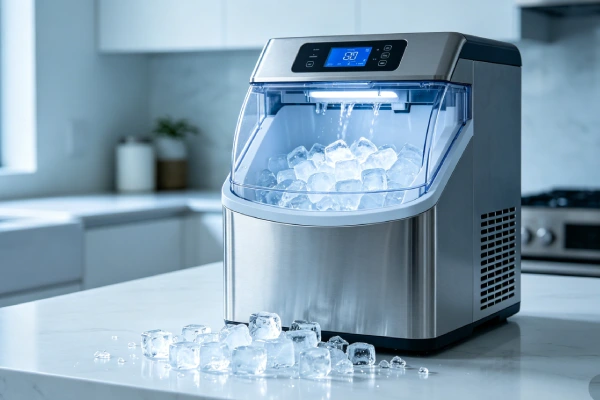
- Countertop combination unit. Usually has its own reservoir, a small pump, and a dispensing valve. It is built for household duty, not continuous commercial use.
- Freestanding or undercounter commercial unit. Typically plumbed, drained, and supported by a service network.
Applying a check from one type to another is the most common buying mistake.
What to Compare Before Buying
| What to compare | Why it matters | Where to verify |
|---|---|---|
| Ice production and storage capacity | Decides whether the machine covers peak demand, not just the daily total | Specification sheet, including the conditions the figures are measured under |
| Water dispensing rate and reservoir | A slow dispenser with a small reservoir becomes a bottleneck | Specification sheet and the manual |
| Active cold-water function, or ambient only | Some units chill water; some dispense at supply temperature | The manual’s description of the dispenser |
| Water supply type | Manual refill, plumbed supply, or both | The manual’s installation section |
| Filter type and replacement interval | Filter cost and availability are recurring ownership costs | The manual’s filter section and the parts catalog |
| Cleaning access | Whether the reservoir, dispenser nozzle, and drip tray can be removed and cleaned | The manual’s cleaning section |
| Installation requirements | Clearance, drainage, and electrical requirements vary by type | Installation instructions |
| Warranty and parts | Whether the warranty covers the dispenser, and whether parts are sold | Warranty document and the official parts catalog |
| Recall and safety notices | Whether the model has a documented issue | The CPSC recall database, or your market’s equivalent authority |
Water Supply, Cold Water, and Filters
Water supply. A manual-fill reservoir needs someone to refill it and a place to empty it. A plumbed supply needs a water line and usually a shutoff valve. Some machines offer both. Decide which fits your space before comparing features. If the dispenser stops filling entirely, see Ice Maker Not Getting Water and Ice Maker Not Filling for the supply-side checks.
Cold water. Not every dispenser chills water. Some dispense at supply temperature, some chill through a reservoir, and some share the refrigerator’s cooling system. Check the manual’s description rather than assuming, and note that a newly installed or long-unused unit may need time before the water reaches its usual temperature. When the water is not cold on a unit that should chill it, the checks in Ice Maker Water Dispenser Not Cold apply before any repair decision.
Filters. A filter is a wear item with a recurring cost. Check the replacement interval in the manual, the price, and whether the filter is sold as a standard part or a model-specific one. A cheap machine with an expensive or hard-to-find filter is not cheap over time. Ice Maker Water Filter covers how to compare filter types and intervals.
Cleaning and Maintenance Access
Shared or frequently used machines fail more often from neglected cleaning than from defects. Check these before buying.
- Can the reservoir be removed? A removable reservoir is easier to clean and inspect.
- Can the dispenser nozzle and drip tray be removed? Residue collects there, and a nozzle that cannot be cleaned is a hygiene problem.
- Does the manual describe a cleaning procedure? A manual with no cleaning section is a warning sign.
- Does the manual specify a descaling or sanitizing step? Follow the manual’s cleaner and concentration; do not assume a general vinegar or bleach routine applies.
On routine cleaning and freezing: running the dispenser weekly does not guarantee that an internal line will not freeze, and a particular cleaning routine does not prevent a fixed percentage of faults. Follow the manual’s maintenance schedule for your model, and treat any advice that promises a specific prevention rate as unverified.
Repair Support and Ownership Cost
| Cost item | What to check | Why it matters |
|---|---|---|
| Purchase price | Retail listing | The starting point, not the whole cost |
| Filters | Price and interval from the manual | A recurring cost, often overlooked |
| Descaler or cleaning supplies | What the manual specifies | Some cleaners are model-specific |
| Dispenser or pump parts | Whether the parts are sold separately | No parts means a failure ends the machine’s life |
| Warranty coverage | Whether the dispenser is covered, and for how long | A covered repair changes the comparison |
| Service availability | Whether authorized service exists in your region | Determines the realistic repair path |
A simple comparison: Total cost ≈ Purchase price + (Filters × years) + (Cleaning supplies × years) + Repairs + Replacement cost spread over the years you keep the machine.
This page does not publish fixed part prices or a fixed replacement age. Local prices and labor rates vary, and a repair decision depends on the confirmed fault, the quote, the warranty, and the machine’s condition. Ice Maker Repair vs Replace covers the comparison method.
Common Dispenser Symptoms and What They Usually Mean
These are categories to check. A symptom does not confirm a specific failed part.
| What you observe | What it may indicate | What to check first |
|---|---|---|
| No water comes out when the button is pressed | Supply, filter, control lock, or a component fault | Water in the reservoir or supply valve open; filter interval; control settings; see Ice Maker Water Dispenser Not Working |
| Water flow is slow | Partially clogged filter, restricted supply, or a weak pump on pump-based units | Filter condition and supply pressure; see Ice Maker Water Dispenser Slow |
| The pump hums but no water flows | Restricted supply, a frozen or kinked line, or a pump problem | Visible line routing and supply; if it persists, see Ice Maker Water Pump Failure |
| Water leaks from the dispenser or the unit | A seal, line, or reservoir problem | Stop using the dispenser and check the drain path; see Ice Maker Water Dispenser Leaking and Ice Maker Leaking |
| Water is not cold | The unit may not have active chilling, may be newly installed, or may have a cooling fault | The manual’s description of the dispenser and the installation time; see Ice Maker Water Dispenser Not Cold |
| The ice maker works but the dispenser does not | The dispenser has its own water path on many models | The dispenser section of the manual; see Ice Maker Not Getting Water |
| Water tastes off | Filter, supply, or a bin and nozzle that need cleaning | Filter interval and the cleaning procedure; see Ice Maker Ice Tastes Like Freezer Burn |
What this cannot tell you: “no sound” does not confirm a failed pump, and “warm water” does not confirm a failed cooling system. Both require the model’s service documentation and, in most cases, a technician.
When Professional Repair Is Needed
Arrange service rather than continuing to troubleshoot if:
- Water leaks where it can reach electrical parts or flooring.
- The dispenser does not work after the supply, filter, and control checks in the manual.
- The machine shows an error code — see Ice Maker Error Code E1, Ice Maker Error Code E2, Ice Maker Error Code E3, and Ice Maker Error Code E4 for general categories.
- The ice maker also stops working — see Ice Maker Not Making Ice.
- The machine trips a breaker or GFCI.
- You cannot identify the fault from the manual’s troubleshooting section.
Internal voltage testing, pump and valve diagnosis, and internal line repair belong to a qualified technician. Do not open panels or test live wiring yourself, and do not use a hair dryer or other heater inside the cabinet to thaw a suspected frozen line unless the manual authorizes that method. Cleaners, concentrations, and rinse steps must match the manual for your model; a general vinegar or bleach routine is not a universal procedure.
Frequently Asked Questions
How do I know whether an ice maker and water dispenser unit suits my use?
Estimate your daily and peak demand for ice and for water, then compare those against the published production and dispensing specifications. Check whether the water supply is manual or plumbed and whether the dispenser chills water, since those features differ by model and type.
Does a refrigerator water dispenser have its own pump?
Not necessarily. Many refrigerator dispensers use an inlet valve and a chilled reservoir rather than a separate dispenser pump. Countertop combination units usually do have a small pump. Check the manual for your model rather than assuming.
Why is the dispensed water not cold?
Not every dispenser chills water; some dispense at supply temperature. A newly installed or long-unused unit may also need time before the water reaches its usual temperature. Check the manual’s description of the dispenser before assuming a cooling fault.
Can I use vinegar or bleach to clean the dispenser?
Only if the manual for your model approves that cleaner and procedure. Many manuals specify a particular descaler or sanitizer and a rinse step. Never mix bleach with vinegar, and do not run either through the water path unless the instructions allow it.
How often should the water filter be replaced?
Follow the interval in the manual. The filter is a wear item with a recurring cost, and a filter that is past its interval can affect flow and taste even when it still passes water.
Is it worth repairing a dispenser fault or replacing the unit?
Compare the confirmed fault, the written quote, the warranty position, and the cost of a comparable replacement over the period you expect to keep the machine. A filter, a cleaning issue, or a minor part is usually straightforward. A major component fault on an older, out-of-warranty unit needs a careful comparison rather than a fixed age rule.
Related Topics
This page covers buying decisions and safe first checks. The guides below cover specific faults and maintenance, and each keeps to its own job, so the pages do not repeat each other.
- Ice Maker Water Pump Failure – Causes and Fixes (pump hums, no flow)
- Ice Maker Not Getting Water – Causes and Fixes (supply-side faults)
- Ice Maker Not Filling – Causes and Fixes (no water reaches the mold)
- Ice Maker Leaking – Causes and Fixes (water under or around the unit)
- Ice Maker Not Making Ice – Causes and Fixes (ice production, not dispensing)
- Ice Maker Ice Tastes Like Freezer Burn – Causes and Checks (taste and odor)
- Ice Maker Water Dispenser Not Working – Causes and Checks (dispenser stops dispensing)
- Ice Maker Water Dispenser Not Cold – Causes and Checks (dispenser water temperature)
- Ice Maker Water Dispenser Leaking – Causes and Checks (dispenser-area leaks)
- Ice Maker Water Dispenser Slow – Causes and Checks (low dispensing rate)
- Ice Maker Water Filter – Selection and Replacement
- Ice Maker Error Code E1
- Ice Maker Error Code E2
- Ice Maker Error Code E3
- Ice Maker Error Code E4
- Ice Maker Repair vs Replace (cost comparison method)